Philosophy
Mohsen Azmoudeh's Report in Etemad Newspaper on the International John Rawls Conference
The Political Science Association held a conference on John Rawls; Hajjarian compared Rawls's overlapping consensus and justice with the teachings of Imam Ali (AS) in Nahj al-Balagha on reciprocal rights, generosity, and justice.
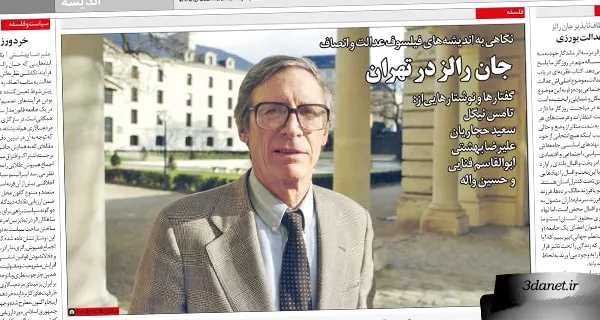
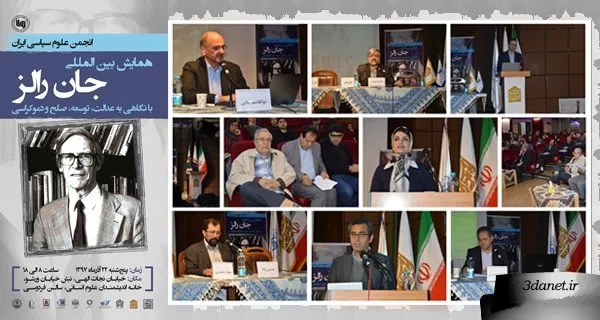
Mohsen Azmoudeh: Among twentieth-century philosophers, especially on the right-leaning front and among thinkers known as liberal, John Rawls (1921–2002) is without doubt the most popular and appealing figure. The American philosopher of politics and ethics, whose most important works—such as A Theory of Justice (translated by Morteza Nouri), Political Liberalism (translated by Musa Akrami), The Law of Peoples (translated by Mohammad Foujian and Morteza Bahrani), and Justice as Fairness (translated by Erfan Sabeti)—have fortunately not only been translated into Persian, and numerous works written about his views, but the works and ideas of some of his most prominent students, such as Thomas Nagel and Joshua Cohen, have also been translated into Persian and become known to Iranian audiences. Now, more than fifteen years after his death, Rawls and his thought are guests in Tehran, thanks to the efforts of the Iranian Political Science Association. On Thursday, December 12, the association held a one-day international conference titled “John Rawls: With a Look at Justice, Development, Peace, and Democracy.” At this conference, whose scientific committee consisted of Professors Javad Heydari, Qadir Nasri, and Hossein Hooshmand, and whose executive secretary was Ali Esmaili Ardakani, a considerable number of political science professors and researchers in Iran presented papers, and some delivered their essays as lectures; among them were Seyed Alireza Beheshti, Qasem Fanaei, and Hossein Valeh. Papers by Thomas Nagel (translated by Javad Heydari), Paul Weithman (translated by Amirhossein Khodaparast), and Joshua Cohen, critiquing, examining, and introducing Rawls’s ideas, were also presented at the conference. In today’s Thought page, alongside presenting Saeed Hajjarian’s article from this gathering, we will read a summary of some of the lectures.
Heralds of Human Justice
Saeed Hajjarian
Throughout history, many individuals from different standpoints and points of departure have endeavored to present their views on justice to human society. From prophets and saints to philosophers and mystics, each in their own turn has made efforts and left behind works. Among these works, two books have become renowned in Iran. The first is the book The Voice of Human Justice or Imam Ali (a.s.): Saut al-‘Adalah al-Insaniyah by George Jordac, published in 1956, and the other is A Theory of Justice by John Rawls, published in 1971. My aim in this article is to compare the views of Imam Ali (a.s.) and John Rawls.
Overlapping Consensus and Universal Justice
Rawls has proposed an idea called overlapping consensus. This idea indicates that, regardless of philosophical, ideological, and religious perspectives, there exists a logical and rational core in the collective wisdom of humanity that guides a person, as a free citizen, toward rational attitudes. The result is that in every culture and creed, elements can be found that overlap on the subject of justice, and consequently, everyone can strengthen the general idea of justice hand in hand. One of the most famous and, of course, most important of these is the golden rule: “Do unto others as you would have them do unto you.” This principle is practically present in all these creeds, religions, and cultures, as if it has an innate origin. As it is stated in the Holy Quran: “Never will you attain the good [reward] until you spend [in the way of Allah] from that which you love” (Aal-e-Imran, 92). We also read: “And they give food in spite of love for it to the needy, the orphan, and the captive” (Al-Insan, 8). Of course, different ethical schools have each built their foundations on different bases and do not necessarily share a common origin. For example, virtue ethics emphasizes moral agents, attachments, and individual character; in contrast, deontological ethics focuses on the moral act itself and considers the human being as the end. Alongside these two are the utilitarians, who pay attention to the consequences of the act.
Rawls is optimistic about human nature and believes that people can generally reach understanding on important issues such as freedom and justice. Kant, in his practical reason, holds that being moral and exercising justice requires accepting the existence of an entity called God. But Rawls stands in opposition to him, offering reasons and arguing that even without such an entity, human beings can be called moral creatures. His first reason is the gradual evolution of human morality. The abolition of slavery, the fulfillment of women's rights, and so on, show that humanity has progressed and become more moral. His other reason is the stability of moral achievements. Rawls puts forward an idea called "reflective equilibrium" and under it explains how, based on a dialectical process, motivations and attitudes reach a stable equilibrium and bring about justice. Imam Ali (AS) is also optimistic about the future of humanity. He sees this optimism as the result of belief in the Almighty Creator and believes that God did not create humanity in vain and has placed motivations in their nature and innate disposition that guide them to the right path. In the present text, by highlighting several components, I try to show that Rawls's idea of overlapping consensus harmonizes with many of the ideas put forward by Imam Ali (AS) in Nahj al-Balagha, and both have offered a practical prescription for establishing justice.
First: Generosity and Justice
In Wisdom 429 of Nahj al-Balagha, generosity and justice are discussed, and a comparison is made between these two components. Imam Ali (AS) says in that wisdom: "الْعدْلُ سائِسٌ عامٌّ و الْجُودُ عارِضٌ خاصٌّ" meaning "Justice encompasses everyone, while generosity benefits only the individual." He then concludes: "فالْعدْلُ أشْرفُهُما و أفْضلُهُما" meaning "Justice is nobler and superior." This distinction also exists in Rawls's thought, when he differentiates between justice and charity. Rawls considers justice a continuous and structured category and contrasts it with a common belief that regards helping one's fellow human beings, and even state support for the people, as a temporary matter and essentially leaves generosity to charities, individuals, and civil institutions.
Second: Virtue Ethics and Reciprocal Rights
Imam Ali (AS) and Rawls have both opposed virtue ethics. The source of charity and generosity is virtue, and generosity is fundamentally a personal matter that cannot be generalized to governance. Rawls also speaks of institutional justice because he considers the generosity of the state to be meaningless. Hence, the thought of both stands in opposition to the thought of Aristotle. Aristotle rejected miserliness on one hand and extravagance on the other, but he considered justice to arise from generosity, and this view has been reproduced in post-Islamic Republic Iran. On the other hand, Imam Ali (AS) accepted the principle of contract, and as we see at Siffin (Sermon 207 of Nahj al-Balagha), he spoke of the mutual duties of the state and the people, believing that the duties of the state and the people are reciprocal and that right is not a one-way street. He says: "لایجْرِی لِأحدٍ إِلا جرى علیهِ و لا یجْرِی علیهِ إِلا جرى لهُ" meaning "No right is established in favor of someone against another unless a similar right is established against him in favor of another." Here, the two concepts of right and duty are separated from each other and proceed in parallel and reciprocally, whether in micro-level relations or between the people and their national and legitimate government; therefore, contracts can be discerned from the speech and thoughts of Imam Ali (AS). Although we must acknowledge that concepts like the free citizen, legal equality, and so on belong to the modern world and did not exist 1400 years ago, the articulation of reciprocal rights between the high and the low in Nahj al-Balagha is a fragrance I doubt can be detected in the words and works of individuals of that era. Rawls is also a contractarian, and in his book "Political Liberalism," by offering a new interpretation and, of course, completing the thought of the social contract theorists, he calls this category a social organization that lays the groundwork for justice. He is, of course, aware that conditions may tip the scales in favor of specific groups and individuals, which is why he emphasizes that such a contract is far from fair. Hence, he speaks of the original position, a hypothesis in light of which initial advantages and various forms of partiality disappear, and justice is gradually prepared, because individuals choose their position in complete freedom and equality, and as a result, the condition of fairness is realized.
Of course, there is also a difference between His Excellency Amīr (ʿA) and Rawls. Under the influence of Kant, Rawls does not involve metaphysical origins, intuition, or sentiments in the discussion of duty, whereas His Excellency Amīr (ʿA) is pre-Kantian and therefore sympathizes and concurs with metaphysics and innate nature (fiṭra).
Third: Justice in Practice
In that same Sermon 207 of Nahj al-Balāgha, it is stated: "الْحقُّ أوْسعُ الْأشْیاءِ فِی التواصُفِ و أضْیقُها فِی التناصُفِ," meaning "Right, when described and discussed with one another, is the most expansive of things, and at the time of action and deed, the most constricted of things." In this statement, theory and practice are separated from one another, and this indicates that His Excellency Amīr (ʿA) rejects mere talk therapy. Rawls, too, removed the foundations of justice from an abstract state and, in his works, presented an executable version, gradually refining and revising his ideas. Unlike thinkers before him, he did not seek to overturn the existing order and build a new society; rather, he sought to reform structures and actions based on a justice-oriented approach.
Fourth: Redistribution
Some commentators have attributed the phrase "ما رایت نعمه موفوره الا و فی جانبها حق مضیع" to His Excellency Amīr (ʿA). This phrase states that abundant wealth and affluence are never amassed unless a right has been violated alongside it. The authenticity of this phrase is subject to doubt, and it is interpreted to mean that the property of the wealthy must be seized and distributed among the poor—an idea in opposition to capital and its accumulation. However, in Wisdom 320 of Nahj al-Balāgha, His Excellency Amīr (ʿA) used a similar, albeit moderated, phrase: "إِنالله سُبْحانهُ فرض فِی أمْوالِ الْأغْنِیاءِ أقْوات الْفُقراءِ فما جاع فقِیرٌ إِلا بِما منع بِهِ غنِی واللّهُ تعالى جدُّهُ سائِلُهُمْ عنْ ذلِك," meaning "God, the Glorified, has made the sustenance of the destitute obligatory in the wealth of the rich; thus, no destitute goes hungry except because of what a rich person has withheld from him, and God, the Exalted, will question them about this on the Day of Resurrection." This phrase is consistent with the nineteenth verse of Sūrat al-Dhāriyāt: "و فی أمْوالِهِمْ حقٌّ لِلسائِلِ و الْمحْرُومِ," meaning "And in their wealth, there was a specified right for the beggar and the deprived." In this matter, too, Rawls and His Excellency Amīr (ʿA) are once again in agreement. His Excellency believes that a portion of the wealth of the rich has been designated for the poor. Rawls also says that the redistribution of wealth towards equality continues until the absolute poverty of the most disadvantaged individuals is alleviated, because he is mindful of the erosion of wealth through excessive redistribution. Rawls specifies that to establish justice, it is not necessary to demolish the peak and descend to the valley, to level everything, and to build a classless society, for he respects the accumulation of wealth through legal and ethical means.
On the necessity of balance among demands
Among the four aforementioned cases, I try to apply the topic of redistribution to other domains. The author believes that establishing a balance between the highest point—whether the wealthy, the radical, etc.—and the lowest point—whether the poor, the conservative, realism, etc.—can be extended to any field. For example, currently in Iran, avant-garde women activists act in ways similar to Russian Femen. This group can be persuaded to freeze their demands for a while and pay attention to the lower strata. This act is like the top economic deciles relinquishing in favor of the lower deciles. Today, some women in society raise avant-garde demands such as unveiled marches, but at the same time, some women are beaten at home and are not even allowed to leave the house, and there are individuals pursuing custody rights and the granting of citizenship to women resulting from the marriage of Iranian women. So, a balance must be struck between these two types of demands and a step forward taken. It is the same in politics. Some want to conquer the peak, while environmental activists, Dervishes, workers, etc., demand their basic rights. This issue is also prevalent at the highest levels of government. For instance, some regions of Iran are grappling with poverty or, affected by natural disasters, demand basic needs. In short, if a society develops and its basic rights are fulfilled, then one can pursue avant-garde demands within it, just as Rawls says in Political Liberalism: "My ideas pertain to well-ordered and developed societies and are not applicable to all societies."
In the field of Rawls's thought, we are still at the beginning of the path and there is still work to be done. Our society is not well-ordered. Rawls spoke for a well-ordered society. We must adapt Rawls's thought to our own society. Unless we indigenize it, we cannot use it. Perhaps some of Rawls's students are better for us and more useful for our society. Rawls has both a dense prose and difficult works, and they are for completely well-ordered societies.
Political affairs analyst
The Most Spiritual Political Philosopher in Human History
On November 24, 2002, with the death of John Rawls due to heart failure at the age of 81, our perilous world, in the words of Thomas Nagel (the eminent contemporary philosopher and one of Rawls's great students), lost both the most important political philosopher of the twentieth century and the most spiritual political philosopher in human history. He was an extraordinarily humble and beloved person, fearful and averse to fame, who constantly rejected the honors bestowed upon him. Rawls refused to become a public figure or a famous media personality, which his successes could have afforded him. Following the appearance of the book "A Theory of Justice" in 1971, in which the ideas were shaped in the aftermath of the Vietnam War, this work became a mandatory source for students of philosophy, politics, and law, and thus Rawls influenced several generations. A Theory of Justice essentially addresses what Rawls called the traditional problems of modern political theory: issues concerning the grounds of basic civil liberties, the limits of political obligation, and economic and social justice. Rawls never wrote anything about himself and almost never gave any interviews. He was held in high esteem and respect by his students and colleagues. His friends describe him as a complex and somewhat anxious person who, although he did not explicitly claim to be a believer, maintained a fundamentally religious outlook. They also emphasize his unfeigned humility and exceptional courtesy. One of his colleagues says, "It is very difficult for me to express what I feel about Rawls. He had a much more highly evolved moral and social instinct than most people." It is worth mentioning that in a field dominated by men, many of Rawls's distinguished students were women.
The Inflexible Compassion of John Rawls
You must practice justice
Thomas Nagel
Translation: Javad Heydari
In his three enduring works, Rawls addresses three major issues of our time. The main subject of A Theory of Justice is social justice, and he gave it the shape and form it has in contemporary discourse. The central problem is this: every person’s expectations and opportunities in life are profoundly affected by the circumstances into which they are born, for which they had no choice. The basic institutions of their society determine their place in the political, social, and economic structure. This introduces a great deal of luck into human life, but that luck is determined by institutions that are, to some extent, under human control. Whether one is born the child of slaves or the child of slave-owners, the child of ordinary workers or the child of wealthy capitalists, is in one sense a matter of pure luck, but the institution of slavery or capitalism is a human creation, and we can ask ourselves, as members of a society (and ultimately as a global order), whether the good and bad luck that affects life and is generated by our institutions is morally acceptable or not.
In Political Liberalism, Rawls addresses the relation and connection between political values and more comprehensive values. Rawls places greater importance on the fact that pluralism regarding ultimate values is inescapable. He argued that religious disagreement is historically the most significant form of conflict over values, and therefore believed that attempting to impose a single, comprehensive system of values on society inevitably leads to oppression. He holds that we need fairness not only in the distribution of social and material benefits but also in the various conceptions of the good. Therefore, the contracting parties in the original position are deprived of information about their full conception of the good life and must, given this situation, choose principles that anyone you can think of might be: from the religious ascetic to the sinful atheist.
The result of applying the veil of ignorance to the realm of values is a system based on toleration. This system of toleration strongly protects the freedom of individuals and groups to pursue different ends in life. According to Rawls, this is not merely a temporary compromise but a requirement of mutual respect. Our sense of justice should not lead us to want to impose our own conception of the good on others against their will, even if we have the political power to do so. In fact, we should want to base the justification of state coercion on a limited set of purely political values, leaving comprehensive religious values and ultimate life goals to voluntary collective and personal activity.
In The Law of Peoples, Rawls adopts an approach to international relations similar to that of his two previous books. Rawls seeks to address the principles of justice in international relations. He does not intend to apply principles of justice between individuals to the entire world; rather, his aim is that we seek things like freedom, equality, and mutual respect for all societies. In Rawls’s view, this yields a degree of inter-societal toleration towards different conceptions of justice, including some non-liberal but “decent” conceptions.
Toleration has limits and boundaries and does not extend to outlaw societies that violate the most basic human rights of the individuals under their rule or aggress against their neighbors; but apart from this, toleration requires respect for sovereignty, the customary obligations of prevailing international law, and also respect for the laws of war, which include the protection of civilians. Although this toleration, in particularly unfavorable circumstances, requires some forms of assistance to human beings and does not include the difference principle in the international sphere, this is because, in Rawls’s view, a kind of economic justice can, on the whole, be chosen and pursued only through political institutions.
Thomas Nagel (b. 1937, USA) is a moral and political philosopher and professor of philosophy and law at New York University. He is one of John Rawls's most distinguished students. Nagel is renowned for his critique of materialist reductionism, a position notably advanced in his essay “What Is It Like to Be a Bat?” (1974). Fortunately, Nagel's most important works, such as Mortal Questions, Equality and Partiality, The Possibility of Altruism, Ethics, and Mind and Cosmos, have been translated into Persian by Javad Heydari, a professor of political science.
Public Reason
Alireza Beheshti| One of the ideas that John Rawls put forward during the evolutionary process of his theory of justice as fairness, as a decisive precondition for the fairness of decision-making processes in a well-ordered, law-governed society, is the idea of public reason. There are valuable discussions regarding the compatibility or incompatibility of this idea with the model of deliberative democracy, attention to which is useful in explaining this idea more precisely, and in the paper I have presented at this conference, I have drawn on some of the salient points of convergence and divergence between the two. Rawls considers an overlapping consensus of reasonable doctrines to be the product of this idea, but it seems that Rawlsian political liberalism is, in terms of its moral content, too thick to become a focal point of attention in culturally multiple and diverse societies. Hence, while critically evaluating Rawls's view, an attempt has been made, by distinguishing two types of politics, to open a path for utilizing this idea alongside Rawls's masterpiece in distinguishing between the rational and the reasonable and limiting the domain of politics to the latter. In another part of this paper, it is shown that the reconstructed approach to the Rawlsian idea of overlapping consensus helps us in assessing the degree of democracy and fairness of countries' constitutions and in amending them to increase their legitimacy and acceptability. Based on this theoretical framework and considering that the political system governing Iran is founded on religious democracy, the capacities for applying the idea of public reason for Iranian citizens, here and now, have been raised, and the general orientation of the Constitution of the Islamic Republic has been evaluated; an evaluation that makes it possible to determine the general direction of its amendment to achieve the manifestation of democracy in the basic structures of Iranian society.
Rawls and the Method of Justifying Moral Theory
Abolghasem Fanaei| The method of justifying moral theories is one of the important topics, and perhaps the most important topic, in moral epistemology. Nevertheless, many moral philosophers have not addressed this topic independently; rather, their views on this subject are implicitly reflected in their works, interwoven with their discussion of the moral theory they defend. John Rawls is one of the philosophers who, in his celebrated book A Theory of Justice, addressed this topic briefly and to some extent independently.
Rawls's view on the method of justifying moral theory is a combination of two different methods of justification, each of which has been used independently and in a simpler form by moral philosophers before him to justify their accepted moral theory. The first method seeks to formulate and then defend a particular moral theory by appealing to moral and meta-ethical intuitions; a defense that also includes the critique of rival theories. The second method, however, seeks to provide the necessary justification for moral theory by appealing to the social contract. Each of these two methods has a long history in moral philosophy and some other branches of philosophy, such as political philosophy. In formulating, justifying, and defending his theory of justice, Rawls firstly offers a novel and advanced reading of these two methods and then combines these two methods in an innovative way. In the paper I have presented for the Rawls conference, I have attempted, while reviewing the most important rival views on the method of justifying moral theories, to explain and elaborate on the various dimensions and components of Rawls's innovative method, and then, in light of some later critiques, to put forward suggestions for completing his view.
A Proposed Reading of the Theory of Government Based on the Foundations of Shiite and Traditional Jurisprudence
Hossein Valeh | In Islamic Sharia, according to the traditional Shiite jurisprudential and theological reading, the norms of desirable governance and the criteria for governmental legitimacy have been articulated. One can derive a theory of government based on the foundations of this jurisprudence and theology, with a reading of political philosophy, that is close to the school of John Rawls. This theory, in several pillars, is more developed than what is legally official and prevalent in Iran today, and in some details, includes the proposal of a smoother and more coherent reading of certain well-known theological doctrines.
The proposed theory consisted of seven pillars, each supported by transmitted evidence. All of these pillars can also be reinforced by pure rational argument; however, due to pragmatic considerations, reliance has been placed on transmitted evidence and pure rational arguments have been avoided. The necessity of government and the basis of its legitimacy, the conditions of public consent and the observance of the principles of justice in the legitimacy of the establishment and survival of government, the minimal scope of the government's domain, the intrinsic and non-intrinsic duties of government, the mutual rights and duties of the government and the citizen, and especially the right to protest and civil disobedience are considered in this theory.
Some of these innovations can be considered as follows: the reasons this theory emphasizes: 1- the discursive nature of norms; 2- the necessity of an intersubjective method for determining official norms; a meta-doctrinal definition of the principles of justice in the political sphere, 3- pluralism and the centrality of citizenship instead of other personal characteristics in the configuration of the theory, 5- the natural and non-violent circulation of power, and 6- reconciling the right to protest with the obligation of obedience through a (often neglected) distinction in the subject of these two



Discussion0 comments
No comments yet; let yours be the first voice.