Philosophy
Etemad Newspaper's Report on the Conference on Rumi's Ethical System
At a Rumi conference, Mostafa Malekian enumerated six sources of normativity: ethics, law, religion, customs, aesthetics, and prudence. In his view, no voluntary act occurs in a normal state of awareness without an inner 'ought'.

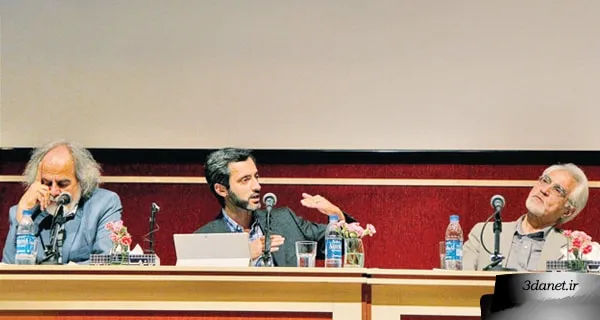
The third Mehr Conference on "Rumi" was held on Thursday and Friday (October 3rd and 4th). This annual gathering, organized by the "Soroush-e Mowlana" Institute, intends to make a detailed project by Mostafa Malekian, titled "Rumi's Ethical System," the focus of its conferences over the next decade. The first step on this path began with a discussion on "Ethics and Other Norm-Giving Sources" and "The Difference Between Ethics and Customs" with a lecture by Professor Malekian at the Ivān-e Shams Hall, a transcription of which you will read below.
Today I will speak about one of the clauses of the outline of Rumi's ethical system, and I will also have a discussion about the differences between "ethics" and "customs, conventions, and habits." But before I begin my discussion, I find it necessary to present some points as an introduction to the lectures that other distinguished figures and professors will deliver over these two days. These points will not only serve as a preliminary preparation for my own discussion but will also be useful for understanding the other lectures. Although other points beyond what I raise may be presented in the other discussions, as the first speaker, I think this introductory framing should be done by me.
Let us begin with the normal states of human consciousness. It must be said that there is no human being who, in a normal state of consciousness, undertakes an action unless, before undertaking that action, an "ought" has been realized within their inner self, mind, psyche, and interior. This point requires explanation. Firstly, when we speak of normal states of consciousness, we mean the state that all of us sitting here possess. In fact, if a human being possesses four characteristics at a single moment, they are said to be in a normal state of consciousness: first, they must be alive and not dead; second, awake and not asleep; third, conscious and not in a coma; and fourth, not intoxicated, "heedless," and oblivious to their surroundings.
Psychologists consider such conditions to be conditions of "normal consciousness." Of course, besides these conditions, human beings also experience "abnormal states of consciousness," of which psychology has so far identified 21 cases, but usually, humans spend most of their lives in the first state, that is, the normal state of consciousness, and not in those 21 abnormal states. Now, the point is that in a normal state of consciousness, no human being undertakes any action unless an "ought" has been formed within them before undertaking that action. A matter that has germinated within them, whether a billionth of a second before an act (like picking up a glass of water) or much later than the occurrence of a person's act (like abandoning a human relationship), for them to undertake that action. This rule applies to all "voluntary" actions of human beings in a normal state of consciousness. Now, the question arises: where did this "ought" itself originate in my mind? What is its source? In answering this question, we arrive at a discussion referred to as "norm-giving sources": that is, the very sources from which these "oughts" emerge.
Norm-Giving Sources
Regarding the "number" of norm-giving sources, varying counts have been seen in different perspectives, but in my personal opinion, six types of norm-giving sources can be enumerated. First: ethics; second: law; third: customs, conventions, and habits; fourth: religion and creed; fifth: expediency; and sixth: aesthetics. The meaning of this is that if we pay close attention to each of the "oughts" that arise for performing an action, we see that the "ought" has originated from one of these "six sources." For example, when we intend to attend a gathering, an "ought" is formed within us: that in this gathering, I "ought" to behave humbly. When we intend to speak, an "ought" is formed within us: I "ought" to tell the truth.
But where did this "ought" to behave humbly and "ought" to tell the truth come from? The answer is that this belief has an "ethical" origin: this "ought" has entered into us from the realm of "ethics." In other words, if it were not for "living ethically," and if it were not for "being ethical," and if it were not for "remaining ethical," this type of belief would not arise in us.
So, the origin of such beliefs is "ethics," which is considered the first norm-giving source.
The second source is “law.” All the “oughts” that arise within us because we live in a particular country and wish to subject ourselves to its legal-juridical system and behave according to its requirements are legal “oughts.” It is obvious that law explicates “rights,” not morality.
We refer to the third norm-giving source as “religion and creed.” If you tell yourself that you must perform the ritual prayer, take the Eucharist, or lament by the Wailing Wall, it becomes clear that you are a Muslim, Christian, or Jew, and you do so because the religion of Islam, the religion of Christ, or the religion of Judaism has commanded you to perform these acts. Whatever “oughts” of this kind are formed in a person are neither our moral “oughts” nor our legal-juridical duties; rather, these “oughts” arise from religion and creed, and are called ritual-ceremonial precepts. These “oughts” usually manifest themselves in the “jurisprudence” of a religion or creed.
The fourth norm-giving source is the “source of customs, conventions, and habits.” That one “ought” not to stay at home on the thirteenth of Farvardin, or “ought” to spend that day in the lap of nature, or on Chaharshanbe Suri night “ought” to jump over fire, or “ought” to sing a particular song—these “oughts” are neither moral “oughts,” nor legal-juridical ones, nor religious-creedal ones. Rather, they arise from the “customs, conventions, and habits” of my society as an “Iranian” society. Just as if we were Japanese, the customs and conventions of that society would demand adherence to other “oughts” from us.
The fifth norm-giving source is “aesthetics,” which is considered the origin of aesthetic “oughts.” These “oughts” arise from our human love of beauty and worship of beauty. We recall that Plato said that in the deepest layer of our “psyche” we love only three things: first, we love truth (veracity); second, we love the good (goodness or virtue); and third, we love beauty (splendor). Whatever else we seek throughout life, we will make it a ladder to reach one of those three loves. These three are “intrinsic” human desires, and the rest are “extrinsic” desires that, through one or more intermediaries, lead us to the three “essentially desired” things. Thus, as a result of the “love of beauty,” which is an inseparable part of the human spirit, a series of “oughts” takes shape within us. Attention to cleanliness (beyond its moral aspect concerning the necessity of not bothering others with filth and pollution) or outward adornment (such as tidying or styling one’s hair, ironing clothes, or observing color coordination) originates from our aesthetic sense. A sense that tells us we must make the world more beautiful than it is, or, in a pessimistic formulation, we must not make the world uglier than it is. Whether we are optimistic or pessimistic, its meaning in practice is one and the same.
The sixth and final social norm-giving source is “prudential reasoning.” A series of beliefs that arise in us are due to the fact that we are prudent, mindful of consequences, or, in Rumi’s phrase, “consequence-seeing” or mindful of the hereafter. The argumentative form of “prudential reasoning” is such that whatever goal you choose in life—small or large, insignificant or important, fateful or temporary—an “ought” is placed upon all the means that lead you to that goal: prudential “oughts.” Suppose a student’s goal is to pass the doctoral exam in philosophy. Then certain “oughts” apply to him. He must read books about Descartes, Kant, Avicenna, and so on, but if he abandons his goal, all those “oughts” that applied to the means of achieving that goal collapse.
Based on what has been said, it appears, by inductive enumeration, that every “ought” formed in a human being originates in one of the six aforementioned social norm-giving sources (morality, law, religion and creed, customs and conventions, aesthetics, and prudential reasoning). Now, look within yourself and see if there is any “ought” that arises from a seventh or eighth source? It is obvious that in that case, one must add to this list.
The Benefits of Distinguishing Norm-Giving Sources
Knowing the difference between these six normative sources has three important effects. In other words, understanding that these six sources each have a specific function, demand different degrees of obligation, and cannot be reduced to, say, five or two sources, yields three benefits: The first benefit is that we understand that “ethics” differs from the other five normative sources. The importance of grasping this point lies in the fact that, in my view, all those who have considered ethics to be “relative” have conflated “ethics” with the other five sources and claimed that “moral judgments are not absolute.” Now, if we look closely, we see that all the examples used by “ethical relativists” to prove their point are drawn from the realms of law, customs, religion, and so on. Thus, the primary importance of this separation is to rescue ethics from relativism and bring us to the “absoluteness” of ethics. That genuinely moral judgments are not constrained or conditional and possess absoluteness: meaning that moral judgments remain the same in all times, places, and circumstances.
I place great emphasis on this first benefit: that to demonstrate the “non-relativity” of ethics, we must separate it from the other five normative sources.
The second importance is that we do not “deceive” ourselves. That is, we do not present an “ought” to ourselves in a different guise. For example, we should not think that if we wear a particular garment, we are religious. Because that garment belongs to the customs, conventions, and habits of this society and has nothing to do with religion. We should not think that fasting, for instance, is synonymous with being ethical, or that laws, instead of having a legal nature, are derived from religion. In other words, we should not consider what is of the nature of adherence to religion as a kind of adherence to rights and law, whereas commitment to law and commitment to religion are not the same.
But the third benefit of precise separation and boundary-drawing between the six sources is that we understand, in the event of a conflict between two sources, which one we should side with. Whereas if there were no separation and a unified conception of the six sources existed, the emergence of conflict would lead to bewilderment.
It is possible that ethics commands me that I must do action “A,” and religion commands that I must do action “B.” If I do not understand that these two “oughts” come from two different realms and think, for example, that both come from the realm of “ethics” or both from the realm of “religion,” I remain perplexed about what to do with two incompatible “oughts” from one realm and which one to side with. But if I know that these two “oughts” come from two realms and also know that wherever a conflict arises between such an “ought” and “ethics,” one must side with “ethics,” then I am freed from bewilderment. Just as in the confrontation between the “ought” of religion and the “ought” of customs, one must side with religion and make conventions and habits subordinate to religion, because it carries stronger obligations. Similarly, in a conflict between the realm of “ethics” and “law,” law must be made subordinate to ethics.
The Difference Between “Ethics” and “Customs”
پس از اين شرح ابتدايي درباره شش منبع هنجارگذار، طبق پيشنهادي كه به برگزاركنندگان همايش داشته ام، در شش سخنراني به تفاوت «اخلاق» با پنج منبع ديگر پرداخته خواهد شد كه بنده به عنوان نخستين موضوع به اختصار هرچه تمام تر در ادامه سخنانم به تفاوت «اخلاق» و «آداب و رسوم و عرف و عادات» مي پردازم. ميان «اخلاق» و «آداب و رسوم و عرف و عادات» چهار تفاوت اساسي وجود دارد. نخستين فرق اينكه اگر يكي از مجموع آداب و رسوم جامعه يي تغيير يافت هيچ مشكلي در آن جامعه پديد نمي آيد. مثلااگر در ميان ما ايرانيان تا ديروز رسم بر آن بود كه به قصد اداي احترام به ديگران كلاه از سر برداريم و از امروز اجماع بر آن شود كه به علامت احترام كلاهي كه در دست داريم را بر سر بگذاريم مشكلي پيش نمي آيد. يا في المثل قرار بگذاريم در تعطيلات نوروز به جاي سيزده به در، پنج به در داشته باشيم، يا به جاي چهارشنبه سوري، بر دوشنبه سوري توافق كنيم، باز هم اتفاقي نمي افتد. در واقع اگر يكان يكان و فقره به فقره آداب و رسومِ يك جامعه تغيير يابند، به شرطي كه «اجماع» عمومي بر اين عوض شدن وجود داشته باشد، مشكلي پيش نمي آيد. اما آيا مي توان همين كار را با «اخلاق» صورت داد؟ به فرض بياييم به جاي صداقت، تزوير و ريا بورزيم، به جاي تواضع، تكبر پيشه كنيم، به جاي وفاي به عهد، خلف وعده و پيمان شكني كنيم، به جاي آنكه امانتدار باشيم، در امانت خيانت بورزيم، به جاي عادل و منصف بودن، بي انصاف باشيم و به فرض، همگان نيز اين تغييرات را بپذيرند، در چنين شرايطي «كيان اجتماع» از ميان خواهد رفت.
چرا كه استقرار احكام اخلاقي، قراردادي نيست. آنچه قراردادي باشد را با قرارداد مي توان تغيير داد (مانند آداب و رسوم)، اما آنچه قراردادي نيست (احكام اخلاقي) را با هيچ قراردادي نمي توان تعويض كرد. به تعبير ديگر، «اخلاق»، قرارداد بين انسان ها نيست بلكه از ذات امور انساني و طبيعت بشري برمي خيزد. در واقع قوانين اخلاقي سلسله يي از «تكوينيات»اند نه «تشريعيات»: سلسله يي از امور طبيعي اند و نه قراردادي.
نتيجه فرق اول، فرق دومي است كه در بيان آن بايد گفت: اخلاق و آداب و رسوم به زمان، مكان و اوضاع و احوال هيچ بستگي ندارند. يعني اگر يك سلسله قواعد اخلاقي، به واقع اخلاقي باشند- و نه خلط شده با حقوق، آداب و رسوم، دين و مذهب مصلحت انديشي و... - در هر زماني، مكاني و اوضاع و احوالي الزام آورند و خواه به آن عمل شود و خواه به آن عمل نشود بر دوش انسانند. البته بايد گفت كه مكان و زمان و اوضاع و احوال، اگرچه احكام اخلاقي را عوض نمي كنند اما ممكن است يك حكم اخلاقي را «بلاموضوع» كنند كه بسيار هم رخ مي دهد. ديده ايد كه گاهي در بازار زير شيشه ميز اين آيه را قرارداده اند كه «فضل الله مُجاهدين علي القاعدين اجرا عظيما»، حال اينكه مقتضاي صدق آن بود كه آيه يي همچون «احل الله البِيع و حرم الربا» قرار داده شود. چراكه مضمون اولي هرچند صحيح ولي براي تاجر «بلاموضوع» است. چرا كه بازار، مكان مجاهده نيست كه مجاهدان را بر قاعدان ارزشي باشد. در نمونه يي ديگر، گاه با از دست رفتن موضوعيت حكمي اخلاقي، كساني بر نسبيت احكام اخلاقي گمان برده اند. در حالي كه اگر حكم اخلاقي «راستگو باش» براي فرد گنگ مادرزاد موضوعيت نمي يابد نتيجه نمي شود كه «راست نبايد گفت». چرا كه راست گفتن و دروغ نگفتن در جايي موضوعيت مي يابد كه «گفتني» در كار باشد.
حال آنكه «آداب و رسوم» تابعي از مكان (بين دو كشور كه البته نافي برخي همپوشاني ها در جوامع همجوار نيست) و زمان (بين دو مقطع تاريخي) و وضع و حال (بين فقرا و اغنيا) هستند.
فرق سوم اينكه آداب و رسوم به نقش هاي اجتماعي بسيار (نمي گويم كاملا) وابسته اند، اما «اخلاق» به نقش هاي اجتماعي چندان (نمي گويم اصلا) وابسته نيست. ما غير از آنكه انسانيم در زندگي نقش هايي را بر عهده مي گيريم: مانند نقش پدري، نقش همسري، نقش دوستي، نقش معلمي، نقش كارمندي، نقش عضو فلان انجمن بودن و... ملاحظه مي كنيد كه آداب و رسوم در واقع بيشتر درباره نقش ها سخن مي گويد، كه في المثل پدر با فرزند خود چنين باشد، فرزند با پدر چنان: شوهر با همسر خود اين گونه باشد و همسر با شوهر خود آن گونه: آداب جنگ يا صلح: آداب عزاداري و...
پس مي بينيم كه آداب، همواره مضاف اليه واقع مي شوند. همچون آداب المعلمين يا آداب المتعلمين.
But ethics is not so dependent on social roles. Ethics is a set of universal precepts. Truth-telling, humility, and so on belong to everyone, regardless of the roles they assume in society.
And finally, the fourth difference is that, supposing someone succeeds in changing customs and traditions, they can teach the new types to their children, and those children will show, firstly, no resistance to “learning” these customs and traditions and, secondly, no resistance to “observing” them in practice. For instance, teaching this new custom to descendants: that instead of the thirteenth day of Farvardin, they go out into nature on the eleventh day. Just as customs and traditions are constantly undergoing transformation and change, and new generations are receptive to them. But if one day we decided to tell lies instead of the truth, and to teach this to our descendants as well, you would observe that they exhibit psychological-emotional resistance from within themselves and will be unable to accept it.
You see that no matter how earnestly you try to change ethics with the weapon of “positing,” “convention,” and “agreement,” and then teach them to your descendants, the next generation, though knowing nothing of the matter and having just entered this world, shows resistance. In other words, if ethics are changed, the “mental health” of individuals is disrupted, but changing customs and traditions does not assail the human soul and psyche. In Darwinian terms, these ethics are necessary for our evolution, and attempting to change them is like resisting human biological evolution, and therefore subsequent generations will not tolerate such resistance.
After mentioning these three differences, I will address this point and conclude my discussion: what should be done if a ruling derived from “customs and traditions” conflicts with a ruling derived from “ethics”? For example, regarding a custom among the Israelites of sacrificing their child to Yahweh on certain occasions. As previously mentioned, in cases of conflict between “ethics” and “customs and traditions,” in all instances, without exception, the ruling of “ethics” must prevail over the ruling of “customs and traditions.” In general, among these six sources of norm-setting that were described, “ethics” takes precedence over the others, and in the event of a conflict with any of the other five sources, its ruling must prevail.
.
.
Etemad Newspaper's Report on the Conference on Rumi's Ethical System
Organized by the Soroush-e Mowlana Institute
Etemad Newspaper | 8 Azar 1394 | Pages 8 and 9
.
.
PDF file of this report | 3.5 MB
.
.





Discussion0 comments
No comments yet; let yours be the first voice.