Philosophy
Etemad Newspaper's Report on the Fifth Conference on Rumi's Ethical System
The necessity of consulting an ethics expert for living an ethical life was the central question of the Fifth Conference on Rumi's Ethical System. Mostafa Malekian and other speakers at the session on moral epistemology examined the relationship between intuition and expertise; a report by Etemad newspaper.
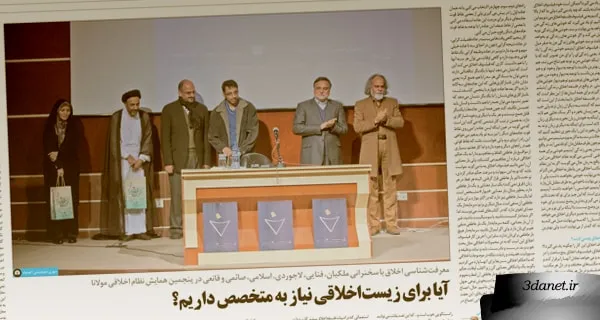
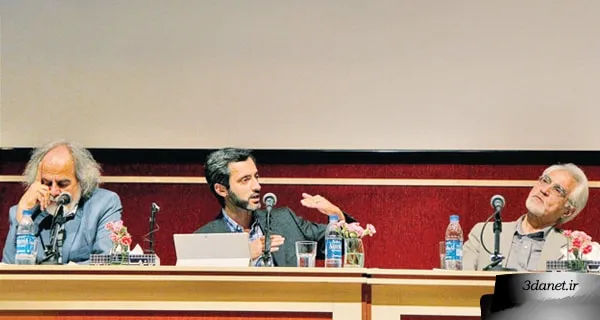
Is a moral expert possible? Is there essentially any need for an expert and a specialist in the field of ethics for an ethical life? This was the main question raised at the epistemology of ethics session, and each of its speakers tried to answer it from their own perspective. Mostafa Malekian, a moral philosopher, in response to this question, while emphasizing the importance of moral intuitions, did not consider them sufficient for an ethical life, which is why, to compensate for this deficiency, we are inevitably forced to refer to someone who is a specialist in ethics and trustworthy. Abolghasem Fanaei, professor of moral philosophy at Mofid University in Qom, also does not consider mere intuition to be reliable for an ethical life, and therefore believes that human intuition must be placed on a correct path so that its validity and reliability become clear, a task which makes referring to a moral expert permissible and even necessary. But Kaveh Lajevardi, a researcher in logic and philosophy, gave the final answer to this question: although it is permissible to refer to a trustworthy moral expert in cases where we are desperate and incapable of discerning our own moral action, this is not very commendable. In fact, from the totality of Lajevardi's remarks, one can infer that, in his belief, an individual should strive to gain discernment in the moral issues they face, but if they lack this discernment in some cases, they are morally permitted to refer to someone they consider a specialist in the science of ethics and trustworthy. However, Seyyed Hassan Eslami approached the discussion of the epistemology of ethics from another angle. "Mystical Selfishness and Ethical Altruism" was the subject of his speech at this session. The professor of moral philosophy at the University of Religions and Denominations in Qom, who is considered a concerned individual in environmental issues and could perhaps be regarded as the first vegetarian cleric, in his discussion, pointing to some twenty-first-century criticisms leveled at certain great religious and mystical figures, said: Today, we are witnessing critics of a different kind who, influenced by the atmosphere of the modern era and under the influence of new human rights concepts and egalitarian perspectives, accuse mystics of inaction, indifference to the issues of the time, and selfishness. They introduce mysticism as a justifier of usurping rulers and attack figures like Rumi, who, during the Mongol invasion, engaged in Sama instead of political action and inviting people "to participate in governance." This critique and the examination of its dimensions show that such criticisms are incorrect due to a disregard for Rumi's era and the dominance of modern standards over it, and are far from fairness and knowledge. Amir Saemi, a faculty member at the Institute for Research in Fundamental Sciences, was another speaker at this session. Reasoning in the epistemology of ethics was the subject of his speech. In his discussion, Saemi analyzed and scrutinized the relationship between moral realism and moral knowledge. The fifth conference on Rumi's Ethical System, titled "The Diver of the Seas," was held on Friday, organized by the Soroush-e Mowlana Institute in collaboration with the Research Institute of Culture, Art and Architecture of the Academic Center for Education, Culture and Research. The closing ceremony of the conference included an appreciation of the speakers, which was conducted by Mostafa Malekian (Scientific Supervisor of the Rumi's Ethical System project), Mohammad Mehdi Mazaheri (President of the ECO Cultural Institute), and Abdoljabar Kakaei (poet). The conference was hosted by Amir Elhami, and at its beginning, the conference message was read by Maryam Mousavi, President of the Soroush-e Mowlana Institute. The conference lasted more than 9 hours, and publishing the full text of the speeches, if not impossible, was at least beyond the capacity of the "Policy Letter" page of the Etemad newspaper. Therefore, we were compelled to publish the discussions raised at this conference selectively. However, in compiling this report, we have made our utmost effort to ensure that the least possible harm is done to the original content of the discussions presented by the speakers.
The Necessity of Referring to Moral Experts
Mostafa Malekian
Moral Philosopher
Do we need an expert in order to live ethically, or not? Let me state this point very clearly and explain it with an example: to know how much protein a food has, how many calories it contains, etc., one must consult an expert, but to discern the taste of food, there is no need to consult an expert. Here, no expert is an expert; rather, everyone is an expert. To know whether this food is tasty or not, I only need to refer to myself. So, just as I did not need to consult an expert, I also cannot now play the role of an expert for you. This simple reasoning shows that regarding the tastiness or untastiness of food, I am an expert, and only for myself, and you are an expert, and only for yourself, and this means that neither are you my expert, nor am I your expert. What is the difference between these two? In the matter of the effects and properties of a food, I am dealing with an objective reality, an external reality, an afaqi reality, but regarding the taste of food, I am dealing with a subjective, internal, anfosi reality. That is, in the matter of the food's constituent materials, I am dealing with a reality that absolutely does not depend on my beliefs, does not depend on my feelings and emotions, does not depend on my desires; rather, it depends on an external, universal reality. But in the matter of the food's taste, no, I am dealing with a subjective reality, an anfosi reality, an internal reality; that is, I am dealing with a reality that depends on my beliefs, feelings and emotions, excitements, and desires, and no one knows my beliefs, feelings, emotions, and desires better than myself. But regarding objective, afaqi, and external realities, or in other words, concrete realities, the story is not like this. In fact, if something's existence is independent of three things belonging to you and me; that is, independent of your and my beliefs, feelings and emotions, and desires concerning that thing, then it is an objective, afaqi, and concrete matter, and if something's existence depends on these three, it is a subjective matter, that is, an internal matter, an anfosi matter, or a mental matter. In mental matters, we do not need an expert, but it is precisely in objective matters that we need an expert. Now the question is whether, in the realm of living ethically, I must also consult an expert? If we say that in these matters you must definitely consult an expert; that means some ethical subjects and issues are objective matters and have specialists and experts, and I must consult their expert, but if you say no, you yourself must understand ethical subjects, meaning that in making an ethical decision or ethical judgment, or in both, there is no need for an expert. Intuitive Propositions in Ethics So the issue is whether in ethics we are dealing with objective matters or subjective matters? Of course, objective matters are also divided, in a sense that has been stated elsewhere, into actual and potential matters. But for my discussion, that division is not important now. One of the ten advances that occur in the domain of a science is that potential objectives gradually become actual objectives; that is, when it is said that a science like physics, chemistry, and biology, or psychology, or economics has progressed, one of the ten areas of a science's progress is that in that area, potential objective realities become actual objective matters, but objectives, whether actual or potential, unlike subjective matters, have an objective and external realization independent of our beliefs, feelings and emotions, and desires. In subjective matters, this is absolutely and utterly not the case. But why has the question been raised whether we need an expert about ethics or not? Why hasn't this question been raised about economics, etc.? Because in ethics, we have a series of ethical intuitions. We have no intuition in economics; therefore, in an economic matter, we must definitely consult economists, but in ethics, every human being has a series of intuitions within themselves that causes them to think whether these intuitions are not sufficient and do not make me needless of consulting an expert. But what is intuition? The intuition we speak of here. Intuition is a term that has multiple meanings in many places, but in this discussion, intuition means a proposition that the mind is incapable of not affirming. If there is a proposition that no matter how much you pressured your mind, you could not not affirm that proposition, the mind's incapacity to not affirm a proposition makes that proposition an intuitive proposition. In ethics, such intuitive propositions exist, but they do not exist in economics, and it is for this reason that in economics we know we must consult an expert.
Now, the question is whether in ethics we must refer to a specialist or not—that is, can the intuitive propositions we have about the moral superiority of honesty over deceit and hypocrisy, benevolence over malevolence, trustworthiness over betrayal, and fidelity over breaking promises, and the superiority of these intuitive propositions—regarding the number of which there is, of course, disagreement among those who believe in moral intuitive propositions—resolve all my issues and problems in moral life? If they can resolve them, then I no longer need a specialist. According to some thinkers, who are indeed the majority of thinkers, we do need specialists in ethics, meaning that our moral intuitions, although a necessary condition for our moral living, are not sufficient. To compensate for this insufficiency and incompleteness, there is no alternative but to refer to moral specialists. What Do Moral Specialists Know? But the next question arises: what do moral specialists know that we do not? When we refer to a specialist called a physician for our physical health, we know why we refer to them, because we know what they know that we do not. Now, what do moral philosophers know that we do not? If you say intuition, we ourselves also had intuition. Moral philosophers certainly have their own moral intuitions as well, but moral intuitions were not sufficient for us, and naturally, they are not sufficient for them either, so they must know something else that has made them specialists. That is, becoming a specialist, an expert, and an authority requires knowledge that is not available or accessible to me, the client. Here, the issue is actually what the general consensus of moral philosophers knows that we do not! What does a moral philosopher learn during the period they study moral philosophy? The moral philosopher themselves might not be aware of what they are learning, but we, looking from above—that is, becoming a philosopher of moral philosophy—know this. They learn that if the pleasures of my life are to reach infinity, the pleasures of your life tend toward zero, and if the pleasures of your life are to reach infinity, the pleasures of my life tend toward zero. The moral philosopher learns the optimum pleasure of life. That is, to depict a life for me that, considering that my pleasure and your pleasure conflict, is the best for me given the wall of your existence, and the best for you given the wall of my existence. Because I am the wall of your pleasures, and you are the wall of my pleasures. In fact, in moral philosophy, they learn the optimum life for all human beings. From this perspective, you see that in moral philosophy, there is constant discussion about acting in a way that the agent does not harm others, but also does not harm themselves, and if somewhere it is inevitable to harm another in order not to harm oneself, and if it is inevitable to harm oneself in order not to harm another, to arrange this in a way that reaches the optimum state; we cannot settle for the maximum and minimum because the other party will not concede. In reality, living morally means the optimum pleasure of life for all human beings. When someone says, "This is my ethical system," they are, in fact, saying in so many words that if you adhere to this ethical system, or my ethical school, or my ethical theory, you will not, of course, have infinite pleasure, but on the other hand, you will not inflict infinite displeasure on the other party either. You will have the optimum pleasure. The optimum pleasure is something where this thing is not the worst situation for you, who are affected by my action, nor is it the worst situation for me, although it is also not the best situation for you or for me. In another interpretation, ethics seeks to bring human excessiveness, which tends toward infinity, to a state that is less than infinity but is the best possible state. What Do Moral Philosophers Do? How does a moral philosopher learn to do this? In moral philosophy, the moral philosopher recognizes five domains within us and seeks to establish their equilibrium, and this is why different schools, and within each school, different systems, and within each system, different theories in ethics emerge. It is at this level of balance that they differ from one another. What I will say next concerns our five domains; first, they must know what interaction and reaction our beliefs and knowledge have with the rest of the domains of our existence. So, a moral philosopher must know epistemology. On the other hand, they must know what interaction and reaction our feelings and emotions have with the rest of our domains. From this perspective, they must know what is referred to as philosophy of mind and psychology (the empirical aspect of which we call psychology, and the philosophical aspect, philosophy of mind). Third, it must also recognize the realm of our desires and needs and understand that, again in this realm, two things are not in balance with one another: our desires and our needs. We have desires that are not necessarily our needs, and we have needs that are not necessarily our desires, but ultimately, desires and needs constitute the third realm of our existence. The fourth realm: it must know linguistics, which I will later explain how linguistics influences moral philosophy, because the fourth realm is also the realm of our speech, the realm of our language, and the fifth realm is the realm of our actions. From this perspective, it must know the philosophy of action. It must know why and how an action is issued from a human being! Then we use the learnings from these five realms to bring human beings to that optimum state. Our intuitions are restored and repaired; this repair and restoration must be carried out by the moral philosopher. In other words, moral philosophy is the pathology of our moral intuitions. When the moral philosopher approaches our intuitions with this knowledge, they see that our intuitions, in order for us to reach that optimum state, have seven defects, and they pathologize them. But those seven defects are as follows: first, we have intuitions but do not pursue their implications. Second, our intuitions are sometimes incompatible with one another; whether it be a matter of contradiction, contrariety, or conflict. The moral philosopher tells me, in those places where intuitions are incompatible, how can you reconcile them? Third, sometimes my intuitions are incompatible with your intuitions, and the optimum was supposed to be a state where my happiness causes the least disturbance to your happiness, and your happiness causes the least disturbance (not zero disturbance) to my happiness; therefore, when there is incompatibility between your intuitions and my intuitions, then it must say how this incompatibility should be reconciled. Fourth, presenting alternative paths that I was unaware of, but it no longer has the right to tell me which of the paths to take. Which path I take is my right, but its service was to show that other paths also exist; I can choose whichever path I want. I might return to my original first path, and I might not return to my path and take another path instead, and of course, a third possibility also exists: that I return to my first path but remedy some of the weaknesses of my first path by considering the other paths. Whichever of these three states occurs, I am still not at the disposal of the moral philosopher but rather at my own disposal, and I can do whatever I want. The moral philosopher only says that the road from Tehran to Mashhad is not just one road, but there are three other roads as well. Now, you either decide to go via the first road, or you choose one of the second, third, or fourth roads, or else, you take the same first road but use some of the strengths of the other roads to repair this road, or you remedy and compensate for some of the weaknesses of this road by considering the strengths of the other roads. The fifth task: sometimes we see that in the road of virtue ethics, in the road of consequentialism (because there are three very important roads in ethics), and also in the road of deontology, there are certain strengths, and sometimes, one can have all three together. What the moral philosopher does is show that these have contradictions with one another and cannot simply be combined all together; that is, showing the incompatibilities that these three roads have, and if a fourth or fifth road is discovered later, showing their incompatibilities with one another so that it is not imagined that one can have them all together, and the human being must make a decision because all these roads are not combinable with one another, and each has aspects of incompatibility with the other. Similarly, the sixth task it performs is to say: while you are traveling this road, let me also teach you the strengths of the other roads. If you want to take this path, go ahead, but be aware that there are also strengths in the other paths. And as for the seventh task: many times, the emotional charge of words and concepts draws us to a moral judgment about those concepts, but we do not know their semantic load. The moral philosopher tells us: be careful that you issued a judgment so easily and quickly; you were influenced by the emotional charge. Of course, every word in every language (it makes no difference) has a semantic load and an emotional charge. For example, the semantic load of "wall" is clear, but it also has an emotional charge, which in most cases is negative for us. Let me give another example; the word "capitalist" has a lexical meaning that is written in dictionaries, but if you are a Marxist or a socialist, beyond that semantic load, the word capitalist also carries a negative emotional charge for you. However, if you are a liberal, capitalist carries no emotional charge for you. Therefore, the ultimate task of the moral philosopher is to say, not about moral predicates such as the discussion of good and bad, right and wrong, ought and ought not, duty and responsibility, virtue and vice, but about the moral subjects upon which we would hastily pass moral judgments: conduct a semantic analysis, because often our positive moral judgment stems from the dominance of the emotional charge of that word and concept. From this perspective, we may be subject to a kind of compound ignorance regarding our moral knowledge. Now, the consensus of the learned—that is, the consensus of moral philosophers—performs these seven tasks, and therefore we must refer to this consensus in moral epistemology.The Place of Intuition in Moral Epistemology
Abolghasem Fanaei
Professor of Moral Philosophy
Reasoning and intuition are not two separate domains, and reasoning does not replace intuition; only through reasoning can we check the validity of our intuitions. When we speak of the place of intuition in moral epistemology, what we mean by moral epistemology is a specialized discipline. For intuition holds an important place and role both in this branch of philosophy and in everyday life. Often in everyday life, we find ourselves in situations where we are compelled to make moral judgments, and many of those moral judgments are precisely what moral philosophers call intuitive judgment or moral intuition. Those judgments that arise from us spontaneously and without reflection are intuitive judgments. Hence, intuitions are not one hundred percent reliable, because what is in our minds is a mixture of true and false intuitions. Accordingly, we need the methods of moral philosophy to arrive at reliable intuitions. To examine the place of intuition in moral epistemology, there are several preliminary questions; first, what moral epistemology essentially is. Second, what intuition is not, and the third question is what intuition is. In answer to the first question, moral epistemology can be defined as a part of two branches of philosophy, one being moral philosophy and the other epistemology; in a sense, it is an interdisciplinary subject wherein, in this part of metaethics or epistemology, those who wish to research these sources address questions that are epistemological. But the subject of these questions is either moral concepts, moral judgments, or moral theories. It can be said that in moral epistemology or general epistemology, there are two main axes; one is the question of knowledge, and the other is the question of a specific type of justification, which is epistemological justification. When we enter moral epistemology, these same questions about moral knowledge and the epistemological justification of moral beliefs are also definable. An incomplete, inductive list of these questions is as follows; the first question concerns the nature of moral knowledge, what kind of knowledge this is. The second subject concerns the possibility of moral knowledge, which is the very point of contention between moral realists and skeptics, where moral skeptics deny the possibility of moral knowledge for various reasons. Another discussion is the scope or domain of moral knowledge. Here, there is disagreement among philosophers, even among realists who also accept the possibility of moral knowledge. Characteristics of Moral Intuition We have similar questions to those above regarding epistemological justification in ethics. The first question is the possibility of the epistemological justification of moral beliefs, where, again, there is disagreement about the very possibility between realists and skeptics, and then, among those who accept the possibility of the epistemological justification of moral beliefs, there is disagreement about the method of this justification or its nature. Another point is that the same question about the scope of moral knowledge can also be repeated regarding moral justification. In moral epistemology, there are two important categories; one is moral conceptions, such as the concept of goodness, rightness, etc., and the question is how we have come to know these concepts. The other is moral affirmations, such as the belief that truth-telling is good, etc., and these affirmations can be the subject of study in moral epistemology. Perhaps moral affirmations can be subsumed under three general categories; I have named one of them "particular moral judgments," meaning those specific moral judgments we might have in a particular case. The second type is "moral principles," such as the obligation to keep promises, etc., and the third type is "moral theory." A moral theory itself—like virtue ethics—can be considered as a general moral judgment whose generality exceeds that of those moral principles. Of course, there is much disagreement here as well. Now let us turn to the second preliminary question, namely, what intuition is not. Because the term intuition has a long history in our culture, and this history may cause misunderstanding, I am compelled, in order to determine the precise meaning of intuition in moral epistemology, to state what intuition is not. Intuition, in the first place, is not knowledge by presence. In our philosophical culture, we distinguish two types of knowledge from one another: knowledge by presence and acquired knowledge. Knowledge by presence means knowledge obtained directly and through the union of the knower and the known. Acquired knowledge is knowledge through a concept, where a concept and mental form mediate between the knower and the known, and the person has knowledge by presence of that concept, which serves as a prelude to acquired knowledge of that known object. Now, the intuitive knowledge spoken of in moral philosophy is, in fact, of the acquired knowledge type.
Meanwhile, this intuition—whether in moral philosophy or in other branches of analytic philosophy—is different from the intuition that our mystics refer to as unveiling and intuition, and it is also different from Platonic intuition. Another important point is that intuition is not the same as intuitionism. Intuitionism is a specific theory in metaethics and normative ethics that has various dimensions and is a theory in its own right alongside other theories we have in this domain. But the intuition we are talking about here is broader. That is, you may not be an intuitionist in moral philosophy, yet still grant epistemological validity to moral intuitions. But what is intuition? Sometimes intuition is taken to mean one of our perceptual and cognitive faculties—a view that does not have many proponents. Intuitionists themselves, however, regard intuition either as one of the functions of the rational faculty or as a kind of sensory perception. Another use of intuition is as one of the sources of knowledge. Sometimes intuition is also meant as one of the sources of epistemological justification, but the usage most common in the literature of moral philosophy is to employ intuition as a type of moral judgment that has two characteristics: first, it is particular, and second, it is spontaneous. Types of Moral Intuition Here, two types of intuition can be distinguished from one another: one is moral intuition and the other is metaethical intuition. Moral intuition is of two kinds: one is particular intuition and the other is general intuition. Metaethical intuition is also of four kinds: linguistic intuition, ontological intuition, epistemological intuition, and genealogical intuition. To explain, discussions in moral philosophy are usually subsumed under three broad branches: the first branch, which is metaethics, deals with the foundations of ethics, and these foundations are themselves diverse. The second branch, which is normative ethics, addresses ethics itself, and the third branch, which is called applied ethics, discusses what implications these theories or general principles we arrived at in normative ethics have in specific domains of human life. Therefore, when we speak of metaethical intuitions, we mean these intuitions, and the subsequent discussion that arises also returns to the status of these moral and metaethical intuitions.The Place of Testimony in Moral Epistemology
Kaveh Lajevardi Researcher in Philosophy and Logic
I am trying to answer the question of whether consulting a specialist in moral matters creates moral knowledge in us, and whether deferring a moral question to another is permissible in the first place. In answering this question, I focus on articles by Sarah McGrath, a Princeton philosopher, from 2011. It can be said that in various fields, such as medicine, the knowledge of the specialist is transferred to others who seek it, and even if it is not, acting on a belief acquired through inquiry is justified. However, it seems that in the domain of ethics, there are considerations for us. So the first question is whether the testimony of others creates moral knowledge for me or not, and if it does not, whether acting on its basis is permissible or not. The second question is why we feel that there is something strange observed in this situation. The term testimony is perhaps more technical than necessary; a word I have rendered as deferral, meaning to entrust the matter to someone. I intend to find out what the situation of deferring to a specialist is like in the purely moral case, and I assume there are differences between moral properties and non-moral properties. Regarding the strangeness of deferral, I give an example: suppose I live in a democratic society, the society has become involved in a war, and now an election is about to be held, and the outcome of this election affects the fate of the war. That is, if the war-mongering party comes to power, the war continues, and if the compromising, peace-seeking party gains power, the war stops. And it is a question for me to decide whether we are on the side of justice in this particular war or not. Now, I have a friend who, whenever a war has broken out and my patriotic feelings have been inflamed and I have thought we must fight and kill people, has said that this war is immoral, and a little later, I too have arrived at this judgment of my friend. Either I have gradually arrived at this judgment myself, or over time, through discussion with my friend, I have concluded that he is right. Now, another war has broken out, my patriotic feelings are inflamed, and the election is the day after tomorrow. I have evidence that my friend's moral judgment is usually closer to the truth. Is it now rational, when he says this war is also unjust, to accept his view just because my friend said so, and since there is no time for reasoning, to look at him merely as a specialist and act on his word? Some of us find this strange. Moral issues are arenas of conflicting opinions I think it is better, in explaining the two questions above, to make some idealizations; to stipulate that certain issues are not our problem and not to worry about them: the first issue is power relations. Many of us feel that the moral specialist, the recognition of the concept of expertise in ethics, and the prevalence of deferral in ethics, creates a kind of power relation that is dangerous. Let us suppose such things do not happen and, through simplification and idealization, set aside the potential problem of power relations. Another idealization I introduce into my discussion concerns finding a trusted specialist. Some of us probably have the worry of where to find a moral specialist in the first place. Part of the complexity of finding such a specialist, or our belief that finding a moral specialist is a difficult task, ultimately goes back to our position in moral philosophy and realism versus anti-realism. But another issue that might trouble us is that disagreement in moral matters is very great, and moral issues are typically arenas of conflicting opinions. Perhaps seeing widespread, intense disagreement makes us reluctant to accept that someone can be a specialist, or makes us think that finding a moral specialist will be very difficult. But taking this discussion of disagreement seriously can be dangerous for our discussion, because the more seriously you take this matter, the more doubt you will naturally have that anyone is a specialist at all, or can exist. In that case, it is not unlikely that we will conclude that we ourselves are not authorities either, and therefore, consulting a specialist is not much superior to deciding for ourselves. One can also have a problem with finding a specialist in another way: that finding a specialist in ethics is a difficult task, not because specialists are scarce, but because ethics is not a domain in which one can have specialists, because you might think that ethics is not a domain of truth and falsity, or of objective, verifiable truth and falsity at all. One radical way to deny that objective, verifiable truth and falsity exist in ethics is to deny altogether that there is truth or falsity in ethics, or to think that someone making a moral judgment is ultimately reporting their own personal taste. That is, ethics ultimately becomes something akin to aesthetics, and in aesthetics it is not strange to think that deferring to an expert is odd. The Realist Philosopher's Encounter with the Problem of Deference Another assumption I introduce into the discussion is the question of how the realist philosopher in ethics should deal with the problem of deference or expertise. Realism means that moral propositions are truth-apt and their truth or falsity is objective, that is, independent of individuals' beliefs, wishes, and desires. In Sarah McGrath's article, the problem of expertise in ethics is fundamentally raised as a transgression and as a challenging problem for moral realism. Especially since realism in ethics should precisely be the domain that submits to consulting an expert. If you believe that there are objective facts in ethics, it is not strange to sometimes feel that the issue is difficult and you must consult an expert, just as you do with physics and chemistry. Even if we are realists in ethics, we cannot automatically conclude that consulting an expert is a normal and trivial matter, because you might believe that the truth or falsity of moral propositions is accessible to all of us, and if examining the truth or falsity of something is accessible to everyone, consulting an expert seems like an odd thing to do. Another point is that the subject of testimony does not necessarily mean that I have presented my moral problem as a problem to the expert; I might have observed the behavior of my expert, mentor, or guide and concluded that they hold such a belief and have adopted it as my own belief. Therefore, it does not necessarily have to be in the form of testimony. Now we turn to the question of whether consulting a moral expert is permissible or not, and whether acting on the basis of this deference is acceptable or not, and we can hope that the answer to this question will help us explain the strangeness of deference in ethics. David Enoch believes that in some domains, consulting an expert is not only permissible but sometimes obligatory, and sometimes the only morally permissible action is for you to consult an expert and act accordingly. The fundamental principle in Enoch's argument is that we are not morally permitted to expose others to unnecessary harm. An expert, in my view, is someone whom our perplexed individual, or someone who is uncertain about a moral issue, believes has the correct judgment, or that it is more probable that this person is right than for the individual to decide for themselves. Another assumption is that what matters to me, the perplexed questioner, is not what I should actually do, because I do not have much access to that actuality; my question is, as far as it concerns my problem now, what does morality require. There are two interesting points about Enoch's approach to this problem; the first point is that the argument Enoch makes in favor of deference in ethics only works in the domain of ethics, meaning this argument is not conclusive in other prescriptive domains like rationality or aesthetics. Another point is that Enoch's argument does not presuppose any specific theory in metaethics. I mentioned that Sarah McGrath fundamentally raises the problem as a problem for the realist, but Enoch explains to us that all these things can be said without assuming realism. That is, suppose what is closer to rationality, what the majority of reasonable people in society would have a consensus on, what can be part of the prescriptive system I am waiting to arrive at, and everything we will say can also be set against the background of other metaethical theories with very minor changes. As long as you assume that in each of these domains there is someone whose judgment can be more appropriate, all the issues can be raised there as well. I prefer to speak using this realist literature. Enoch explains to us that part of our unease about the discussion of deference in ethics stems from the fact that our evidence is opaque evidence. Opaque evidence is evidence that raises the probability that a proposition is true but does not tell me by what means this proposition is true and what the truthmaker of that proposition would be. It seems that we feel unease when facing opaque evidence or acting upon it. Consulting a moral expert is obligatory Let us suppose that I have accepted that there is someone who has a more appropriate judgment than I do; in that case, what happens if I do not consult the expert? If I accept that my moral duty is not to expose others to unnecessary injustice, it seems that the requirement of this is also to act on the expert's word. Perhaps some of us might think that Enoch has committed a subtle conflation here. Perhaps we might think that what is relevant here is not that an unnecessary injustice has been done, but rather that unnecessary harm has been inflicted on someone, and if I do not consult the expert, I have increased the risk of unnecessary harm to others, and we might conclude that this has nothing to do with morality at all and is a very crude utilitarian argument that I should act so that fewer people are harmed. Enoch's answer would be: suppose that the potential harms to both parties are equal, only one party is harmed contrary to justice, while the harm to the other would not be wrongful. Now, if we repeat this argument, we see that if I—in the sense I mentioned—do not consult the expert, it seems I have done something immoral. Another objection is that you might say, with all this, what becomes of the role of autonomy, independence of judgment, and moral understanding? There is a famous argument in Kant's book *Groundwork of the Metaphysics of Morals* that discusses two shopkeepers, both of whom are scrupulous in giving customers their change. But one of them does this because he correctly believes that through this act he can gain a reputation for honesty and, consequently, attract more customers and thereby earn more profit. The other, however, does this because he believes it is the right thing to do and is required by fairness. Kant's intuition is that at least something is lacking in the first shopkeeper, who does the right thing with a profit-seeking calculation. Now, if we multiply the second shopkeeper and suppose that instead of one second shopkeeper who does the right thing, we have two shopkeepers. The first shopkeeper remains in his place; the second shopkeeper also does the right thing because he has heard it from a moral expert. In fact, without examining the reason for it, he does it solely because a trusted moral expert has told him it is the right thing to do; there is no understanding of why, and he does not know by virtue of what this action is right. The third shopkeeper, however, has examined the reasons or, through reflection, has reached the conclusion to give the customer exact change. It seems that just as we believe the third shopkeeper is more praiseworthy than someone who does the right thing merely by consulting a moral expert, and perhaps performs a more moral act because moral understanding is involved in it, we might consider consulting a moral expert to be something strange or inappropriate. Perhaps it seems that by referring the matter to an expert, we weaken our autonomy and agency. No one doubts that autonomy and moral understanding are useful because they increase the probability of the truth of the conclusion, and Enoch says, of course, I wish I had arrived at my moral judgments through reflection, but this emphasis on understanding and autonomy never gives us a reason to knowingly increase the probability of our judgment being wrong. If you deliberately lower the probability of your judgment being true merely to be the one who is acting, it seems unreasonable and perhaps even self-defeating and a kind of contradiction in practice. Another point is that if I consult an expert and act based on this consultation, my action becomes justified. What is lacking is something close to understanding. That is, I am not responding to the appropriate aspect of the action; I perform the moral act merely because it is moral, while the act itself has not affected me, and sometimes this is somewhat cold and distanced from human emotions. In summary, Enoch's position—with which I am also very sympathetic—is that at least in some domains, consulting an expert is not only permissible but obligatory, and these are the very domains in which we are supposed to act on the basis of our judgments, which seems to be the fundamental function of morality.
Mystical Egoism and Ethical Altruism
Seyyed Hassan Eslami Professor at the University of Religions and Denominations
The title of my discussion is “Mystical Egoism and Ethical Altruism: An Examination of Critiques,” which I will begin by referring to two stories. Albert Schweitzer, the theologian, religious scholar, philanthropist, and Nobel Peace Prize laureate, while traveling by boat on a river in Africa, upon seeing four hippopotamuses and their calves walking on the shore, suddenly arrived at the concept of “the reverence for life.” According to him, he had never thought about this concept before. But following this encounter, he arrived at this concept and realized that every being “has a will to live,” and this desire must be respected. This experience became his point of departure in his ethical project, according to which the foundation of ethics is precisely this reverence for life, in all its manifestations. The second story takes place in the Islamic tradition, according to which Fudayl ibn Iyad, who was a highwayman, was transformed upon hearing this verse and abandoned his former life and repented of his past: “Has not the time come for those who have believed that their hearts should become humbly submissive at the remembrance of Allah...?” Such mystical and spiritual experiences, from the perspective of mystics, are the foundation of ethical knowledge and conduct. Following the mystical experience, mystics suddenly encounter a unified reality and see the entire universe as interconnected and interrelated. As Stace writes in his book Mysticism and Philosophy, the mystical experience is the foundation of ethical understanding, knowledge, and action, and the mystical experience and seeing and knowing existence as one is considered the source of ethical conduct. Regarding souls as separate leads to self-centeredness and egoism. But a person who has undergone the experience of union considers all creatures as part of that “One” and loves them all. Thus, in Stace’s words: “Ethical values arise from the mystical experience, and this experience leads to the One or the universal self, which is the principle and foundation of the world.” This mystical intuition frees mystics from egoity, self-interest, and self-centeredness and summons them to altruism and compassion for creation. Consequently, the mystical experience is considered the origin of ethical behavior. The intention here is not to defend mysticism or confirm this point; the discussion is that, from a mystical perspective, the sole or most important source of ethics is this unitary experience or the intuition of the “One” or the manifestation of God in all beings of the world, high and low. Self-sacrifice and compassion for creation; the essence of Sufism For this reason, most mystical texts emphasize the importance of self-sacrifice and sometimes consider the very essence of Sufism to be this self-sacrifice and compassion for creation. For example, Khwaja Abdullah Ansari writes in this regard: “The spokesmen of this science agree on the point that Sufism is ethics itself, and its essence revolves around one axis, which is spreading goodness and refraining from evil, and this ethics has three degrees: The first degree is that you recognize the station of people and know that they are bound to their own destiny, imprisoned within the limits of their own capacity, and dependent on the divine decree. Consequently, from this recognition you gain three benefits: the safety of creation, even dogs, from you; the love of creation for you; and the salvation of creation at your hands.” Ibn Sina, in the ninth section of his al-Isharat wa al-Tanbihat, also speaks of the ethical disposition and conduct of mystics and the equality of all people in their view as follows: “The mystic is cheerful, smiling, and open-hearted, and out of humility, he honors the small as he does the great, and rejoices at seeing the obscure as he does the renowned. Why should he not be cheerful, when he is joyful with the Truth and sees the Truth in everything? And why should he not regard all as equal, when all are equal in his sight and encompassed by mercy, even if they are occupied with falsehood?” Likewise, Khwaja Abdullah Ansari, in his Manazil al-Sa’irin, considers one of the stations of the spiritual path to be self-sacrifice and devotion, and writes about it: “Self-sacrifice has three degrees: The first degree is that you prefer others over yourself, as long as it does not corrupt your religion, block your path, or waste your time. This is achieved through three things: magnifying the rights of others, aversion to stinginess, and a passion for noble ethics.” In contrast to this mystical disposition and claim, throughout history, mystics have been subject to numerous critiques, and many critics throughout history have attacked them. The critics of mystics and mysticism can be placed into four general groups: jurists, philosophers, mystics, and modern social thinkers. The oldest critics of the mystics have been the jurists, who have at times accused them of abandoning the Sharia or of negligence in performing religious duties. Philosophers have also sometimes accused them of irrationalism or of discrediting reason, and have accorded little validity to their mystical unveiling and intuition.
The third group of critics of mysticism have been the great mystics themselves, who attacked the abuses of certain Sufis or pseudo-Sufis and their disregard for the Sharia. For example, Abu al-Qasim al-Qushayri, in the introduction to al-Risala al-Qushayriyya, lamented the past and spoke of the irreverence of some pseudo-Sufis. However, today we witness critics of a different kind who, influenced by the atmosphere of the modern era and under the sway of new concepts of human rights and egalitarian perspectives, accuse mystics of inaction, indifference to the issues of the time, and selfishness. They portray mysticism as a justification for usurping rulers and attack figures like Rumi, who, at the time of the Mongol invasion, engaged in sama instead of political action and calling people "to participate in government." This critique and an examination of its dimensions show that such criticisms are incorrect due to their disregard for Rumi's era and the dominance of modern standards over it, and are far from fairness and knowledge.
Reasoning in Moral Epistemology
Amir Saemi Faculty Member, Institute for Research in Fundamental Sciences
Scholars in psychology have concluded that at least in our rational system, two distinct systems are recognizable, and they have named them System One and System Two. System One is a system that decides very quickly and is heavily based on emotion and feelings. System Two is a system that is heavily based on reasoning and logic, and often the everyday decisions we make are carried out through System One because we don't have much time to deliberate over everything, and psychological research also shows us that in most cases, the majority of people who make moral decisions use System One. This has led some to think that in our moral system, System Two plays no role. Today I want to talk about the role of System Two and its importance in the moral system, because in order to know whether the moral principles you use are valid or not, ultimately, you must use System Two. The path I take to develop my discussion begins with a famous argument put forward around 2005 by Ms. Street. She claims that moral realism is mistaken. I will delve into Street's argument, and ultimately I hope we can understand where the place of this incidental argument lies. Moral realism, at least as Street and I use it, means you think that moral truths exist independently of our desires, feelings, and beliefs. In that case, morality is independent of my emotions and feelings, and what I want is not necessarily moral. Before explaining why this claim is made, I will first point out a nuance. There is a concept in English that Dr. Soroush has translated as the 'motive/motivated fallacy.' This fallacy means that if you know someone's motive, that is not a reason for their statement to be false. That is, you cannot determine the truth or falsity of someone's statement from their motive, and those who judge in this way are committing the motive/motivated fallacy. Nevertheless, there is one correct thing: to draw a distinction between knowledge and truth and falsity. Knowledge, in its traditional sense, is justified true belief. If someone sometimes—and not always—shows you that the genealogy of your belief is problematic, they may show you that you no longer have knowledge of that belief, and this may well destroy our knowledge because it destroys our justification. Moral Beliefs and Moral Truths Street claims that moral realism is wrong with the argument that you, if you are a realist, also accept that you have knowledge of moral truths. She says that if you are a moral realist, you can no longer speak of moral knowledge. In fact, moral realism prevents moral knowledge. Whereas moral realists tend to say we also have moral knowledge, what Street more or less intends to do is to say that the roots of our moral beliefs are bad roots, and for this reason, it calls our moral knowledge into question in principle. Among the factors playing a role in this is that we have certain beliefs, including beliefs that benefit us, increase our fitness, and cause us to reproduce more easily. For example, creatures that believe they should care for their children will be more successful in procreation and caring for their children, and therefore there is a direct evolutionary preference for such beliefs. But on the other hand, according to Street, the moral facts claimed by the realist are not subject to evolutionary changes. Therefore, a miracle must be at work for us to be so fortunate that our moral beliefs, influenced by evolutionary forces, correspond with moral truths independent of evolutionary forces. For instance, imagine a tornado picks you up; a miracle must be at work for this tornado to ultimately deliver you exactly to your intended destination. In the same vein, if our moral beliefs are shaped under the influence of evolutionary forces but moral truths are not, the realist cannot explain why there is a correspondence between moral beliefs and moral truths, and therefore the realist cannot account for our moral knowledge. But not all of our moral beliefs increase the likelihood of procreation. For example, egalitarian moral beliefs or our moral beliefs about compassion for weak or distant individuals have no evolutionary preference and have emerged despite evolutionary forces for the formation of contrary beliefs. It is as if reasoning is another effective force in shaping moral beliefs.
Therefore, our moral beliefs are not confined solely to beliefs for which there is an evolutionary preference. In other words, the relationship of our moral beliefs to evolution is not like the tornado example, where we have no agency whatsoever in the face of it. Reasoning can play an important role in correcting and directing our moral beliefs. Reasoning can assess the validity of moral beliefs influenced by evolution. Hence, Street's argument to demonstrate the impossibility of moral knowledge ultimately fails. Contrary to Street's claim, the realist can state that reasoning, through moral cognitions that have not been directly influenced by evolutionary forces, can assess and examine the validity of moral beliefs directly influenced by evolution, and therefore the correspondence between our moral beliefs and moral truths need not be merely a product of chance or miracle. Nevertheless, the failure of Street's argument is instructive for us. From reflecting on this argument, we learn that when we know some of our moral emotions, such as disgust, have been influenced by evolutionary forces, we should then view beliefs whose origin lies in such emotions with skepticism. It is true that many of our moral beliefs are quickly formed by System 1. But we must pause before some of them. We should only trust those beliefs formed by System 1 whose validity has previously been confirmed by System 2. Complete trust in System 1 is a mistake. When we know that, for example, we have formed our moral beliefs under the influence of disgust, and the feeling of disgust has a direct evolutionary explanation, we should view beliefs formed by this emotion with skepticism. We must be able to assess the validity of moral beliefs formed on the basis of emotions such as disgust by employing System 2, or in other words, through reflection and reasoning..
.
PDF file of Etemad Newspaper, Tuesday, 23 Azar 1395
.
.
The Epistemology of Ethics with lectures by Malekian, Fanaei, Lajevardi, Eslami, Saemi, and Ghanei at the Fifth Conference on Rumi's Ethical System
Do we need experts for ethical living?
Source: Etemad Newspaper, Tuesday, 23 Azar 1395 | Azim Mahmoudabadi – Atefeh Shams
.
.




Discussion0 comments
No comments yet; let yours be the first voice.