International Conference on John Rawls: Perspectives on Justice, Development, Peace, and Democracy | Sedanet
Political Science
International Conference on John Rawls: Perspectives on Justice, Development, Peace, and Democracy
At an international conference on John Rawls, Hossein Houshmand described justice as a 'practical social duty,' while T. M. Scanlon characterised his theory not as individualistic but as cooperation for mutual advantage; a report from a meeting of the Iranian Political Science Association.
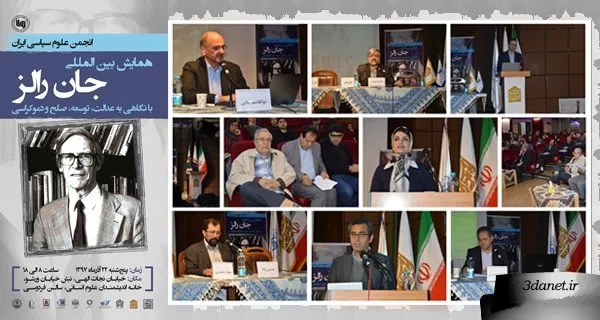
On Thursday, December 13, 2018, the "International Conference on John Rawls: Perspectives on Justice, Development, Peace, and Democracy" was held by the Iranian Political Science Association in the Ferdowsi Hall of the House of Humanities Thinkers. The conference, which ran from 8 a.m. to 6 p.m. that day, featured speakers such as Saeed Hajjarian, Abolghasem Fanaei, and Mohammad Reza Beheshti, as well as several internationally renowned scholars of Rawls who participated by presenting dedicated papers or via video conference. Among these speakers was T. M. Scanlon, Professor of Philosophy at Harvard University, whose paper written specifically for this conference was presented in the first panel with a translation by Narges Salahshour.
Justice is a social duty
Before the presentation of Scanlon's paper, Hossein Hooshmand, professor of political philosophy and a member of the conference's scientific committee, delivered a speech entitled "John Rawls's Political Philosophy and Public Intellectualism." At the beginning of his remarks, Hooshmand stated that in this speech he intended to examine some of the issues afflicting Iran from Rawls's perspective, so that perhaps we might better understand these issues. He then said: "One cannot read Rawls and learn about him without a fundamental transformation occurring in our understanding of morality and fundamental social issues. Rawls's most important critic, Robert Nozick, says of the significance of Rawls's theory of justice that political philosophers in the current situation must either think within the framework Rawls has articulated or explain why they do not think in this way."Hooshmand spoke about the importance of addressing the category of political philosophy: "Political philosophy plays a role in the realm of civil society by offering a particular understanding and perception of the fundamental issues gripping society. Political philosophy helps us to articulate our understanding and judgment about public institutions and policies more clearly. The texts of political philosophy address issues such as national unity, justice, national tranquility, public welfare, etc., and a democratic system cannot remain stable unless its citizens become familiar with the foundations of political philosophy that are the basis of democracy. Rawls believed that to achieve democracy, we need a democratic political philosophy."In another part of his speech, he addressed the relationship between the individual and society, saying: "Rawls says that society and its values cannot determine any absolute duty for the individual. No particular belief or model has authority beyond the individual. We can present our judgments about the existing cultural structure as equal citizens, a judgment that amounts to the rejection or acceptance of the heritage of the past. In Rawls's theory of liberalism, human beings are fundamentally autonomous beings who have the capacity to critique the customs, traditions, and functions of existing cultural institutions."Another part of Hooshmand's speech was dedicated to the relationship between Rawls's political conception of justice and metaphysical theories of justice. He said: "Unlike metaphysical theories of justice, which generalize it to the category of divine decree or individual behaviors, the scope of the political conception of justice in Rawls's view is limited to basic institutions, i.e., judicial and economic institutions, and from this perspective, justice is a practical social duty rather than a metaphysical and epistemological category. Such a conception of justice is derived from the shared beliefs of the citizens of a democratic society. This conception of justice is a freestanding conception, independent of any moral system, whether secular or religious. The political conception of justice is independent of moral systems both in terms of content and justification. The establishment of a just system is contingent solely upon acknowledging that the defense of justice is not confined to a specific epistemic apparatus."In the final part of his speech, Hooshmand explained the relationship of Rawls's views to appropriate model-building for the present and future society of Iran as follows: "Our citizens, before engaging in politics in society, must learn concepts such as justice, fairness, etc., within society. Otherwise, democracy will not endure. Rawls says one of the reasons for the failure of the Weimar Republic was that intellectuals lacked the moral readiness to defend democratic principles. In our society, intellectuals are worshipped without criticism and become the spiritual guides and mentors of the people. But the Rawlsian political philosopher enters the scene merely as a thoughtful citizen and puts an end to this situation."He also addressed the reasons for the lack of attention to Rawls in Iran, stating: "Perhaps one of the reasons for the lack of attention to political philosophy, especially Rawls, in Iran is the dominance of sociology in its Marxist interpretation, which thinks of changing the world and not analyzing it. But the issue is that without having an ideal theory of justice, we cannot make a good transition from the current situation, because we are not armed with the appropriate tools to evaluate the ways out. The revival of normative political thought in the university and overcoming the current deadlock awaits a kind of Rawlsian political philosophy."
International Conference on John Rawls: Perspectives on Justice, Development, Peace, and DemocracyRawls's Theory Is Not Individualistic
After Houshmand's lecture, it was time for the presentation of the exclusive article by T. M. Scanlon, one of Rawls's commentators and a professor at Harvard University. Scanlon is considered one of Rawls's most important students and was a colleague of Rawls at Harvard University. According to Narges Salhshour, the translator of the article, he is one of the most important living philosophers in the world, yet he is not known in Iran at all, and no book by him has been translated into Persian to date. In his article, titled "Some Remarks on Rawls's Theory of Justice," Scanlon offered an interpretation of the features of Rawls's theory of justice.
According to him: "The first feature of Rawls's theory of justice is that it views society as a kind of primary cooperation for achieving mutual advantage. This statement is a normative claim that must be justified on the basis that social institutions are a fair framework for achieving the public good. Based on this claim, it seems that Rawls's theory is individualistic, but this is not correct. In this idea, the meaning of an individual's good has a broad sense. For example, an individual's goal could be to propagate their religion, and this social action does not conflict with the individual good as intended by Rawls. The issue is that individuals create a conception of the good and pursue it."
Scanlon explained the concept of justice as fairness in Rawls's thought as follows: "Rawls writes that social cooperation requires a unity of interests in the service of the public good. Rawls considers the conflict of values to be ineliminable. Therefore, social institutions must manage conflicts in a way that is fair in the eyes of the public. It is on this basis that Rawls proposes justice as fairness."
He also said that the idea of justice in Rawls's thought is political in two senses: "Firstly, Rawls's theory only encompasses the basic foundations of society, and secondly, the principles of justice do not merely answer abstract questions, but the assumption is that this idea plays a specific role in society, and to play such a role, members of society must have commonalities to be obligated to these principles."
Scanlon also stated: "In modern society, where citizens believe in different religions, Durkheim believed that the only basis for our unity is humanity, and Rawls agrees with this. According to Rawls, citizens have a duty to participate in a civilized manner in discussions concerning the public good and the constitution, and in these discussions, to use reasons based on the public good, not ideological reasons. The basis is rational and fair decision-making for the public."
Scanlon also addressed Rawls's answer to the question of how fair processes can be formed and said: "According to Rawls's view, these processes cannot be formed through voting and elections. The appropriate path for shaping fair processes is the justification of these processes with the help of public reasons, and one must act through persuasion."
The final point Scanlon mentioned was: "According to Rawls's belief, the perspective of liberalism offers a positive response to the goodness in the public sphere."
.
.
Audio Recordings of Lectures at the International John Rawls Conference
You shall do justice, justice; John Rawls's Unyielding Compassion
.
.
International Conference on John Rawls: Perspectives on Justice, Development, Peace, and Democracy
With the participation of:
Thomas Nagel (student of Rawls, prominent contemporary political philosopher)
Joshua Cohen (distinguished student of Rawls, Professor of Political Philosophy at UC Berkeley)
T. M. Scanlon (prominent political philosopher and colleague of Rawls at Harvard University)

 Audio Recording of Abolghasem Fanaei's Lecture
Rawls and the Method of Justifying Ethical Theory
.
Audio Recording of Abolghasem Fanaei's Lecture
Rawls and the Method of Justifying Ethical Theory
.




Discussion0 comments
No comments yet; let yours be the first voice.