اندیشهفلسفهخردگفتگوحکمتمعناپرسشفرهنگ
Philosophy
Lecture by Dr. Seyyed Mehdi Nazemi: “From Cartesian Self-Founding to Kantian Autonomy”
Kant criticizes Descartes for turning the 'self' into a substance; its foundation rests on the 'cogito'—not a logical argument, but the intuitive, indubitable nature of the 'knower.' A lecture by Dr. Nazemi on the trajectory from Cartesian self-grounding to Kantian autonomy.
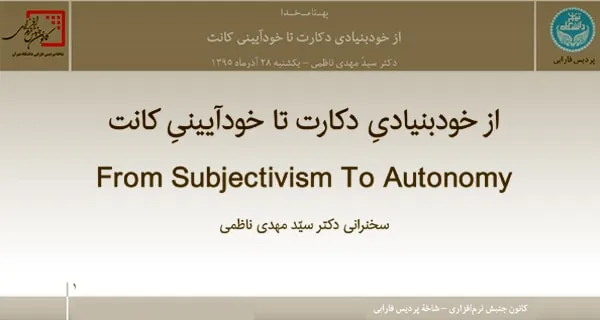
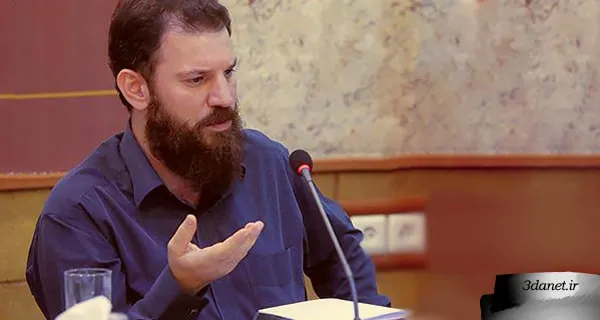
Seyyed Mehdi Nazemi Qareh Bagh: The audio and transcribed text of Mr. Seyyed Mehdi Nazemi's lecture entitled "From Cartesian Self-Founding to Kantian Autonomy," which was held at the Farabi Campus of the University of Tehran, has been prepared through the efforts of the inviting friends from the Software Movement Club of Farabi Campus. While sincerely thanking these friends for their speed and accuracy in preparing this lecture, we invite you to study this text or listen to its audio.
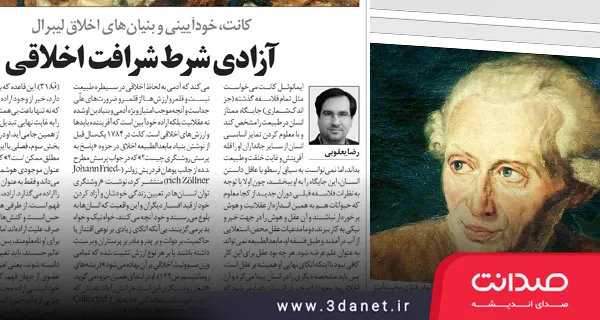
In a famous position, Kant criticizes Descartes and says that Descartes turns the "soul" or the "knower" into a substance, whereas such a thing is not the case, is impossible, and is an erroneous path. He goes on to say that we cannot proceed on this basis at all, nor even divide things and space and say that being consists of space and in that space we have objects, and so on. What is the basis upon which Kant criticizes Descartes? You have probably heard that this basis goes back to Descartes' "Cogito." Descartes, as you know, said: "I think, therefore I am." This statement of Descartes is not an argument, because if it were intended as an argument, it would be "circular." You have used the word "I" twice in the sentence "I think, therefore I am," as if you have said "I am, therefore I am," and this is logically circular. However, one must note that philosophy in its body is argumentative, but in its core and foundations, it is not argumentative; rather, it is an intuitive matter. Not in the sense of mystical intuition, of course, but in the sense that it has certain fundamental points that a person feels have come to them like a discovery, and when they express it, many others accept that discovery. In any case, that fundamental point of the Cartesian Cogito is that the "knower" (I deliberately do not use the word "I," because it might mislead us and make us think Descartes means individual human beings or persons, whereas this is not the case, and Descartes means the knowing I, that is, the universal I or the universal human, or the one who begins to know) is the origin and foundation of thought. Descartes' point was that the first thing we can be certain of its existence in this world is neither theological things nor natural things; that is, neither the objects of natural science are things in which we cannot doubt, nor theology and otherworldly matters are things in which we cannot doubt. The only thing in which we absolutely cannot doubt is this very act of knowing of ours; because I doubt, and when I doubt, I am therefore thinking, which is a mental act, and because I think, therefore I am. This was the foundation that Descartes laid for thought, and its universality remains to this day. Of course, although, as we will say, it is Kant who traced the foundation of human thought and is, in fact, the quintessential philosopher of modernity, Kant nonetheless came after Descartes.
.
.
Audio of Dr. Seyyed Mehdi Nazemi's lecture entitled "From Cartesian Self-Founding to Kantian Autonomy"
Text of Dr. Seyyed Mehdi Nazemi's lecture entitled "From Cartesian Self-Founding to Kantian Autonomy"
.
.
Lecture by Dr. Seyyed Mehdi Nazemi entitled "From Cartesian Self-Founding to Kantian Autonomy"
From Cartesian Self-Founding to Kantian Autonomy: An Introduction to the Concept of Law
Sunday, 18 Azar - Qom, Farabi Campus, Faculty of Law, Dr. Almasi Hall
Source: Telegram channel of Seyyed Mehdi Nazemi Qareh Bagh
.
.




Discussion1 comments
تنها صفحه ای را که لفت ندادم صدانت است بی طرفی خود را حفظ کنید و ذوب در اتوریته ای نشوید