Philosophy
The Possibility of Islamic Humanism According to Muhammad Legenhausen
Challenging the common perception of humanism as an anthropocentrism opposed to theocentrism, Muhammad Legenhausen shows that multiple readings of the concept are compatible with Islam and Islamic philosophy; a report on his talk at Sharif University.
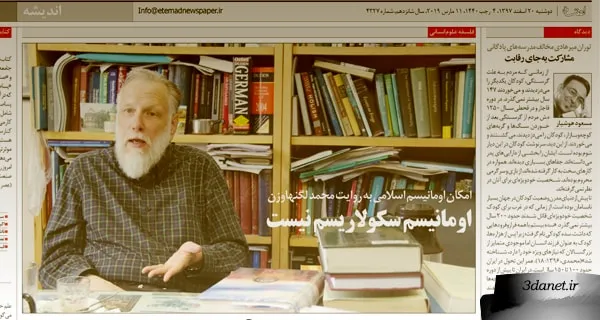
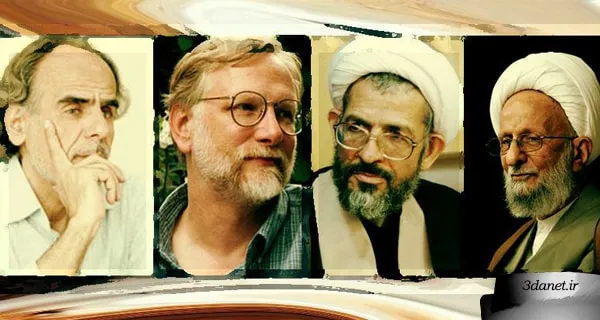
Mohsen Azmoudeh| The key and fundamental concept of humanism in our common perception means human-centeredness instead of God-centeredness, and on this basis, speaking of “Islamic humanism” seems strange. Muhammad Legenhausen, however, challenges this common but, in his opinion, erroneous perception. In the following talk, presented at Sharif University, by showing the multiple and diverse meanings of the concept of humanism, he demonstrates that this common perception is, in fact, gravely mistaken and only refers to some readings of this concept. In other words, according to this prominent scholar of Western and Islamic philosophy, by re-examining various readings of the concept of humanism, we find that a significant number of interpretations of the concept of humanism find it compatible and consistent with religion and religiosity. Muhammad (Gary Carl) Legenhausen, professor of logic and philosophy, founder of the Muslim Students Association at the University of Southern Texas, and faculty member at the Imam Khomeini Educational and Research Institute, traveled to Iran in 1990 at the invitation of the Society for Wisdom and Philosophy, and for nearly three decades now, he has been teaching modern philosophy and logic at Iranian universities and educational institutes. In 2010, he was selected as an Enduring Figure in philosophy.
What is humanism? Can we have Islamic humanism? The discussions that took place around humanism in the 1930s and 1940s might help us answer these questions. First, I will discuss humanism in America. Of course, this is a detailed and multi-branched discussion in itself, and if you search the internet on this topic, you will find plenty of material.
The Humanist Manifesto
The first Humanist Manifesto in America was presented in 1933, which was, of course, a form of religious humanism. This declaration was written by the American Unitarian minister Raymond Bragg (1902-1979) and the Canadian philosopher Roy Wood Sellars (1880-1973). Thirty-four American philosophers, thinkers, and intellectuals, including the prominent pragmatist philosopher John Dewey, along with 15 American Unitarian ministers and one Jewish rabbi, signed this manifesto. This manifesto states that the religious humanist views the world as something that exists by itself and is not created. It is interesting that they consider themselves “religious,” and on the other hand, they say the world is not created, and a rabbi and 15 ministers signed it! This manifesto declares that the era of “theism,” meaning “belief in a personal God,” has passed, but its signatories still say that we want “religious humanism,” which is, in fact, a new form of religion in light of the scientific spirit. Of course, secular humanism was later proposed, but the important point is that in the first Humanist Manifesto, the demand was for religious humanism. Humanism, in the common perception, is usually accompanied by secularism, meaning the idea that religion should withdraw from official public life. It is also said that humanists do not even accept personal religious beliefs. But it must be kept in mind that this is only one account of humanism. In the 1930s and 1940s, various viewpoints competed with each other to monopolize the title of humanism. At that time, opposition to religion was not necessary to be considered a humanist; some were so, and some were not. Therefore, humanism does not mean the replacement of God by man and the substitution of religious values with human values. Of course, there are those who call themselves humanists and oppose religiosity, but humanism is not merely limited to opposition to religion. In fact, when we examine the course of humanist thought, we see that only a minority held such a view.
Is Avicenna a Humanist?
Suppose we brought Avicenna to 1930s America and asked him to sign the aforementioned manifesto. It is certainly clear that Avicenna would not do so. The discussion among the religious humanists of the 1930s regarding creation was that they wanted to reject creation at a specific point in time. Avicenna also held such a view, meaning he opposed creation in time, and it was for this reason that al-Ghazali declared him an infidel. Therefore, the religious humanists could have asked him to sign this manifesto. Theism means belief in a personal God, whereas Avicenna believed that God is not a substance at all and cannot be a person. Thus, we could say Avicenna was an esoteric humanist, while his exoteric view contradicts this perspective. Leo Strauss (1899–1973) believed that Avicenna believed in 'emanation' and held that the world emanated from God. Emanation differs from creation. Creation occurs on a specific day, but emanation occurs outside of time. Avicenna also emphasizes the importance of practical wisdom, and when he speaks of revelation, he interprets it based on practical wisdom. For Avicenna, revelation is the use of practical wisdom in a very rapid manner. Therefore, we might perhaps call Avicenna an esoteric humanist. Strauss says Avicenna did not really believe in God but did not want to say this openly because fanaticism was widespread, so he presented it under the cover of religious and philosophical discussions. But I do not accept this claim of Strauss and believe that Avicenna did not hold such a view. He would say, for instance, that when the Holy Quran speaks of the hand of God, it does not mean God is corporeal; rather, it has a symbolic meaning. Therefore, when the Quran discusses creation, its philosophical interpretation is emanation. Avicenna believed that when God is depicted as a person in religious sources, this is due to the limitations of people's imagination, but the philosopher knows that God is greater than these things. So, in my opinion, Avicenna wants to reconcile religion and philosophy and, through philosophy, provide an esoteric interpretation of religion.
If we consider humanism as systems of thought that esoterically deny, reconstruct, or reinterpret traditional religious teachings in a way that they can be reconciled with reason, then in one sense, it can be said that the classical tradition of Islamic philosophy is humanistic, and the enemies of this tradition, like al-Ghazali, claimed that Islamic philosophy is not Islamic at all. They reject this type of Islamic humanism as heresy. The issue is that any concept of humanism that depends on the denial or new interpretation of the literal meaning of religious texts and denies the anthropomorphism of God is marginal to the discussions that led to the modern concept of humanism. My aim is to state that even assuming the acceptance of the esoteric interpretation from Avicenna's perspective, his signature would still not fit under the aforementioned manifesto. Because Avicenna was very intelligent and would realize that the modern concept of humanism is incompatible with the philosophy he had in mind.
The Third Wave of Humanism
Between the two world wars, the third humanism was proposed. The first form of humanism, which emerged during the Renaissance, was scholarly humanism, whose leaders included figures such as Desiderius Erasmus of Rotterdam (1466–1536). The second period was that of New Humanism, whose intellectual leaders included figures such as Wilhelm von Humboldt (1767–1835), who paid special attention to aesthetics and believed that education in schools and universities should not be confined to the natural, industrial, and technical sciences without regard for spirituality and artistic beauty. But what is the third wave of humanism? Thinkers in the 1920s said we need a new humanism that is not only scholarly and aesthetic but also political. We must have a political humanism. The first person to propose such a view was Eduard Spranger (1882–1963). Another figure who wrote a book on this subject was Wolfgang Frommel (1902–1986). More important than these two figures, however, was Werner Jaeger (1888–1961), who wrote a three-volume work on the third humanism. The third humanism emerged during the Weimar Republic, that is, at a time when the Nazis were coming to power. The Nazis said that they too were humanists and wanted to establish a humanism based on blood and race. They wanted to return to ancient Greece. Another figure who discussed Nazi humanism was Ernst Krieck (1882–1947), a Nazi scholar and theorist who published the journal Volk im Werden (People in the Making). Krieck said that the third humanism Jaeger proposed was liberal and paid little attention to race. Hans Bogner also said that in the Nazi German curriculum, while paying attention to ancient Greece, we should also pay attention to the Spartans, who were serious and harsh. He said humanism is a return to Spartan authoritarianism. Another figure was Hans Drexler, a member of the Nazi Party, who wrote a critique of Werner Jaeger entitled "The Third Humanism." He believed that Jaeger's conception of humanism was incorrect. In his view, Jaeger had tried to reconstruct the history of ancient Greece in alignment with his own liberal thought. Drexler, however, believed that we Nazis want to build a kind of realistic humanism by reconstructing the reality of ancient Greece. Another Nazi critic wrote a treatise on the difference between humanism and humanity, criticizing Drexler. During this period in Germany, the academic discipline of philology was very important, which went far beyond the science of word roots. At that time, philology involved lessons about ancient and classical civilization, especially Rome and ancient Greece. This was because the prevailing notion in Europe was that the origin of European civilization came from ancient Greece, so attention had to be paid to the Greek and Latin languages. The word "humanism" itself is the Latin translation of the Greek word "paideia," whose German translation is "Bildung," and in Persian means "training" and cultivation; therefore, humanism in the sense of Bildung means education and upbringing. In that period in Germany, there was a special focus on Plato. They saw the mission of humanism as strengthening civilization against barbarism.
Christian Humanism
Now, with these explanations in mind, the question is whether one can have an Islamic humanism in this sense. In this sense, one could say that Islamic philosophy is humanistic because al-Farabi believed that Plato was a divine sage, and Shaykh al-Ishraq Suhrawardi saw Aristotle in a dream. Even the ancient pre-Socratic philosophers were greatly esteemed in Islamic philosophy. Socrates was even sometimes called a prophet. Whereas none of the European philologists spoke of Socrates with such appreciation and praise. After the Second World War, in 1949, a conference was held in Geneva, Switzerland. The name of this conference was "For a New Humanism." At this conference, Karl Barth
(1886–1968), a prominent Protestant theologian, was present. His report on this conference is interesting. He says the audience who came to this conference did not know what humanism was and had no consensus about it. Even those who were philologists and spoke about ancient Greece and ancient Rome did not agree on which aspect of that ancient civilization is important for us today. While Barth is not an advocate of Christian humanism because he believes Christianity should not be placed alongside a school of thought, his discussions show that at that time Christian humanists and Marxist humanists were very active. In 1936, the French Catholic philosopher Jacques Maritain (1882–1973) published the book Integral Humanism, in which he argues that true humanism must consider all dimensions of the human being, such as spirituality. He believed that we find a better framework in the Catholic religion than in secular humanism. The current Pope, in 2013, went to South America, to the city of Rio, and said we are advocates of "integral humanism." He believed in Catholic teachings about the human person and pointed out that some heresies stem from a failure to understand integral humanism.
As Narrated by Marxists and Existentialists
Of course, in discussing humanism, one must also pay attention to the Marxists. In the 1930s, the writings of the young Marx, which he had written in Paris, were published. These works were published in the Soviet Union in 1927 and then in German in Germany. He had written important discussions about alienation and the way to overcome it. In the 1960s, Erich Fromm, a prominent thinker, defended socialist humanism. But at the same time, the French thinker Louis Althusser believed that Marx's humanist perspective should be rejected because it was put forward in his youth and is immature. Among leftists, those who were supporters of Stalin were not very much in favor of humanism, but those in Eastern Europe, like Georg Lukács, leaned towards Marxist humanism. However, a humanist tendency also emerged among the existentialists. After World War II, Jean-Paul Sartre, in an important lecture titled "Existentialism is a Humanism," claimed that the philosophy of existence is a kind of humanism. In response, Martin Heidegger wrote a famous letter to him titled "On Humanism," which was published in 1949. The dispute between Sartre and Heidegger is interesting. Sartre, in fact, wanted to respond to Marxists who equated the philosophy of existence with despair, depression, and nihilism. In his response, he said we existentialists are humanists, we are committed to values, and we are not merely nihilists. He said our philosophy is inspired by Martin Heidegger. But Heidegger, in response, completely opposed Sartre's views and said I do not accept the philosophy of existence and humanism, nor do I accept Sartre's atheism. Later, Sartre himself said that he regretted writing that treatise.
The Possibility of Islamic Humanism
Thus we see that various meanings of humanism emerged in the twentieth century, and what has been mentioned is only a reference to some of them. Accordingly, it is meaningless to speak of humanism or the possibility of Islamic humanism or religious humanism without attending to this diversity and plurality, because the meaning of humanism, as we have seen, is multiple. That is, for example, in one sense of humanism—namely, in the sense of Bildung and cultivation—one can say that Islamic philosophy is humanistic. Whereas the meaning that the general public understands by humanism is a mixture of all these historical currents concerning this concept. Meanwhile, the concept of humanism finds its own particular fate in Iran. For instance, it is sometimes said that certain famous thinkers were Muslim, or it is said that humanism is compatible with an important strand in Muslim thought, or it is said that this particular view of humanism has been accepted by some religious authorities, or it is said that this view is a reflection of principles found implicitly in religious sources. Accordingly, when speaking of the human sciences and their relation to Islam, one view is to consider the values behind the modern human sciences and see whether they are compatible with Islamic values or not. In this view, the Islamization of these sciences means that the assumed values of these sciences become a reflection of Islamic values. Therefore, if the discussion of the Islamization of the human sciences is in this sense and society is to be educated, one can speak of a kind of Islamic humanism. But here, what is meant by humanism is in the sense of education (paideia), not the humanism that replaces God with man, or Humboldtian humanism. One Lebanese thinker, raised in Saudi Arabia and a professor at the University of Münster, in his book, considering the different meanings of humanism, ultimately says that we are free to use humanism in whatever way we wish. He defines humanism as openness. This humanism, if not exactly Islamic, is open to all. He emphasizes, of course, that any use of these concepts may be misunderstood, and resolving the ambiguities in this field is very difficult. Therefore, even if we could present an Islamic humanism that is acceptable, I do not wish to do so. I do not want to say that we must create a new school called Islamic humanism, because the different meanings regarding humanism would cause this new understanding to also be misunderstood, since ultimately, in the public imagination, humanism is considered to mean setting God aside.
.
.
PDF file of Professor Muhammad Legenhausen's lecture report on humanism
.
.
The Possibility of Islamic Humanism According to Muhammad Legenhausen
Humanism Is Not Secularism
Published in: Etemad Newspaper / Page 15, Thought / March 11, 2019
.
.


Discussion2 comments
جنگ های جهانی محصول اومانبسم. جهان مدرن منبع خشم و بیرحمی است داعش را ایجاد می کند و جنگ نیابتی راه ما
سلام بسیار عالی