Iranian thinker
Abbas Milani
Abbas MilaniModern Iranian HistoryIranianb. 1949
If you want to understand the dynamics of Iranian society, you need to understand its culture.
Life and Thought
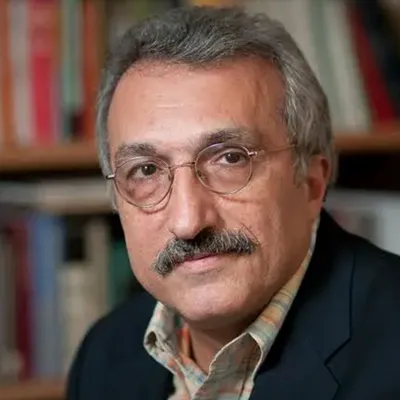
Abbas Milani is an Iranian historian, Iranologist, researcher, and writer based in the United States. He directs the Iranian Studies Program at Stanford University and is a research fellow at the Hoover Institution. His work focuses primarily on modern Iranian political history, the Pahlavi era, and the question of modernity in Iran.
Abbas Malekzadeh Milani, known as Abbas Milani, was born in Tehran in 1949. He studied political science and economics at the University of California, Berkeley, and received his PhD in political science from the University of Hawaii in 1974. He subsequently taught at the National University of Iran and later at the Faculty of Law and Political Science of the University of Tehran.
After immigrating to the United States, Milani served for a time as a professor of history and political science and as a department chair at Notre Dame de Namur University in California. He later joined the Hoover Institution and Stanford University, where he became known as the director of the Iranian Studies Program and a scholar of contemporary Iran.
Most of Milani’s work concerns the political and intellectual history of modern Iran. His major books include Modernity and Its Foes in Iran, The Persian Sphinx, Eminent Persians, and The Shah. In these works, he examines political figures and institutions as well as Iran’s intellectual and social transformations, particularly during the Pahlavi period and the years leading up to the 1979 Revolution.
The significance of Milani’s scholarship lies in its combination of political biography, modern historiography, and the study of modernity in Iran. Although his work has attracted both supporters and critics, it remains widely cited in discussions of the Pahlavi era, Iranian intellectual life, reform, authoritarianism, and the transition to modernity.