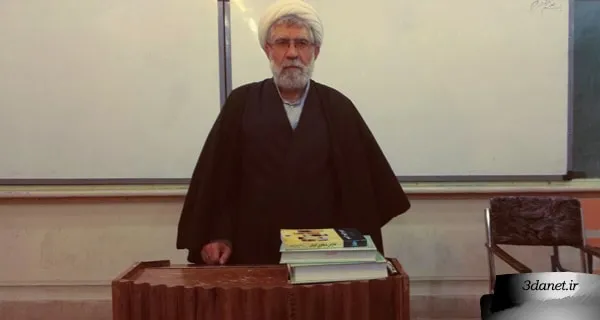
Iranian thinker
Abdolrahim Soleimani Ardestani
Abdolrahim Soleimani ArdestaniReligious Studies, Comparative Theology, and Abrahamic ReligionsIranianb. 1959

Life and Thought
Abdolrahim Soleimani Ardestani, born in 1959, is a scholar of religion and a retired professor at Mofid University. He works in the fields of religious studies, Christian studies, Jewish studies, and comparative theology, and has authored numerous educational and research works on Abrahamic religions and the relationship between religion and human rights.
Abdolrahim Soleimani Ardestani, born in 1959, is a scholar of religion, a retired professor at Mofid University, and one of the well-known authors in the fields of religious studies, Christian studies, Jewish studies, and comparative theology. He taught and conducted research for many years at Mofid University in Qom, and within Iran's religious sphere, he is primarily recognized for his educational and research works on Abrahamic religions, the Bible, Christianity, Judaism, and the relationship between religion and human rights.
Soleimani Ardestani is among the researchers who have endeavored to introduce religions through a comparative, historical, and educational approach. His works are typically written for students of theology, religious studies, and comparative studies, which is why the language of many of his books is clear, textbook-like, and systematic. The list of his published works includes books on the living religions of the world, primal religions, the Bible, Judaism, Christianity, religions in the Quran, comparative theology of Islam and Christianity, and the relationship between religion and human autonomy.
In religious discussions, he has sometimes presented views differing from the official or common narrative within the seminary tradition, which has created some controversy for him in recent years. However, in his scholarly profile, the main focus is not these controversies, but his standing in the teaching and research of religions, particularly in the fields of Christianity and Judaism.
Soleimani Ardestani's work is largely concentrated on several axes: Abrahamic religions, Christianity, Judaism, the Bible, comparative theology, religion and human rights, and the examination of the relationship between religious faith and human moral autonomy. In some of his works, he has tried to show that dialogue between Islam and Christianity is not merely a comparison of two religious traditions, but can be a path to a better understanding of concepts such as God, revelation, salvation, humanity, ethics, and freedom.
His articles also address topics such as human moral independence, Abrahamic religions, theories of religion, faith, and ethics. Persian article databases have registered several of his articles in the fields of ethics, religious studies, and religions.
Bibliography
Writings and transcribed lectures13 titles
Living Religions of the World
Primitive and Silent Religions
Religions in the Quran
The Bible
Judaism
Christianity
An Introduction to Comparative Theology of Islam and Christianity
Human Nature in Islam and Christianity
Religion and Human Autonomy: An Introduction to the Problem of Religion and Human Rights
The Conflict of Religious Claims
A Textual and Documentary Examination of the Judeo-Christian Scriptures
Contemporary Iranian Muslim Thinkers' Encounter with the New Human Rights System
A Primer on Abrahamic Religions