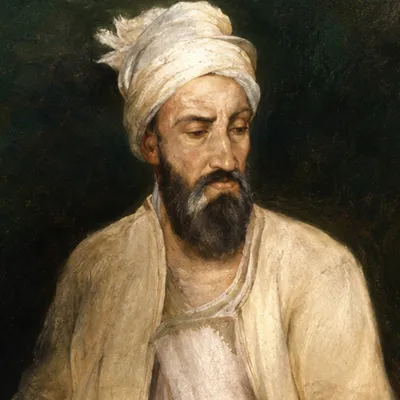
Whoever enters this house, give them bread and do not ask about their faith, for the one who is worthy of a soul before God Almighty is certainly worthy of bread at the table of Abul-Hassan.
In their times
Open in the Timeline of Thought


Life and Thought
Ali ibn Ahmad Kharaqani, known as Abul-Hassan Kharaqani, is one of the renowned mystics and Sufis of the fourth and fifth centuries AH in Iran. Due to his humanistic outlook, chivalry, and rejection of ideological discrimination in serving God's creatures, he holds a lofty and unparalleled position in the history of Islamic mysticism.
Sheikh Abul-Hassan Ali ibn Ahmad Kharaqani (352 – 425 AH) is one of the greatest and most influential Iranian mystics and Sufis, who lived in the village of Kharaqan, near Bastam (present-day Shahrud). He was unlettered and had not attended school, yet due to his uplifting spiritual experience and inner wayfaring, he was in the company of great mystics and thinkers such as Avicenna and Abu Sa'id Abu'l-Khayr, and was held in extraordinary esteem by them. He considered himself, in the manner of Uways, a devotee and spiritual follower of Bayazid Bastami.
Kharaqani did not write any works himself, but his disciples and students compiled his sayings, aphorisms, and spiritual states in a collection titled Nur al-'Ulum (The Light of the Sciences). Furthermore, significant portions of his sayings and character are reflected in Attar of Nishapur's Tadhkirat al-Awliya (Memorial of the Saints). His thought and spiritual conduct represent the school of futuwwa (chivalry), magnanimity, and boundless compassion for all creatures.
Kharaqani's most famous rationalistic and humanistic thought and phrase was inscribed above the entrance to his khanaqah, upholding human dignity and unconditional service to human beings, regardless of their religion, creed, or beliefs. His teachings had a profound impact on the Khorasani mystical tradition and on later mystics, especially Rumi and Attar.