
Life and Thought
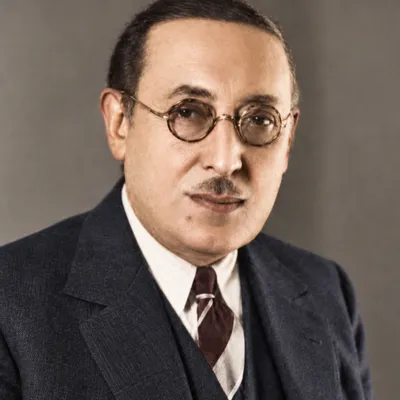
Ahmad Qavam, titled Qavam al-Saltaneh (c. 1873–1955), was an Iranian statesman of the late Qajar and Pahlavi periods who served five times as prime minister between 1300 and 1331 SH (1921–1952). His name is tied to Colonel Pesyan's uprising in Khorasan, the Azerbaijan crisis and the withdrawal of Soviet troops in 1325 SH (1946), and the Uprising of 30 Tir 1331 SH (July 1952).
Ahmad Qavam, known as Qavam al-Saltaneh, was born around 1252 SH (1873 CE) in Tehran; sources disagree on the exact year of his birth. He belonged to the Mostowfian Ashtiani family and was the son of Mirza Ebrahim Motamed al-Saltaneh and the younger brother of Hassan Vosugh al-Dowleh, who also served as prime minister of Iran.
In 1315 AH Qavam entered the court of Mozaffar al-Din Shah as "monshi-ye hozur" (court scribe) and was later known as "dabir-e hozur" and "vazir-e hozur." He received the title Qavam al-Saltaneh in the same period. Some sources mention his role in drafting the constitutional decree. In 1909 he became minister of justice, in 1910 minister of the interior, and in 1918 he was appointed governor of Khorasan.
He served five times as prime minister of Iran: in two terms between 1300 and 1301 SH at the end of the Qajar period, then in 1321 SH, from 1324 to 1326 SH, and in 1331 SH under Mohammad Reza Pahlavi. His first government saw the uprising of Colonel Mohammad Taqi Khan Pesyan in Khorasan, and in Azar 1300 SH the 1921 treaty between Iran and the Soviet Union and the treaty between Iran and Afghanistan were ratified. Qavam tried to limit the powers of Reza Khan, the minister of war, and resigned as prime minister in Bahman 1301 SH.
His most significant period came in the 1320s SH. In 1325 SH he founded the Democrat Party of Iran and played a central role in the Azerbaijan crisis and the withdrawal of Soviet troops from Iran; he travelled to Moscow and negotiated with Soviet officials. In Tir 1331 SH Mohammad Reza Shah appointed him prime minister again, but after the Uprising of 30 Tir 1331 SH he resigned following four days in office, and Mosaddegh returned as prime minister. The seventeenth Majlis declared him "mahdur al-dam" (one whose blood may be shed with impunity) and an order was issued to confiscate his property, but the order was not carried out and was cancelled after the coup of 28 Mordad 1332 SH.
After these events Qavam went to Europe and returned to Iran in Farvardin 1333 SH. He died in Tehran in Tir 1334 SH and was buried in the Shrine of Fatima Masumeh in Qom. Assessments of him differ: some see him as a manager of crises who untied political knots, while others criticise his style of politics and his closeness to foreign powers.