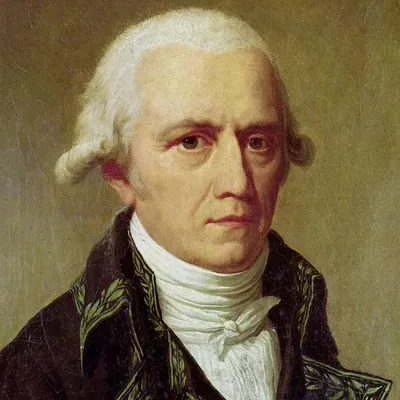

Life and Thought
Jean-Baptiste Lamarck, a French naturalist, was among the first to propose a systematic theory of the transformation of living species. He is best known for the doctrine of the "inheritance of acquired characteristics", and he helped bring into scientific use the term "invertebrates" and the concept of "biology" in its modern sense. His classification of invertebrate animals is counted among the foundations of modern zoology.
Jean-Baptiste Pierre Antoine de Monet, Chevalier de Lamarck, was born on 1 August 1744 in Bazentin, in the Picardy region of France, the youngest child of an aristocratic but impoverished family. His family intended him for the clergy and sent him to the Jesuit school in Amiens, but after his father's death Lamarck abandoned his studies and joined the army, serving in the Seven Years' War. Illness and injury forced him out of military service, and in Paris he turned to the study of medicine and botany.
In 1778 he published Flore françoise, a key for identifying the plants of France, which made his name in the scientific circles of Paris. With the patronage of Georges-Louis Leclerc, Comte de Buffon, he gained entry to the Royal Botanical Garden and in 1788 became keeper of its herbarium. After the French Revolution and the reorganization of the institution as the National Museum of Natural History in 1793, he became professor of the zoology of insects and worms, taking charge of a vast group of animals that had until then received little study.
During this period Lamarck separated invertebrates from vertebrates as a scientific category and proposed a new classification for them. His multi-volume Natural History of Invertebrate Animals (1815–1822) is the fruit of this research. In the early nineteenth century he also used the term "biology" (biologie) for a unified science of living beings and argued for the necessity of such a science.
His most important theoretical work is Philosophie zoologique, published in 1809. In it Lamarck argued that species are not fixed but change over time in response to environmental conditions. In his view two mechanisms are at work: an inner tendency of living beings toward greater complexity, and the influence of needs and environment, which causes organs to develop through use or atrophy through disuse. He believed these acquired changes were passed on to the next generation. This view, later known as Lamarckism, was set aside in light of the findings of modern genetics, yet Lamarck was among the first scientists to examine the transformation of species within a scientific framework, without recourse to supernatural causes.
In his final years Lamarck faced blindness and poverty, and his views were sharply criticized by colleagues such as Georges Cuvier. He died in Paris on 18 December 1829. Later revisions of the history of science have recognized his contribution to the emergence of evolutionary thought and to the founding of invertebrate zoology.