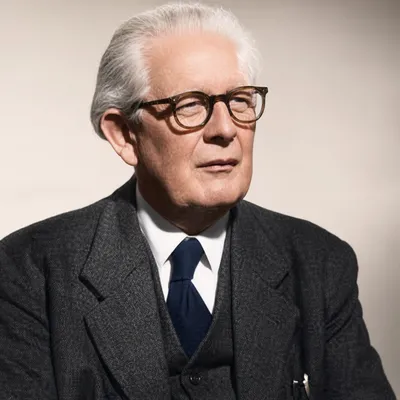
Foreign thinker
Jean Piaget
Jean PiagetDevelopmental psychology and genetic epistemologySwiss1896–1980
"Intelligence is nothing more than what we use to solve problems."


Life and Thought
Jean Piaget was a Swiss psychologist, biologist, and epistemologist and one of the most important theorists of developmental psychology in the twentieth century. Through his study of children's cognitive development and his theory of stages of intellectual growth, he had a profound influence on psychology, education, and the philosophy of science.
Jean Piaget was born in 1896 in Neuchâtel, Switzerland. From an early age, he was interested in biology and the study of nature, and he conducted his first scientific research in zoology. After studying and working in biology, Piaget turned to examining how knowledge is formed in the human mind and became one of the founders of developmental psychology.
Piaget proposed a theory according to which children understand the world differently from adults and their cognition develops through organized stages. He introduced four main stages of cognitive development: the sensorimotor stage, the preoperational stage, the concrete operational stage, and the formal operational stage. Concepts such as assimilation, accommodation, and equilibration are among the key ideas of his theory.
He was also the founder of genetic epistemology, an approach that studies how knowledge is formed and transformed. His important works include "The Language and Thought of the Child", "The Construction of Reality in the Child", and "The Origins of Intelligence in Children". Piaget's ideas have had a wide influence on educational methods, cognitive psychology, and research on learning.