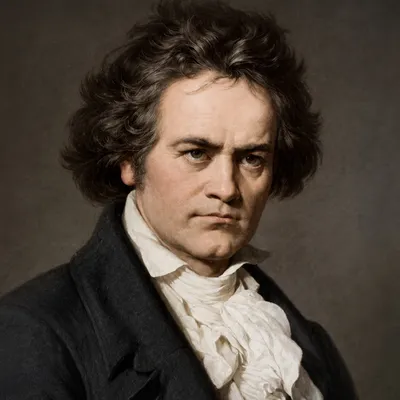
Foreign thinker
Ludwig van Beethoven
Ludwig van BeethovenComposition and classical musicGerman1770–1827
“I shall seize Fate by the throat; it shall never succeed in completely crushing me.”


Life and Thought
Ludwig van Beethoven was a German composer and one of the defining figures in the history of Western music. His work bridged the Classical and Romantic eras and transformed the course of nineteenth-century music by expanding the language of the symphony, sonata, and string quartet.
Ludwig van Beethoven was born in Bonn on 17 December 1770 and began musical training in childhood. In 1792, he moved to Vienna, the city that remained the principal setting of his work and life until his death. There he encountered the musical tradition of Haydn and Mozart, while gradually forging a powerful and distinctive compositional language.
Progressive hearing loss, which began in the late 1790s, made his life increasingly difficult but did not prevent the creation of his major works. His Third, Fifth, Sixth, and Ninth Symphonies; the opera Fidelio; his piano and violin concertos; piano sonatas; and string quartets are among his most important achievements. The Ninth Symphony, which uses Friedrich Schiller’s Ode to Joy in its final movement, occupies an exceptional place in music history.
Beethoven’s late works—including the Missa solemnis, the Diabelli Variations, his final piano sonatas, and late string quartets—are distinguished by formal innovation, emotional depth, and musical complexity. He died in Vienna on 26 March 1827. His enduring legacy lies in his commitment to freedom of artistic expression, individual strength, and music’s capacity to convey profound human experience.