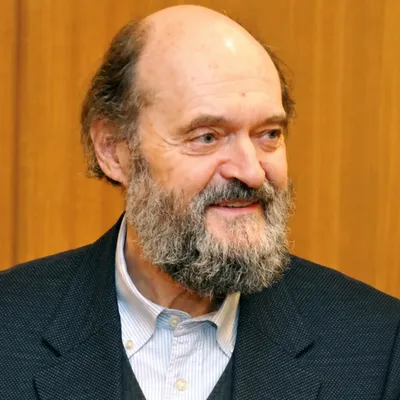
“I could compare my music to white light which contains all colours. Only a prism can divide the colours and make them appear; this prism could be the spirit of the listener.”
In their times
Open in the Timeline of ThoughtLife and Thought
Arvo Pärt is an Estonian composer and one of the leading figures in contemporary classical music. He created the tintinnabuli compositional style: a minimalist, bell-like, and deeply contemplative musical language that often draws on sacred music and early traditions. Für Alina, Fratres, Tabula rasa, and Spiegel im Spiegel are among his best-known works.
Arvo Pärt was born in Paide, Estonia, on September 11, 1935, and studied composition at the Tallinn State Conservatory under Heino Eller. In the early years of his career, he worked in film music and experimented with modernist techniques such as serialism and collage. Nekrolog was among Estonia’s first twelve-tone works, while Credo was a major work from this period.
After a creative crisis in the late 1960s, Pärt withdrew from composing for several years and studied medieval and Renaissance music, Gregorian chant, and early European polyphony. He converted to Orthodox Christianity in 1972, and these spiritual and musical experiences played a decisive role in the formation of his new musical language.
In 1976, with the piano piece Für Alina, he introduced the style he called tintinnabuli, a term derived from the Latin for “little bell.” The style is marked by simplicity, meaningful silences, restrained melodic movement, and the resonance of triads. Fratres, Cantus in Memory of Benjamin Britten, Tabula rasa, Spiegel im Spiegel, Passio, and Te Deum are among the major works of this period.
Although Pärt is often associated with minimalism, his music is grounded above all in silence, concentration, prayer, and the act of listening. His works have had a major influence on contemporary choral, orchestral, and film music, making him one of the world’s most frequently performed living composers.