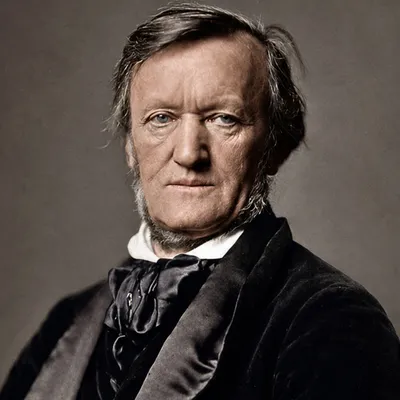
“The oldest, truest, and most beautiful organ of music—the source to which our music alone owes its being—is the human voice.”


Life and Thought
Richard Wagner was a German composer, conductor, and writer who transformed nineteenth-century opera. Through his idea of the “total work of art,” he brought music, text, drama, and visual elements together in the form of music drama.
Richard Wagner was born in Leipzig on 22 May 1813. In his youth, he turned to composition and conducting, gaining recognition with operas such as The Flying Dutchman, Tannhäuser, and Lohengrin. His participation in the 1849 Dresden uprising led to his exile from Germany, and he spent years in Zurich and other European cities.
In his writings and works, Wagner developed the theory of the “total work of art,” in which poetry, music, acting, stage design, and theatre serve a unified drama. He employed expansive orchestral textures, continuous musical flow, and recurring musical ideas. The four-part Ring of the Nibelung, Tristan and Isolde, The Mastersingers of Nuremberg, and Parsifal are among his most important works.
Wagner built the Bayreuth Festival Theatre for the performance of his works, and the first Bayreuth Festival took place in 1876 with the complete staging of the Ring cycle. Arthur Schopenhauer’s philosophy shaped his later period, especially Tristan and Isolde and Parsifal. Alongside his immense artistic significance, Wagner’s antisemitic writings and views remain an inseparable part of evaluating his legacy. He died in Venice on 13 February 1883.