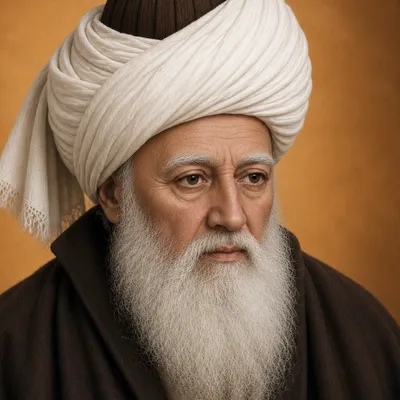
Foreign thinker
Mirza Abdul Qadir Bedil
Mirza Abdul Qadir BedilPersian poetry, Sufism and the Indian styleIndian1644–1721
In their times
Open in the Timeline of Thought


Life and Thought
Mirza Abdolqader Bidel, known as Bidel Dehlavi, was a Persian-speaking Sufi poet and thinker from India and one of the most prominent representatives of the late period of the Indian style in Persian poetry. His poetry is renowned for its linguistic complexity, compressed imagery, and mystical and philosophical themes.
Mirza Abdul-Qadir Bedil, known as Bedil Dehlavi, was born in 1644 CE in Azimabad, present-day Patna. His family were of Turkic descent, belonging to the Chagatai Arlas tribe, and his ancestors had migrated to India from Central Asia. Bedil lost both his parents in childhood and was subsequently raised under the guardianship of his uncle, Mirza Qalandar. Association with Sufis and extensive study of Persian literature were key factors in shaping his intellectual and literary character.
Bedil is considered one of the most important Persian-speaking poets of the subcontinent and the most prominent representative of the late phase of the 'Indian style'. The language of his poetry is known for its density of meaning, compound formations, complex imagination, and mystical and philosophical reflections; characteristics that make his poetry difficult to understand but semantically very rich. He spent a significant part of his life in Delhi and died there.
Bedil's works are not limited to ghazals and other poetic forms. 'The Four Elements' (Chahār ʿUnṣur) is one of his most important prose writings and a fundamental source for understanding his life and intellectual world. 'The Great Ocean' (Muḥīṭ-i Aʿẓam) and 'Gnosis' (ʿIrfān) are also among his significant verse works, and his extensive collection of poems and writings has found a special place in the Persian literary tradition, particularly in India, Afghanistan, and Central Asia.
Mystical themes have a strong presence throughout Bedil's works. Humanity, self-knowledge, truth, the unity of being, and the relationship between the exoteric and the esoteric are subjects repeatedly formulated in his metaphorical and imaginative language. It is this very fusion of poetry, mysticism, and philosophical reflection that has led to Bedil being recognized not only as a great poet but also as one of the important figures of mystical thought in the Persian-speaking tradition.