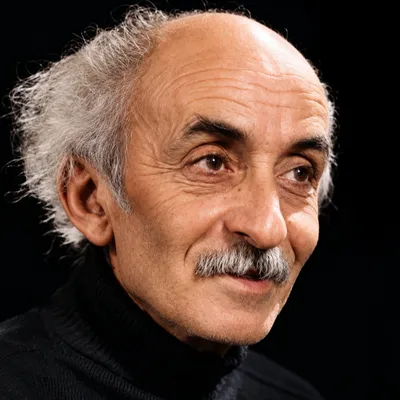
Iranian thinker
Nima Yooshij
Nima YooshijModern Persian PoetryIranian1897–1960

Life and Thought
Nima Yooshij, born Ali Esfandiari, was an Iranian poet and the founder of modern Persian poetry. By breaking the requirement of uniform hemistich length and freeing rhyme, he created a new structure for Persian verse. His narrative poem "Afsaneh" and the poem "Qoqnoos" (The Phoenix) are among his best-known works and profoundly influenced later generations of Iranian poets.
Ali Esfandiari, known as Nima Yooshij, was born on 11 November 1897 (21 Aban 1276) in the village of Yush in Mazandaran. He spent his childhood in Yush amid village and tribal life, and the landscape of northern Iran later left a strong mark on his poetry. As a teenager he moved to Tehran and studied at the Saint-Louis school, a French school. There he became acquainted with French language and literature, and his teacher Nezam-al-Din Khan introduced him to classical Persian poetry and European literature.
Nima first wrote poetry in traditional forms, and his early work followed the style of the classical poets. With the publication of the narrative poem "Afsaneh" in 1301 (1922), he took a clear step toward transforming Persian poetry. In poems such as "Qoqnoos" (1316/1937), "Manli" and "Ghorab" (The Crow), he extended his new experiments. He freed Persian poetry from uniform hemistich length and fixed rhyme schemes, and used prosodic meter with a free and varied number of feet. In this way a poem could adapt the length of its lines to its theme and mood.
In his theoretical writings, including "Harf-ha-ye Hamsayeh" (The Neighbor's Words) and "Arzesh-e Ehsasat" (The Value of Feelings), Nima emphasized the connection of poetry with the poet's lived experience and life. He believed that poetry must spring from nature and everyday life, merge with the poet's language and outlook, and be free of decorative conventions. His attention to precise imagery, an objective view of nature, and the union of form and content are among the fundamental features of his poetry.
He spent most of his life in a simple, low-income existence between Tehran and Yush, and his works were at first met with indifference and even opposition from some literary circles. Nevertheless, poets such as Ahmad Shamlou, Mehdi Akhavan-Sales, Forough Farrokhzad and Sohrab Sepehri, each in their own way, drew on the path he opened. Nima died in Tehran on 6 January 1960 (16 Dey 1338), and after his death his standing as the father of modern Persian poetry was accepted.