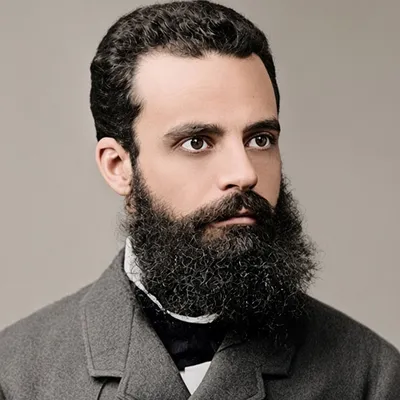
“History is a graveyard of aristocracies.”
In their times
Open in the Timeline of ThoughtLife and Thought
Vilfredo Pareto was an Italian economist, sociologist, and political theorist best known for his theory of elites and the concept of the “circulation of elites.” He also made significant contributions to mathematical economics and social sciences through his analysis of income distribution and the Pareto principle.
Vilfredo Pareto was born in Paris in 1848 to an Italian family and later moved to Italy. He studied engineering and worked for a time in the railway industry, but gradually turned his attention to political economy and the analysis of social issues. Pareto taught economics at the University of Lausanne in Switzerland and became one of the leading figures of the Lausanne School of mathematical economics after Léon Walras.
In economics, Pareto became known for his studies of wealth and income distribution. He observed that income distribution in many societies follows an unequal pattern, a finding later associated with the “Pareto law” or the “80/20 principle,” although modern applications of this idea extend beyond his original formulation. His major economic works include Cours d’économie politique (1896–1897).
In his later years, Pareto increasingly focused on sociology. His major work, Trattato di sociologia generale (1916), developed a theory of social structure, the role of elites, and historical change. He argued that societies are consistently influenced by elite groups and that political history can partly be understood as a process of the rise, consolidation, and replacement of elites.
Pareto’s ideas influenced the development of modern political sociology, elite theory, and organizational studies. However, some aspects of his theories, especially his views on human behavior and the role of elites, have remained subjects of debate and criticism among sociologists and political theorists.