Religion
Translation of the Stanford Encyclopedia of Philosophy entry “Mysticism in Arabic and Islamic Philosophy”
Islamic mysticism rests on two pillars, the practical and the philosophical, and is rooted in the Quran. The integration of mystical elements into Islamic philosophy began with the Neoplatonic school and became an inseparable part of it; a translation of the Stanford Encyclopedia of Philosophy entry.
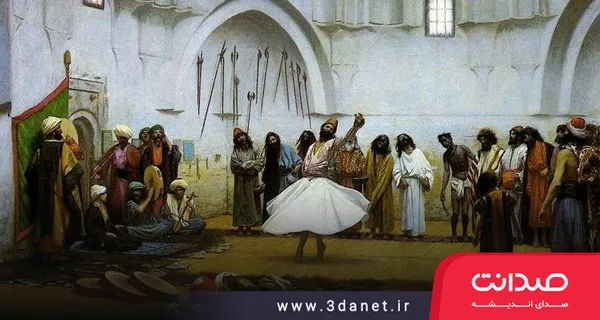
Ehsan Arzroomchilar: Awareness of the roots and, subsequently, the history of a thought greatly aids in a better and more accurate understanding of that thought. Thought does not arise in a vacuum, nor does it grow in a vacuum; rather, it is influenced by and simultaneously influences other thoughts. The history of thought in the Islamic world is replete with such influences and receptions. Whether in Islamic philosophy, which is laden with concepts and components employed in earlier reflections, from Aristotle and Plato to Plotinus; or in Islamic theology (kalām), which in many places has been receptive to the philosophical ideas of predecessors, especially Avicenna; or in Islamic mysticism, which borrows many elements from other branches of thought, from Greek philosophy to Islamic philosophy and even Eastern reflections, particularly Hinduism and Buddhism.
The author of this article, Mehdi Aminrazavi, a former student of Seyyed Hossein Nasr and a professor of philosophy and mysticism in America, explores in this article the course of the entry of mystical ideas into the world of Islamic philosophy. In this writing, he begins with Plotinus and Neoplatonism and shows how mysticism and mystical ideas gradually found their way into the world of philosophy and, over time, became an inseparable part of Islamic philosophy. Through this text, the reader not only becomes acquainted with the course and manner of the entry of mystical components into the world of philosophy but also gains preliminary awareness of the intellectual foundations of various schools in Islamic philosophy.
Mysticism in Islamic and Arabic Philosophy
Mysticism in the Islamic world has long[1] had an inseparable link with the concept of ḥikmat, a concept that is simultaneously wisdom and philosophy (Nasr 1996). In the Islamic world, the source of mysticism and mystical components must be sought in the Quran and in the teachings of Islam themselves. Muslim mystics and philosopher-mystics viewed certain verses of the Quran as allegorical[2] and symbolic[3] allusions for those who have the capacity to receive them. “God is the Manifest and the Hidden”[4] (al-Ḥadīd, 3), “He grants wisdom to whom He pleases, and whoever is granted wisdom has indeed been granted abundant good” (al-Baqarah, 269). And also the famous Light Verse:
God is the Light of the heavens and the earth; the parable of His Light is as if there were a Niche and within it a Lamp: the Lamp enclosed in Glass: the glass as it were a brilliant star: Lit from a blessed Tree, an Olive, neither of the east nor of the west, whose oil is well-nigh luminous, though fire scarce touched it: Light upon Light! God doth guide whom He will to His Light: and God doth set forth Parables for men: and God doth know all things. (al-Nūr, 35).
All of these verses can be considered to contain esoteric insight. Over many years, these verses have inspired a number of Muslim esotericists[5], and some of them, such as Shihāb al-Dīn Suhrawardī (12th century CE) and Mullā Ṣadrā (16th century CE), have also written commentaries on them (for example, Mullā Ṣadrā’s commentary on the hermeneutics of the Light Verse in the Quran).
From a mystical point of view, all subsequent expansions and interactions between Islamic philosophy and other intellectual traditions should only be considered as the intellectual translation of the mystical components within the Islamic milieu. Mystical components in Islam exist in two different and independent forms. From a practical dimension, Sufism represents the esoteric aspect of the purest form of Islam; while from a theoretical dimension, the central components of Islamic mysticism gradually made their way into the tradition of Islamic philosophy. Thus, Islamic mysticism stands on two pillars: one practical and the other philosophical. That is, to attain esoteric wisdom, one can either choose practical wisdom[6], which consists of inner purification and ascetic living, or reach it through a type of philosophy, which includes (and is not limited to) deductive reasoning.
1- The Neoplatonic School and Sufism
2- The Ismaili Tradition
3- The “Period of Decline” and the School of Shiraz
4- The School of Isfahan and Mulla Sadra
5- Conclusion
1- The Neoplatonic School and Sufism
After the early theological schools in Islam, including the predestinarians (Qadariyya), the eschatologists (Murji'ah and Wa'idiyya), and the faith-oriented theologians[7] (Ash'ariyya), diverse Islamic philosophical traditions and schools of thought came into being. Al-Kindi is usually named as the first Islamic philosopher, but the full and complete influences of Greek thought on Islamic philosophy must be sought in the intellectual system of Abu Nasr al-Farabi (10th century CE). Al-Farabi, who is known as the father of logic in the Islamic philosophical tradition, is also the first to adopt the Neoplatonic school, albeit in a limited sense. It is his intellectual framework that paved the way for the entry of mysticism into Islamic philosophy.
The Neoplatonic school, which has remained one of the important pillars of Islamic philosophy, has had two functions: intellectual and practical, both of which have become an inseparable part of a philosophical life. Philosophically, the Neoplatonic school answers the most important questions about Islam; questions such as how multiplicity arises from unity, how corporeality results from an immaterial God, and how the ascending and descending order of beings is explained.
Mysticism in al-Farabi's thought manifests itself in two forms, philosophical and practical. From a philosophical perspective, as is evident in his work Epistle on the Intellect, his interpretation of the concept of the four intellects paved the way for his successor Ibn Sina (Avicenna, 981-1037), who made full and complete use of the Neoplatonic school. In his writings, al-Farabi not only attempted to reconcile the views of Plato—with a perspective that viewed Plato as a mystical figure—and Aristotle, but in his discussions on political philosophy, he replaced Plato's philosopher-king with the Imam; an Imam who has an intuitive reception of the truth, knows both the theoretical virtues and is familiar with the practical virtues. Despite the fact that his expositions are prevalent among some Sufi orders in Turkey and the Indian subcontinent, and the influence of Sufism can be seen in his Fusus al-Hikam, the accounts presented of his being a Sufi himself are not very accurate.
Regarding the leader of the Peripatetics, Ibn Sina, scholars also agree that he is a rationalist who adopted specific concepts from Plato, Aristotle, and the Neoplatonic school, and also that the core of his writings is essentially discursive. From this point onward, two different interpretations of Ibn Sina are generally observed: one group considers him merely a rationalist who had no connection with mysticism, and another group argues that the later Ibn Sina had embraced mysticism, as this influence is reflected in his later works.
Most Western scholars who consider Ibn Sina, like al-Farabi and Ibn Rushd, merely a rationalist (Gutas 2006, Adamson 2013) rely primarily on his discursive and rational writings. Many Muslim philosophers, and specifically Iranian scholars of Ibn Sina, have a more comprehensive reading of his writings and tend to emphasize that Ibn Sina had an inclination toward mysticism in the later period of his life (Nasr and Leaman 1996, Inati 1996).
For Ibn Sina, as for many other Muslim philosophers, the ultimate philosophical endeavor was to unveil the mystery of creation; specifically, how divine unity became the multiplicity of the world of existents. To solve this complex problem, Ibn Sina adopts the Neoplatonic solution of emanation[8], which [after him] was used not only by Islamic Sufis and esotericists to explain the spiritual journey of the human being toward God, but also by almost all philosopher-mystics, from Suhrawardi and Mulla Sadra to Sabzavari and Tabataba'i.
Ibn Sina was not a Sufi affiliated with any particular Sufi order. In fact, the meeting of Ibn Sina with the great Sufi master Abu Sa'id Abu al-Khayr (d. 1049) and the existence of an Oriental philosophy (al-Hikma al-Mashriqiyya) in his writings is most likely legendary; however, the presence of mystical components in some of his later writings seems undeniable (Amin Razavi 2003). For example, in the ninth chapter of his philosophical masterpiece al-Isharat wa al-Tanbihat, in a section entitled Fi Maqamat al-'Arifin, Ibn Sina appears to provide an exposition of Sufi teachings and explicitly defends esotericism and the Sufi path for attaining truth. While the authenticity of some of his Persian writings has been questioned, in some of his allegorical [Arabic] writings, such as Mi'raj Nama, Risalat al-Tayr, Salaman wa Absal, Hayy ibn Yaqzan, Risala fi al-'Ishq, and naturally his famous poem al-Qasida al-'Ayniyya, the presence of esoteric and Sufi elements is clearly evident to those seeking this type of interpretation of him.
Alongside Ibn Sina, who represents the pinnacle of rationalist philosophy in Persia, two other intellectual currents emerge. On the one hand is the prominent thinker Abu Hamid al-Ghazali, who rejects philosophy entirely and becomes solely a proponent of Sufism. On the other hand, Ismaili philosophy takes shape, combining Sufism within a philosophical system with Hermetic-Pythagorean teachings[9].
Al-Ghazali, the orthodox jurist[10] and important proponent of faith-based theology (Ash'arism) who had himself studied philosophy, initially thought that deductive reasoning stood on firm ground, but soon turned his back on philosophy and presented a devastating critique of reason in Tahafut al-Falasifa. After despairing of all forms of rational knowledge, he practiced asceticism in solitude for several years and ultimately found his answers in the Sufi tradition. Al-Ghazali's spiritual transition from an orthodox jurist to a Sufi is one of the most prominent sagas of a seeker's transformation, turning from an exoteric Islamic life to an inner life and finding Sufism to be the only method for reaching the truth. He spent the remaining years of his life teaching Sufi doctrines, writing, and living as a Sufi.
Al-Ghazali is one of the few mystics whose form of Sufism simultaneously encompasses religious orthodoxy, an esoteric intellectual framework, and, above all, the ascetic and practical aspect of the spiritual path. Unlike the antinomian Sufis[11] who transgress Islamic law (Shari'a), and likewise the negligent approach of some others, al-Ghazali was a staunch and strict proponent of the Shari'a.
He wrote extensively on mysticism, claiming that this path is the best way to reach the truth. Among his writings on mysticism, Mishkat al-Anwar is a prominent work; an important work of an illuminationist nature that was influential in the formation of Suhrawardi's doctrine of Illumination (Amin Razavi 1996). Also, sections of his most important[12] work, Ihya' 'Ulum al-Din, such as its thirty-fifth book, Kitab al-Tawhid wa al-Tawakkul, are largely dedicated to explaining Sufi teachings. He has also written commentaries on the spiritual significance of fasting, prayer, invocation of the Divine Names and Attributes, and spiritual music as a means for purifying the soul.
2- The Ismaili Tradition
Among the Ismailis, Ismaili philosophers had adopted the esoteric doctrines of Hermeticism and the mystical teachings of the Greco-Alexandrian tradition[13]. Concepts such as emanation from the One, asceticism, the body as a prison and the soul imprisoned within it, guidance[14] toward esoteric inner knowledge, layers of spiritual hermeneutics (taʾwīl), sacred geometry and its esoteric symbology, cycles of prophecy, and the guiding role of[15] the Shiite Imams were part of the themes of the Ismaili philosophical tradition. Among the most prominent Ismaili figures of the tenth and eleventh centuries CE is Jābir ibn Ḥayyān (d. 815), who was more than a scientist and chemist, and in his work Kitāb al-Aḥjār provides a mystical interpretation of the science of letters and esoteric mathematical concepts influenced by Pythagorean geometry. It should be noted that many works by different thinkers may have been collected under his name. Abū Yaʿqūb al-Sijistānī was another prominent figure of this movement, whose mystical writings in Kashf al-Maḥjūb and Kitāb al-Yanābīʿ contain an esoteric commentary on important philosophical works and religious subjects (see Nasr and Aminrazavi 1999/2001). Al-Sijistānī's writings, which should be regarded as a spiritual commentary on the esoteric doctrine concerning the soul's flight toward its heavenly abode, revolve around the oneness of God, the Intellects, and the various kinds of soul and their relationship with the body. In the aforementioned works, al-Sijistānī systematically addresses concepts such as creation, the role of prophets as spiritual guides, and the hidden symbology of their teachings. When a person moves from the outer layers of Islam to its inner, esoteric layers, they attain an awareness that is the key to understanding the allegories of the prophets' teachings. Abū Ḥātim al-Rāzī is another important figure of this current, who in his book Aʿlām al-Nubuwwa applies the concept of emanation to the phrase Be (kun)[16] and provides a mystical account of how the human soul is a shadow of a higher and more perfect soul.
Also to be mentioned is Ḥamīd al-Dīn al-Kirmānī (996–1021) and his numerous writings on Sufism and esotericism, the most remarkable of which is Rāḥat al-ʿAql. He is an important Ismaili philosopher, considered by some to be the Avicenna of the Ismailis, who argued that any correct understanding of reality is based on two doctrines: first, the individual must live an ascetic life, and second, an adept must also prepare themselves philosophically. The chapters of the book Rāḥat al-ʿAql are called ramparts (aswār) and the paragraphs are called paths (mashāriʿ). The novice wayfarer must traverse fifty-six paths and seven walls for their soul to gain knowledge of reality. Reality, in al-Kirmānī's view, is divided into four levels: the first is the world of divine creation or the incorporeal world (ʿālam al-ibdāʿ); the second is the corporeal world (ʿālam al-jism); the third is the domain of religion (ʿālam al-dīn); and finally, the return of the world toward its original union with God (Baumstark 1932; Corbin 1961; Corbin 1964, 1–130; Hunzai 1986).
Perhaps the most important figure of the Ismaili tradition who was both a poet and a philosopher is Nāṣir-i Khusraw (1004–1072). He tirelessly advocates for the purification of the soul and the pursuit of the spiritual journey, whether in his collection of didactic and mystical poems called the Dīwān, or in his mystical [prose] works such as Jāmiʿ al-Ḥikmatayn and Gushāyish wa Rahāyish. Nāṣir-i Khusraw's effort to reconcile Sufism and reason can be seen in Jāmiʿ al-Ḥikmatayn, where he argues that the sages of the true religion and the philosophers are in agreement with one another. For Nāṣir-i Khusraw, knowledge of the soul is a path to attaining true knowledge; a knowledge that transcends the distinction between the perceiver and the perceived[17].
Nāṣir-i Khusraw provides a specific set of instructions for novice wayfarers on how to pursue the spiritual path by relying on ascetic exercises. Like St. Augustine and Francis of Assisi, Nāṣir-i Khusraw sought a life of pure pleasure-seeking in his early youth; but he experienced a severe transformation and thereafter devoted himself to the Sufi path. Traces of both stages of his life can be seen among his works (Hansberger 2000).
Several other encyclopedic works[18] from the Ismaili tradition are extant whose authors are unknown. Many of them deal with Sufism and mystical subjects. Among the works that have been influential in the dissemination and popularization of esoteric (bāṭinī) views, one can mention treatises such as the Epistles of the Brethren of Purity (Ikhwān al-Ṣafāʾ) and the Umm al-Kitāb (Daftary 1990; Nasr and Aminrazavi 1999/2001).
3. The “Period of Decline” and the School of Shiraz
It is customary for historians of philosophy to argue that philosophical activities in Iran and the eastern part of the Islamic world declined after al-Ghazālī in the eleventh century CE and shifted toward Islamic Spain. Many attribute this to al-Ghazālī’s devastating attacks on the philosophers, but such a belief is nothing more than a myth. The Islamic world of that period was vast and expansive, and no single book could, in such a rich and pluralistic intellectual environment, single-handedly put an end to philosophy and rational argumentation. It is true that Peripatetic philosophy temporarily weakened, but the reason for this lies in the political and social events of the Seljuk era, as well as the Islamic world’s conflicts with external factors such as the Crusades. Recent studies show that the so-called period of decline in Islamic philosophy was, in fact, an era of flourishing intellectual activity in southern Iran, where a school known as the School of Shiraz emerged. This school, whose most important characteristic was the synthesis of rationality, mysticism, intellectual intuition, and even conventional Sufism, undoubtedly constitutes a precursor to the School of Isfahan.
Among the great masters of philosophical mysticism born in Spain, Ibn Masarra (883–931) is a prominent thinker. The views of this ascetic on the soul’s quest for unity with God constitute an important part of the themes of philosophical mysticism. Other mystics include: Ibn Ḥazm (994–1064), who emphasized mystical love; Ibn Bājja (1095–1138), who dealt with the concept of intellectual and mystical intuition as a faculty capable of experiencing divine realities; Ibn Sayyid al-Baṭalyawsī (1052–1127), who developed a doctrine that some called mathematical mysticism; Ibn Ṭufayl (1105–1185), who, with the allegorical mystical tale Ḥayy ibn Yaqẓān and the concept of the Active Intellect, became one of the most important promoters of mysticism in the Islamic philosophical tradition. Finally, a Sufi philosopher named Ibn Sabʿīn (1217–1268), who attempted to establish a link between philosophy and Sufism by systematically addressing mystical subjects.
Despite the importance of the figures mentioned, none of them attained the renown of the most prominent master of esotericism and philosophical Sufism, Shaykh Muḥyī al-Dīn Ibn ʿArabī (1165–1240), often called al-Shaykh al-Akbar (the Greatest Master). Ibn ʿArabī’s encyclopedic works, Fuṣūṣ al-Ḥikam (The Bezels of Wisdom) and al-Futūḥāt al-Makkiyya (The Meccan Openings), confront us with the most complex mystical models in the branch of Islamic mysticism. Ibn ʿArabī’s philosophical mysticism, commonly referred to as waḥdat al-wujūd (the Unity of Being), is a vast spectrum of esoteric and Sufi ideas, as well as a kind of philosophical discourse that for the first time formulates the teachings of Sufism. In studying Ibn ʿArabī’s works, we encounter a monumental effort that seeks to speak about the various metaphysical, cosmological, and psychological dimensions of esotericism, thereby presenting a picture of reality whose attainment requires setting foot on the Sufi path. Ibn ʿArabī’s philosophical-mystical system of thought is a process of spiritual interpretation based on a symbolic language to guide a novice seeker from the outward (ẓāhir) to the inward (bāṭin). For Ibn ʿArabī, the entire cosmos represents signs (āyāt) that pave the way for offering a symbolic interpretation of it, a process whose culmination is the Perfect Human (al-insān al-kāmil). Despite the fact that his doctrine of waḥdat al-wujūd has been considered by many to be a form of pantheism[19], Ibn ʿArabī himself was careful enough to argue that although God dwells in things, the world is not [equivalent to] God. For Ibn ʿArabī, human beings are the microcosm and the universe is the macrocosm; the Perfect Human is one who has realized all their innate potentials, including, as the Quran states, the divine breath blown into humanity, which was granted to humankind by God at the beginning of creation. He believes that the spiritual realization of God is within the soul, which leads to unity with God (see Nasr 1964; Chittick 1989 and 2007).
In the twelfth century, during the period known as the “period of decline,” the most important philosopher-mystic figure was Shaykh Shihāb al-Dīn Suhrawardī, the founder of the Illuminationist (Ishrāqī) school. Suhrawardī, who was considered a Peripatetic philosopher, wrote four major works that largely fall within the Aristotelian tradition. He also wrote a number of works in a strangely enigmatic style, using what he himself called the language of Illumination (Ishrāq). In his Illuminationist writings, Suhrawardī’s emphasis was on the Neoplatonic path; but he replaced concepts such as being and existence with light and illumination. The result of this work can be called an esoteric-Illuminationist version of Avicenna’s philosophy (Amin Razavi 2003). He presents the doctrine of Illumination in his important book Ḥikmat al-Ishrāq (The Philosophy of Illumination).
In his Sufi writings, Suhrawardī uses both advisory and allegorical language to advise the novice seeker, to show them how to traverse the Sufi path. Moreover, he often sets forth specific instructions for spiritual discipline. Practical wisdom[20] constitutes an inseparable part of the Illuminationist doctrine, to the extent that Suhrawardī, in the introduction to his main work Ḥikmat al-Ishrāq, warns the reader that the secrets of this book will remain hidden unless the reader fasts for forty days and abstains from consuming meat. Like Ibn ʿArabī, Suhrawardī uses the allegory of nature and animals to offer a spiritual interpretation; an interpretation that begins with rational philosophy but culminates in esotericism and the spiritual return of humanity to its original abode.
Suhrawardī is also renowned for his emphasis on what is called knowledge by presence (al-ʿilm al-ḥuḍūrī). In knowledge by presence, the perceiver, the perceived, and the epistemic relationship between the two become one, and knowledge is obtained in an immediate and experiential manner (Yazdi 1992). Suhrawardī’s works on Sufism, most of which are written in Persian, include ʿAql-i Surkh (The Red Intellect), Āwāz-i Par-i Jibrāʾīl (The Chant of Gabriel’s Wing), Qiṣṣat al-Ghurbat al-Gharbiyya (The Tale of the Occidental Exile), Lughat-i Mūrān (The Language of the Ants), Risāla fī Ḥālat al-Ṭufūliyya (Treatise on the State of Childhood), Rūzī bā Jamāʿat-i Ṣūfiyān (A Day with the Community of Sufis), Ṣafīr-i Sīmurgh (The Simurgh’s Shrill Cry), Risāla fī al-Miʿrāj (Treatise on the Ascension), and Partaw-Nāmah (The Book of Radiance) (Amin Razavi 1994).
Suhrawardī’s Illuminationist philosophy influenced many philosophers who wrote important commentaries on esoteric and Sufi texts, among them thinkers such as Quṭb al-Dīn al-Shīrāzī (1236–1311), Muḥammad Shahrazūrī (d. 1153), and Ibn Turka al-Iṣfahānī (1362–1433). [Another sign of Suhrawardī’s influence is that] after Suhrawardī, a greater solidarity between philosophy and mysticism is evident. A number of rationalist philosophers who had adopted Sufi views, and were often themselves Sufis, became promoters of philosophical mysticism. The philosopher-mystics who, after Suhrawardī, continued the path of organizing the link between philosophy and mysticism later became known as the “School of Shiraz.”
Recent research has revealed that, despite what was traditionally known as a period of decline in philosophical activity in Iran, it was in fact a very flourishing period for philosophical activity in the southern part of Iran. Between the eleventh and sixteenth centuries CE, Shiraz became a cradle of esoteric and Sufi thought. The School of Shiraz, whose initiator, Quṭb al-Dīn al-Shīrāzī, wrote an important commentary on Ḥikmat al-Ishrāq in an effort to clarify Suhrawardī’s Illuminationist thought, nurtured a number of philosopher-Sufis. Quṭb al-Dīn al-Shīrāzī’s successor, Mīr Ṣadr al-Dīn Dashtakī (b. 1424), addressed the problem of existence and the question of its principality. Jalāl al-Dīn Dawānī (b. 1427), another philosopher of this current, wrote both on exoteric subjects such as law and on esoteric subjects. His work Lawāmiʿ al-Ishrāq fī Makārim al-Akhlāq, written on the relationship between Sufism, ethics, and Illuminationist thought, and also known as Akhlāq-i Jalālī, is of particular importance. This work, as a practical guide on how spiritual ethics can purify the soul, is still used by Sufi masters today. Dawānī also wrote a number of commentaries on Suhrawardī’s Illuminationist philosophy, such as Shawākil al-Ḥūr fī Sharḥ Hayākil al-Nūr. The next philosopher-mystic belonging to the School of Shiraz is Ghiyāth al-Dīn Manṣūr Dashtakī (b. 1461), the eldest son of Ṣadr al-Dīn Dashtakī and the greatest esoteric philosopher of this period. Called a “one-man university[21],” he was adept in law and jurisprudence as well as theoretical Sufism. Among his many works, Maqāmāt al-ʿĀrifīn is a prominent and deeply esoteric work that gradually became emblematic of the spirit of the School of Shiraz. In this work, Dashtakī, through a rich and esoteric commentary on verses of the Quran, hadiths, and sayings of certain Sufi masters such as al-Ḥallāj (858–922), Rūmī (1207–1273), and Ḥāfiẓ (1320–1388), presents a picture of how love for God leads to the transcendent unity of being. The influence of Ibn ʿArabī is quite evident in this book. Once again, a link is established between Peripatetic philosophy, Illuminationist doctrine, theology, and mysticism to help the seeker of the path of truth find their way amidst the confusion of spiritual dangers.
Naṣīr al-Dīn Ṭūsī (1201–1274) is another philosopher of this period who was not necessarily affiliated with the School of Shiraz but was nonetheless interested in Sufism. He wrote a work on Sufi ethics entitled Awṣāf al-Ashrāf. Similarly, Afḍal al-Dīn Kāshānī (d. 1213) is also a Sufi poet and philosopher. Afḍal al-Dīn Kāshānī was a thoroughgoing Aristotelian who wrote numerous commentaries on logic and other aspects of Aristotelian thought. While the bulk of Kāshānī’s fifty-two works are philosophical in nature, he saw the mission of philosophy, as the title of one of his works indicates, as facilitating “traversing the path of God.” His commentary on Ibn ʿArabī, his references to other Sufi and esoteric figures, and his mystical poetry have introduced him more as a Sufi than a rationalist philosopher. In most of his quatrains, written in the style of ʿUmar Khayyām (1048–1131), Sufism is evident. In one of his quatrains, he says:
O pure Sufi who seeks God,
He has no place, so where do you seek Him?
If you know Him, why do you want Him?
And if you know Him not, whom do you seek?
At the beginning of Ghaznavid rule over India in the eleventh century CE, philosophical mysticism and Sufism became prevalent among Indian Muslim philosophers. Among the central figures of this current, one can mention Shaykh Yusuf Gardi Multani, Shaykh Isma'il Lahori, Imam Hasan San'ani, and Shaykh Abu al-Hasan Ali Hujwiri, the philosopher-Sufi and author of the book Kashf al-Mahjub. At that time, Ismaili missionaries, who had previously disseminated esoteric interpretations of Islam in India, had prepared the intellectual climate for Sufi and esoteric views. By the fourteenth century CE, due to the migration of some Persian-speaking philosophers and their students to the northern parts of India, the philosophical views of the aforementioned figures, which had pronounced mystical dimensions, became widespread in India.
Despite the vicissitudes of several royal dynasties over the next two centuries, the flourishing of philosophers in India did not diminish overall. The influence of Sufism reached its peak during the Mughal period, and many Mughal rulers were specifically interested in Sufism and all its manifestations, including philosophy, poetry, and the visual arts. Among the prominent philosophers who migrated to India during this period, one can name Taftazani (1322–1390) and Jurjani (1097–1127). Their [intellectual] path was followed by figures such as Mir Fathullah Shirazi, who reformed curricula and educational programs to place greater emphasis on the philosophical and mystical teachings of his Persian-speaking masters.
Philosophical mysticism in the Islamic philosophical tradition of northern India was continued by figures such as Khwaja Muhammad Baqi Billah[22] (born 1563), the renowned mystic and founder of the Naqshbandi Sufi order, and his student Shaykh Ahmad Sirhindi[23] (1564–1624), the proponent of the doctrine of "wahdat al-shuhud" and author of the Maktubat. Other Indian-Pakistani philosophers who were drawn to mysticism include Abdul Hakim Sialkoti[24], Mulla Muhammad Janpuri Faruqi[25], and Mirza Muhammad Zahid Herawi[26] (1603–1652), an adherent of Suhrawardi's Illuminationist philosophy. Perhaps the best-known philosopher-mystic is Shah Waliullah, who lived in the eighteenth century and attempted to integrate Ibn Arabi's doctrine of "wahdat al-wujud" with Sirhindi's doctrine of "wahdat al-shuhud". In addition to Shah Waliullah's numerous writings on the metaphysical foundations of Sufism, he must also be credited with legitimizing mystical teachings. Despite attacks from orthodox jurists who considered Sufism a deviation, he endeavored to promote it.
4. The School of Isfahan and Mulla Sadra
The sixteenth century CE in Iran coincides with the emergence of the Safavid dynasty. The founders of this dynasty were Sufis affiliated with the great Sufi master, Safi al-Din Ardabili (1252–1334). During this era, the utilization of the teachings of Sufism, philosophy, and asceticism within a single philosophical system reached its zenith. For the school that later came to be called the "School of Isfahan," the most important issue was "the reality of existence" as opposed to "the concept of existence".
The founder of the School of Isfahan, Mir Damad (d. 1631 or 1632), was a follower of Suhrawardi's Illuminationist philosophy and even chose Ishraq as his pen name. Not only did he write extensively on the metaphysical foundations of mysticism in his important book al-Qabasat, as well as in Jadhawat, Khalsat al-Malakut, and al-Khayalat, but he also composed mystical poetry. Although Mir Damad wrote profusely on Peripatetic philosophy, particularly concerning the concept of time, he must be regarded as someone who offered an esoteric interpretation of Avicenna's philosophy. His philosophical-mystical structure, which is based on the primacy of quiddity, provides an intellectual framework for the soul's transcendence and its ultimate union with its source.
But perhaps the greatest metaphysical theorist of the Islamic philosophical tradition can be called Mīr Dāmād's student, Ṣadr al-Dīn Shīrāzī, known as Mullā Ṣadrā. The novel synthesis he created of discursive philosophy, intellectual intuition, and asceticism gradually became known as "al-Ḥikma al-Mutaʿāliya" (Transcendent Theosophy). According to Mullā Ṣadrā's belief, this philosophical perspective was disclosed to him by God after many years of inner purification. It is with Mullā Ṣadrā that the effort to provide a spiritual exegesis (taʾwīl) of the Qurʾān from an esoteric Shīʿī perspective, as well as the concept of "spiritual guidance" (wilāya), reached its zenith.
His most important work, al-Asfār al-Arbaʿa al-ʿAqliyya (The Four Intellectual Journeys), is a philosophical and esoteric commentary of the highest quality, detailing the soul's descending journey from God and its ascent back toward God. al-Asfār is considered an encyclopedia of esotericism, philosophy, and mysticism, integrating many of the doctrines cultivated by Ibn ʿArabī and other philosopher-mystics. For Mullā Ṣadrā, creation represents four journeys. First, the fall, in which unity becomes multiplicity. Then an earthly journey during which the pain of separation causes an existential thirst for humanity's original abode. From Mullā Ṣadrā's perspective, the spiritual transcendence of humanity, occurring through the path of Sufism and esotericism, constitutes the third part of this journey, until unity and oneness are achieved once more. The final stage is abiding in the Divine Court, from the Real to the Real, which perhaps only a select few have ever experienced.
Mullā Ṣadrā can perhaps be considered the reviver of a kind of authentic mystical wisdom attainable through mysticism and an intellectual intuition that is not detached from rationality. Mullā Ṣadrā makes extensive use of logical analysis and demonstrative proofs, calling the basis of these proofs the "Ishrāqī Rule" (qāʿidat al-ishrāqiyya); that is, whatever has entered the heart (al-wāridāt al-qalbiyya) or "knowledge realized by Divinity" (taḥqīq al-ʿarshī).
Works that attest to his commitment to philosophical mysticism include al-Mashāʿir, Ḥikmat al-ʿArshiyya, Ittiḥād al-ʿĀqil wa al-Maʿqūl, and Asrār al-Āyāt, the last of which is an esoteric commentary on the famous Light Verse.
In his effort to link philosophy and mysticism, by integrating mysticism as an assumed part of philosophizing, Mullā Ṣadrā left a lasting impact on Islamic philosophy. His students transmitted his philosophical legacy well into the modern era. ʿAbd al-Razzāq Lāhījī (d. 1661–1662) wrote a commentary on Gulshan-i Rāz; a meticulous exposition of the spiritual path and humanity's journey through bewilderment in the stages and stations of the Sufi way. Mīr Findiriskī (d. 1640–1641) wrote a mystical commentary on the Jūg Bāsisht[27], and Mullā Muḥsin Fayḍ Kāshānī (d. 1680) authored two mystical treatises named Kalimāt al-Maknūna and al-Maʿārif al-Ilāhiyya. Qāḍī Saʿīd Qummī (d. 1696), another student of Mullā Ṣadrā and a faithful Neoplatonist, wrote a number of mystical treatises, including Asrār al-ʿIbādāt. He also left behind an important esoteric book called Taʿlīqāt ʿalā Uthūlūjiyā. The Uthūlūjiyā is a work attributed to Aristotle[28], derived from Plotinus's work of the same name (see the bibliography section, The Theology of Aristotle by Peter Adamson).
All the works mentioned are a continuation of Ṣadrian philosophy and meticulously expound the key points of Transcendent Theosophy. This philosophical tradition is based on three pillars: the primacy of existence over quiddity, the gradation of existence, and the unity that manifests as multiplicity. The question is how to transcend the world of objects, which appears as multiple, and witness the One God hidden within this multiplicity. The post-Suhrawardī and Ṣadrian answer is that one can gain the insight to witness the One God hidden within multiplicity through a mixture of practical wisdom and intellectual intuition that transcends deductive reasoning.
5. Conclusion
Although post-Sadrian philosophy in the Islamic tradition never reached the heights of the achievements of the great masters of the Safavid period, Sadrian metaphysics found followers in later periods, both within Iran and beyond. Mulla Sadra's influence in the Arab world was slight and marginal; a world that seems always to have kept itself aloof from traditional metaphysical issues. In contrast, this philosophy was well received in India, where it is taught in traditional schools today.
With the rise of the Qajar dynasty in Iran in the early eighteenth century, Sadrian philosophy once again became the focal point of philosophical activity. The greatest proponents of esotericism and philosophical mysticism in this period later became known as the "School of Tehran." Mulla Ali Nuri (d. 1830–1), author of the Hawashi Asrar al-Ayat, an esoteric commentary on verses of the Quran; Mulla Ismail Khwajui (d. 1759), who wrote on the concept of time within an esoteric framework; and the best-known figure of this period, Hajji Mulla Hadi Sabziwari (1797–1873), author of the richly esoteric philosophical work Sharh al-Manzumah, constitute the members of this school. Sabziwari, who composed poetry under the pen name "Asrar," created a link between the various currents of mystical philosophy and considered asceticism a central part of the philosophical life. With Sabziwari's death in 1873, Tehran became the center of philosophical activities, many of which revolved around the philosophy of Mulla Sadra and Sabziwari. Among the most important views of the School of Tehran was that knowledge is inherently gradational and that discursive philosophy, for all its utility, is ultimately still limited. In this tradition, it is only through the passage of intellectual intuition, illumination, and inner purification that the reality of existence can be experienced. Among the masters of this period, one can mention Mulla Abdullah Zunuzi (d. 1841–2), author of al-Lama'at al-Ilahiyyah, and his son Mulla Ali Zunuzi (d. 1889–1900), who wrote Badayi' al-Hikam. The works of both are esoteric and mystical commentaries on a wide range of philosophical issues. Since the School of Tehran was formed by those who were also jurists, despite continuing the Sadrian and Sabziwarian tradition, they distanced themselves from popular Sufism, in which they saw a kind of laxity and even a tendency toward antinomianism. The emphasis on piety, asceticism, and self-purification within the framework of the limits prescribed by the Sharia, which was perhaps partly a reaction to modernity, is the most important characteristic of the School of Tehran.
The number of philosophers in the Islamic world who have become proponents of mystical philosophy is too great to mention them all here. Mysticism is clearly a living tradition that has always occupied a central place in philosophy in the Islamic world. Providing a complete account of all the mystical traditions in the Islamic world is nearly impossible, although such traditions are present today in almost all Muslim countries (see Clich 1996).
The influence of mysticism on Islamic philosophy has been so profound that it has even transformed the nature and definition of philosophizing. For the majority of philosophers, engaging in philosophy is not a purely intellectual activity, but rather the intellectual dimension of the soul's spiritual journey in discovering the truth. Therefore, according to Muslim philosopher-mystics, authentic philosophy is committed to providing a rational account of what has traditionally fallen solely within the domain of mysticism.
.
.
Bibliography
Afifi, A.E., 1951. “The Influence of Hermetic Literature on Moslem Thought.”Bulletin of the School of Oriental and African Studies, 13 (4): 840–855.
Aminrazavi, M., 1994. “The Significance of Suhrawardī’s Persian Sufi Writings in the Philosophy of Illumination.” inClassical Persian Sufism: From Its Origin to Rumi, ed. L. Lewisohn, London: KNP Press, pp. 259–283.
–––, 1996.Suhrawardī and the School of Illumination, London: Curzon Press.
–––, 2003. “The Logic of Orientals: Whose Logic and Which Orient?” inBeacon of Knowledge: Essays in Honor of S. H. Nasr, M. H. Faghfouri (ed.), Louisville, KY: Fons Vitae, pp. 41–49.
–––, 2003. “How Avicennian was Suhrawardī’s Theory of Knowledge?”Philosophy, East & West, 53 (2): 203–214.
Ashtiyānī, Mehdi, 1973.Commentary on Sabzawārī’s “Sharḥ-i manẓumah” Falaturi and M. Mohaghegh (eds.), Tehran.
Baumstark, A., 1932. “Zu den Schriftzitaten al-Kirmānīs”, inDer Islam, 20: 308–13; in C. Brockelmann, Geschichte der Arabischen Litteratur, Volume I, Leiden: Brill, 1943, pp. 325–6.
Chittick, W. C., 2007. Ibn Arabī,Ibn Arabī’s Metaphysics of Imagination, Oxford: Oneworld Press.
–––, 1989.The Sufi Path of Knowledge, Albany, NY: SUNY Press.
–––, 2001.The Heart of Islamic Philosophy: The Quest for Self-Knowledge in the Teachings of Afḍal al-Dīn Kāshanī. New York: Oxford University Press, 2001.
Corbin, H., 1980.Avicenna and the Visionary Recital. W.R. Trask (trans.), Princeton: Princeton University Press.
–––, 1961.Trilogie ismaelienne, Tehran-Paris: L’Institut Franco-Iranien and Adrien-Maisonneuve.
–––, 1964.Histoire de la philosophie islamique, Paris: Gallimard.
Daftary, F., 1990.The Ismā‘īlīs: Their History and Doctrine, Cambridge: Cambridge University Press.
Gutas, D., 2000. “Avicenna’s Eastern (‘Oriental’) Philosophy: Nature Contents, Transmission.”Arabic Sciences and Philosophy, 10: 159–180.
–––, 2006. “Intellect Without Limits: The Absence of Mysticism in Avicenna,” in M. Cândida-Pacheco and J. Francisco-Meirinhos (eds),Intellect et Imagination dans la Philosophie Médiévale, Brepols: Turnhout, Volume 1, 351–72.
Ha’irī, Y. M., 1992.Principles of Epistemology in Islamic Philosophy: Knowledge by Presence, Albany, NY: SUNY Press.
Houben, J.J., 1956. “Avicenna on Mysticism,”Avicenna Commemoration Volume, Calcutta: Iran Society.
Hunzai, F. M., 1986.The Concept of Tawḥid in the Thought of Ḥamid al-Dīn al-Kirmānī, Ph.D. Dissertation, McGill University.
Sabzavārī, M. H., 1969.Sharḥ-i manẓumah, ed. Toshihiko Izutsu and Mehdi Mohaghegh, Tehran: Tehran University Press.
Houben, J. J., 1956. “Avicenna on Mysticism.”Avicenna Commemoration Volume, Calcutta: Iran Society.
Hunsburger, A.C., 2000.Nasir Khusraw:The Ruby of Badakhshan, London: I.B. Tauris.
Inati, Sh., 1996.Ibn Sina and Mysticism, New York, London: Kegan Paul International.
Kiliç, M. E., 1996. “Mysticism” inHistory of Islamic Philosophy, Part I, S.H. Nasr and O. Leaman (eds.), London: Routledge Press, pp. 947–958.
Shirazi, Mullā Ṣadrā, 2004.On the Hermeneutics of the Light Verse of the Quran, Translated, introduced and commentary by Latimah-Parvin Peerwani, London: Islamic College for Advanced Studies Press.
Nwyia, P., 1970.Exègése coranique et langage mystique, Beirut.
Nasr, S.H. & Aminrazavi, M., 1999/2001.An Anthology of Philosophy in Persia, Volumes 1 & 2, New York: Oxford University Press.
–––, 1996. “Introduction to the Mystical Tradition” inHistory of Islamic Philosophy, Part I, S.H. Nasr and O. Leaman (eds.), London: Routledge, pp. 367–373.
–––, 1964,Three Muslim Sages, Cambridge, MA: Harvard University Press.
–––, 1996. “Introduction to the Mystical Tradition” inHistory of Islamic Philosophy, Part I, S.H. Nasr and O. Leaman (eds.), London: Routledge, pp. 367–373.
–––, 1967. “Hermes and Hermetic Writings in the Islamic World.”Islamic Studies, Beirut.
Nasr, S.H. and Leaman, O., 1996.History of Islamic Philosophy, London and New York: Routledge.
Schimmel, A., 1975.Mystical Dimensions of Islam. Chapel Hill: University of North Carolina Press.
Ha’iri Yazdi, M., 1992.Principles of Epistemology in Islamic Philosophy: Knowledge by Presence, Albany, NY: SUNY Press.
.
.
[1] traditionally
[2] allegorical
[3] esoteric
[4] The translation of the verses is based on the translation by Makarem Shirazi. [Tr.]
[5] In this text, the term Gnostics refers to the concept of the esoteric (bāṭiniyya), or concepts derived from it such as esotericism, in a general sense, and not in its specific sense referring to the Ismaili sect. [Tr.]
[6] practical wisdom
[7] faith based theologians
[8] emanation
[9] Hermetico-Pythagorean
[10] orthodox
[11] antinomian
[12] Magnum Opus
[13] Greco-Alexandrian
[14] initiation
[15] initiatic role
[16] A reference to the phrase “kun fa-yakūn” (Be, and it is). [Tr.]
[17] In this part, the author cites a poem as evidence and attributes it to Nāṣir Khusraw. However much the translator tried, he could not locate the original poem by Nāṣir Khusraw, and no poem with this content was found. Unfortunately, the author of the article, Mr. Amin Razavi, was also unable to find the original poem by Nāṣir Khusraw. The English and then a literal translation of the poem are provided here:
Between the knower and the known. There lies a distinction by one who Has awakened from sleep of heedlessness
Between the perceiver and the perceived
There lies a distinction by one who
Has awakened from the sleep of heedlessness
[18] This refers to works that encompass a wide range of subjects. —Tr.
[19] pantheism
[20] Practical wisdom
[21] one man university
[22] Khāwjah Muḥammad Baqī bi’llāh
[23] Shaykh Aḥmad Sirhindī
[24] Abd al-Ḥakīm Siyalkotī
[25] Mullā Maḥmūd Junpurī Faruqī
[26] Mīrzā Muḥammad Zāhid Harawī
[27] Yoga Vaishishe is a book originally written in Sanskrit, with its origins in India and the Hindu faith. —Tr.
[28] pseudo-Aristotelian: a work that is purported to be attributed to Aristotle, while in reality he did not produce this work. —Tr.
.
.






Discussion0 comments
No comments yet; let yours be the first voice.