Philosophy
Trapped in the Box: A Reflection on the Necessity of Critique and Discernment
Knowing is the possession of information, while thinking is the process of critiquing and evaluating it. Without this processing, one falls into memory-thinking, imprisoned in an outdated and static world, where one's actions become a source of suffering for oneself and society.

In this discourse, we will examine the difference between the two concepts of “knowing” and “thinking,” and explore the dead ends human thought encounters without the process of critique and discernment, and how one’s behaviors become a source of suffering and misery for oneself and society.
1. Knowing and Thinking
From a general perspective, it can be said that what we call thought or the power of thinking can be divided into two parts: knowing and thinking. In other words, we humans, as thinking beings, possess two things: the known and thought. The known consists of our knowledge and information, that is, the data we have acquired through various means and the things we know about the world. Such as the names of objects, the names of countries, our home address, or the method for repairing a car. All of these fall into the category of our information or the known.
The characteristic of the known is that they are products, not processes. In other words, knowing is not a process, but possession—the possession of specific data or information. In this sense, our knowns are not activities but products. The known are exactly like packets of information that we have received from environmental sources such as the words of those around us, the content of books, and the like, and have committed to memory.
Another characteristic of the known is that they are not necessarily our own achievements, but rather imported possessions. That is, one can have a great deal of information in memory without that information being the result of our own research or inquiry. Most of our knowns are like products we obtain from a store and arrange in our home’s storage or our room’s closet. We have them, but we did not produce them. Of course, it should be known that the term “known” encompasses a very wide spectrum of information and learnings, including general knowledge, the sayings of thinkers, specialized sciences, the opinions of philosophers, and the scenes and behaviors we have witnessed in life. Even the good and bad we have learned from our parents and attribute to this or that, or the way we judge ourselves or life’s events, all fall into this category.
But thinking is a different category. Thinking means the analysis of the known. Unlike knowing, thinking is a process, not a product. Thinking judges and supervises the known and draws conclusions from them. In other words, thinking is not possession or property; it is a capability and an ability. In the process of thinking, in the sense intended in this discourse, we pass what we see, hear, or read through a filter called assessment and processing, and we critique and judge it.
2. Thinking and Intelligence
In this world we are confronted with hundreds of thousands of statements, behaviors, beliefs, and claims. We are constantly bombarded by our environment with a mass of information and beliefs, both true and false, and it is obvious that we cannot abandon ourselves like a rudderless boat to the mercy of the contradictory and endless waves of our surroundings. A conscious human being, who is well aware of this, does not accept everything he sees without reflection; rather, in every encounter he first pauses, subjects that phenomenon, statement, or behavior to doubt and questioning, and then proceeds to critique and judge it, accepting it only if it is compatible with logic and reason. He subjects everything to critique and analysis, including the words and actions of people, the speeches of leaders, news from publications, and media propaganda. A conscious human being even critiques and assesses deep-rooted and pervasive institutions such as social values, religious teachings, public culture, tradition, and the behavioral trends prevalent in society, in order to ascertain the correctness of what flows around him. Reflection and questioning, of course, also include the critique of the actions and the behavioral and emotional patterns dominating the environment; things that, collectively, shape our psychological structure and play the main role in determining our behavior, attitude, and destiny. We learn many of our reactions from our environment and implant them in our mind and emotions. We often display the same type of reaction to phenomena that we have seen in the behavior of our parents and those around us. Many of our angers, satisfactions, hatreds, and pleasures are derived from patterns we have absorbed from our environment, and had we grown up in a different environment, we might well have shown a different kind of action or reaction. It is natural to look at all of these at least once, not through the narrow aperture of imitation and repetition, but through the wide window of assessment and questioning.
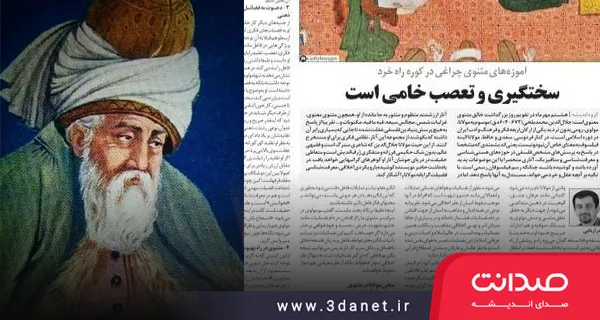
Rumi, in censuring people who imitatively cling to the hems of one another's robes while none of them knows the reason for the path the group is taking, likens them to a "circle of the blind":
What business have you in the circle of the blind? Bring the watchman into the midst.
3. Memory-Thinking
What we said earlier can also be expressed in this way: our thinking is a set comprising two elements: Material and Process. In the process we call thinking, knowledge and information are the material, and assessment and critique are the process. Undoubtedly, no set can function without both of these elements. We bring known facts to mind and, through their analysis and synthesis, arrive at new conclusions. In this sense, there is no doubt that known facts are necessary and useful for human life; however, possessing a stockpiled volume of memorized information has little value in and of itself. Especially today, the collection of information contained in a 10,000-volume library can easily be gathered onto a single computer CD. One who is merely engaged in collecting unexamined and undigested information from various sources is using his mind at the level of a "burned" CD, no more.
The place of the known fact is memory, and the place of thought is the mind. It is critical assessment that keeps thought alive and human thinking dynamic. From this perspective, one who contents himself with known facts and does not take the trouble to critique and process data should be called a memory-thinking person.
Memory-thinking is a destructive and harmful phenomenon. The memory-thinking person is imprisoned in an old and repetitive world of static images and thoughts. His mind is not connected to the flowing river of life, and his thinking constantly ruminates from the nosebag of memory. His entire world is the small jar of his mental constructs, a jar that has no access to the sea of existence and whose stale water has remained the same for years. The memory-thinking person has few new ideas in his mind, and if an idea is "new" to him, its newness is because it has just been borrowed. Of course, accumulating newer data does not resolve the problem of intellectual stagnation either; it merely causes the ever-increasing inflation of memory. The memory-thinking person is like a gardener whose orchard trees have become barren and yield no fruit, and what he has in his storehouse are fruits borrowed from others' gardens.
4. The Box of Forms
Memory-thinking is old thinking and old living. The memory-thinking person has no real connection with the outside world and lives within the narrow confines of their own mind. What they call thinking is the movement of the contents of memory to the mind and back again. Since the old-thinking person has closed the windows of their mind to new ideas and perspectives, their thinking does not entail learning or transformation, but is a circulation of a handful of known things in a closed circuit. Just like a small pond in which water appears to be flowing, but this flow is not the result of a connection to a living, natural spring, but rather due to the artificial pumping of water from a reservoir upwards and back again. It is obvious that in such a state, there is no freshness or renewal at work.
It is for this reason that Rumi considers a life arising from memory to be the "veil of God" and the cause of human suffering, saying:
Consciousness is from the memory of our past; your past and future are the veil of God.
In the Masnavi, the term "consciousness" (hushyari) means egoism, and here, being the "veil of God" is a metaphor for concealing the truths of existence. He says that the movement of thought along a line called past and future is the source of human egoism, meaning the cause of their bondage and misery. Because in such a state, a veil of memory-thinking falls over the human eye, obstructing their insight and vision. The rumination of memory prevents a person from truly looking at the world, and the severance of connection with the realities of the world is the deepest form of ignorance and blindness, an ignorance that is the cause of all human suffering:
Thought is of the past and the future; when one is freed from these two, the problem is solved.
Elsewhere, in an expressive depiction, he likens the world of the memory-thinking person to a narrow box.
His soul has not tasted the joy of freedom; the box of forms is his arena.
If he goes from one box to another, he is not heavenly; he is box-like.
He says the entire world of such an individual is the box of their old mental constructs. As long as a person has not looked at the world with a naked gaze, they have no liberation from the narrowness of the box of their own mentalities. Even if they imagine they have leaped from one place to another, such a movement is not a flight in open space, but a jump, a jump from the enclosure of one box to the narrowness of another box.
The mind can be likened to a pond in which pure, clear water is flowing. The water of the pond remains fresh and clear as long as a spring flows into it on one side and out on the other. The life of the pond and its creatures depends on this flow. If the flow of the spring water is cut off from either side, the pond will soon turn into stagnant water, and stagnant water into a swamp. Reading, thinking, and awakening dialogues are exactly like the spring that brings fresh water into the pond of the human mind and keeps its interior alive and flowing. Receptiveness to critique and the refinement of one's thoughts is like the outflow of water from the other side of the pond. A person without reading, thinking, and critiquing will drown in the swamp of closed thoughts and old notions and will lose the alertness of their mind.
5. Inner Captivity
Another predicament arising from memory-thinking is inner captivity. The suffering of the memory-thinking person is not merely their confinement within the boundaries of old and borrowed knowledge. The greater problem is their captivity in the bonds of environmental indoctrination. Since the memory-thinking individual assumes the possession of a handful of known things to be thinking, they fundamentally see no need for reflection and questioning and are alien to critique and discernment. And this is, of course, the very essence of compound ignorance: not knowing and the delusion of knowing. In social life, such a person is easily deceived by environmental suggestions and readily goes along with social, political, and behavioral waves, serving them involuntarily like a robot. No one can bind or exploit an intelligent, questioning human being. The deceitful and exploitative leaders, systems, and regimes of the world emerge, in the first instance, not by the force of the spear, but with the help of robotic, self-lost individuals, and it is by employing them that they continue their plunder and the spread of poverty, oppression, and misery.
6. Dogmatism and Prejudice
Rigor and prejudice are immaturity; so long as you are an embryo, your work is blood-drinking
I believe this couplet is among the most exquisite verses of the Masnavi, which beautifully displays the intelligence and subtlety of Rumi's thought in a miniature of simile and imagery. Rumi considers human tolerance and forbearance to be signs of maturity and greatness of spirit, and conversely, regards rigor and prejudice as arising from the smallness of thought and the narrowness of the human spirit and mind. A rigorous and dogmatic person is like a premature fetus who, in its narrow world, "drinks blood." He is dependent and powerless, and has no sign of the vast and expansive worlds.
The explanation of this concept is that in memory-based thinking, a person has no achievement other than what they have learned and accumulated. On the other hand, due to the weakness of the faculty of discernment, they are terrified of encountering unfamiliar ideas because they fear they will be unable to meet new challenges. The result of such a process is clinging ever more tightly to one's mental possessions and insisting upon them, and this is the inevitable point of the birth of prejudice and dogmatism. That is why we always see that what is in the sack of a memory-oriented person is a handful of information, guarded by the sentinel of prejudice, which prevents their transformation or replacement.
Dogmatism and prejudice have another cause as well. The difference between a dogmatic individual and a critical person is the difference between relying on ability and relying on possessions. For one who is familiar with questioning, the most valuable wealth is their power of critique and awareness. Therefore, they have no fear of intellectual transformation or changing their viewpoints, because what is important to them is the discovery of truth, and their security is obtained from living in the safe shade of truth. Their capital is their enlightenment, not their beliefs. The beliefs of such a person are merely a means for living better. For them, ideas are the means and a better life is the goal, and therefore they do not insist on preserving opinions; rather, what they insist on preserving is awareness and the search for truth.
But for one who is dogmatic, all their capital is their knowledge and opinions. Since the memory-oriented individual sees themselves as incapable of critiquing environmental teachings and producing new thoughts, they suffer from a deep and hidden sense of weakness and lack of self-confidence. The result is that to fill their void, they create an identity for themselves from their opinions, so as to appear strong and rich backed by them. It is no wonder that the memory-oriented person reduces themselves to the level of a guardian of the indoctrinated beliefs of their environment, because they conceive of the human being in the service of preserving belief, not belief in the service of safeguarding the human being.
6. Discernment and Peace
Another point is that thinking independently and living consciously does not entail war between the individual and society. The intelligent person is well aware that for peace and coexistence with society, they are not compelled to abandon their faculty of reason and intellect. A healthy and dynamic relationship is one in which the individual and the environment engage in mutual interaction for each other's growth and flourishing, and mutual critique in this relationship plays a vitalizing role. If everyone in a group is to follow one another, that society will very soon lose its power of sight, reform and progress within it will cease, and the river of its growth and fertility will turn into a stagnant and dangerous swamp.
Living and remaining conscious is only possible through critique and questioning. Not questioning what goes on around us will drag us into an intellectual and behavioral quagmire. With a passing glance, one can clearly see that critical individuals enjoy an intelligent and free life, while imitative people are caught in the spider's web of a blind and painful existence. The same is true, of course, for societies. The most fundamental characteristic of free and prosperous societies is that questioning, assessment, and research have become part of people's intellectual behavior, and imitation and cultural monologue have given way to questioning and intellectual and behavioral dialogue. Such a method always preserves a person's intellectual independence and alertness, and enables them to distinguish what is correct and rational from what is baseless and unreasonable, so they may live consciously and freely.
7. The Fruits of Discernment
Questioning and inquiry acquaint a person with different ideas and other perspectives, enrich their thought, and expand their world. Such breadth of awareness and intellectual expanse has several significant consequences.
A. Breadth of Vision: The first product of thinking is the quenching of the fire of prejudice and egotism. An aware person realizes that their values and beliefs are not necessarily the absolute truths of the universe but are always a product of their mode of thinking and the scope of their knowledge and assessment. For this reason, as we said earlier, the outlook and judgments of a wise person are always accompanied by a certain humility and readiness for self-critique and revision.
B. Peace and Friendship: The second fruit of this awareness is peace and friendship with others in one's feelings and thoughts. A thinking person, who does not consider their own values as absolute decrees or eternal laws, also grants the right of presence and expression to other values and beliefs. Since an intelligent person does not sacrifice the growth and maturation of their own thought to preserve a set of beliefs, they are always eager to hear and learn from new perspectives, and such an approach is a source of tolerance, acceptance of others, and peace, as well as a factor in the intellectual and behavioral growth and maturity of the thinking individual and society.
C. Inner Freedom: The third result of such a method is freedom from the bondage of intellectual and emotional captivity. A discerning person does not see themselves as bound and captive to the specific values of their own environment but is aware that what is promoted in their particular culture has arisen from the specific characteristics of their own society and environment, and therefore, like any other philosophy or viewpoint, has its own strengths and weaknesses and is naturally subject to critique and revision. With such an insight, the pressure of imposed and conflicting beliefs is lifted from the human psyche, and instead of passively submitting to the dictates and value judgments of the environment, one freely engages in assessment and choice.
What has been said, and hundreds of other unspoken points, reveals the vital role of thinking in the life of the individual and society and shows how essential critical thinking is for the liberation of humanity from the prison of ignorance, suffering, and prejudice. At the end of this discourse, I adorn this speech with an excerpt from the beautiful poem "The Garden of the Mind" by Mojtaba Kashani:
Our mind is a prison, we are prisoners within it
Break its lock, open its door,
And emerge from this dark pit
If you do not open it, my flower,
You will imprison yourself within it,
You will become the companion of ignorance within it,
The companion of the knowledge and wisdom of your own confines
Everyone is a prisoner in the cage of their own mind,
A mind without a window is without a message,
A mind without a window is filled with smoke
Let us open, in this darkness, an aperture
And build a window in it
Let us open the window a little
Let us send thought out to breathe some air
And go to the feast of the world
Our mind is a garden
Flowers must be planted in it
And if you do not plant, my flower,
Weeds will grow in it
Let us plant flowers, come,
So that weeds find no opportunity
Without adorning the mind with flowers, dear one,
A human will never become human.
.
.
Trapped in the Box
A Reflection on the Roots of Prejudice and Dogmatism
Author: Sasan Habibvand
Ways to contact the author:
email: sasan.habibvand@yahoo.com
telegram.me/sasanhabibvand
.
.


Discussion0 comments
No comments yet; let yours be the first voice.