Philosophy
Nader Arbabian's Essay 'Strictness and Bigotry Are a Sign of Immaturity'
In the Masnavi, Rumi goes beyond mysticism, employing an ethical and virtue-epistemological approach to improve the quality of thinking. By avoiding the promptings of the ego and using allegory, he safeguards the reader from intellectual error. An essay by Nader Arbabi.
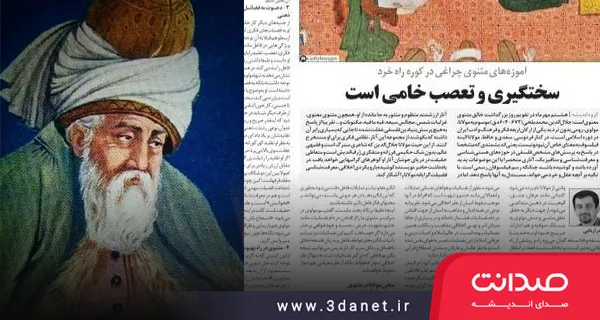
The Teachings of the Masnavi: A Lamp on the Path of Reason
Strictness and Bigotry Are a Sign of Immaturity
Nader Arbabian (Physician and M.A. Student of Moral Philosophy)
Published in Etemad Newspaper | Issue 4755 - Tuesday, 29 September 2020
Andisheh Group| The eighth of Mehr on the calendar marks the commemoration day of the creator of the Masnavi-ye Ma'navi: Jalal al-Din Muhammad Balkhi (604-672 AH), known as Molana, Mowlavi, Rumi. He is undoubtedly one of the four pillars of thought, culture, and literature in Iran during the Islamic period, alongside Ferdowsi, Sa'di, and Hafez. Molana, of course, was not and is not a philosopher in the specific sense of the term—that is, a thinker who, specifically in response to particular philosophical questions in the realms of ontology, epistemology, and metaphysics, produced works exclusively on these subjects and endeavored, as is the custom of official philosophers, to answer them with reasoned arguments by relying on what is called intellect and reason. However, in the valuable poetic and prose works left behind by him, such as the Masnavi-ye Ma'navi, the Ghazals of Shams, the Majales-e Sab'a, the Fihi Ma Fihi, the Maktubat, and so on, almost no fundamental philosophical question has been neglected, to the extent that many have been prompted to try to extract a system of thought for him from the totality of these works. In this respect, Molana Jalal al-Din, who is a great poet and a learned jurist, is without doubt a wise sage and a profound thinker, and a seeker of truth will find precious gems in the surging sea of his works. In the present note, the author has attempted, with an ethical approach, to reveal Molana's virtue-oriented epistemology.
When Molana's name is mentioned, words like mysticism, love, and divinity are evoked in the mind. On the other hand, because of Mowlavi's affiliation with the Sufi path in his conduct and character, and also his own explicit references to opposition to philosophy and philosophers, it is assumed that his way and method are far from the rational path, and the audience should only expect esoteric and illuminative methods in his works. However, throughout this writing, our intention is to show that this aversion to reason is the appearance of the matter, and in the inner meaning of Molana's words, at least in the Masnavi, there is great attention to thinking and the prevention of intellectual and mental error.
In the Masnavi, although Molana, in one dimension, sees the foundation of reasoning and the reasoners as wooden, insofar as it relates to the sciences and knowledge of his time, in another dimension, he shows the audience the many pitfalls on the path of thought and reflection, attention to which makes the audience's passage through this winding road much safer. In this respect, his work is very similar to that of philosophical thinkers, whose collective efforts in the way of right-thinking led to the formation and evolution of the "science of logic." But how does the improvement of thinking take place? Generally speaking, it can be said that the thinking skills of the Masnavi's audience are influenced and improved by the Masnavi in four ways. These four ways will be discussed below.
1- The Masnavi's Method of Expression, Which is Allegorical, Influences Thought
We know that Molana's Masnavi-ye Ma'navi is a didactic book, and its teachings are specifically delivered through allegory, which makes learning much easier and better for the audience. Allegory, in itself, alongside deduction and induction, is one of the methods of reasoning and can be both instructive for the audience (in terms of the content conveyed to them through allegory) and inspiring in terms of the method and mode of thinking, so that they too can use this method in the way of mutual understanding with others.
2- The Ethical Lessons of the Masnavi, Especially Where It Advises Distance from Carnal Desires, Lead to Improved Thinking and Fewer Errors
It is not hidden from anyone with even a slight familiarity with the Masnavi that throughout the Masnavi, abstaining from carnal desires and avoiding sensuality is recommended. He considers the self an idol that is the source of all evils. But the intention is to show where and how the idol of the self relates to the way of thinking. By sensuality and carnal desires, we mean inclinations and passions such as anger and lust, the excess of which causes the moral downfall of a human being. In almost all religions and creeds, humans have been warned against falling into the trap of sensuality, and in many places, the basis of the moral commands and prohibitions of religions and schools has been these very sensualities. In the Islamic world and in the religious and mystical literature of Islam, these sensualities have been interpreted as carnal desire, and according to Muslim scholars and mystics, the Quranic term *nafs-e ammāra* (the commanding self) refers to these very sensualities.
In the world of philosophy, the traces of sensuality and their influence on humans should be sought more in the virtue ethics school of Socrates, Plato, and Aristotle. Although the other two major schools of moral philosophy, namely utilitarianism and deontology, are also directly or indirectly, negatively or positively, related to the discussion of sensuality.
From sensuality to the method of thinking, from ethics to knowledge.
Knowledge is justified true belief. Epistemology is the discipline that seeks philosophical inquiry into knowing and searching for appropriate ways to believe any statement and discover the truth (veracity). The various mental methods used by humans for knowing and discovering knowledge are the main concern of epistemologists. For example, what reasoning was used to accept a matter, and whether this reasoning was appropriate or not. Of course, such issues are also examined in the science of logic, but in epistemology, all aspects of acquiring knowledge are discussed, including the connection of psychological and moral issues to the acquisition of knowledge. In other words, knowledge is influenced both by issues related to the realm of knowledge and by issues from the non-knowledge realm. Ms. Linda Zagzebski is one of the contemporary epistemologists who has focused more on the influence of the non-epistemic realm on knowledge. In this regard, her virtue epistemology theory is very famous. In her theory, she mentions both the influence of psychological factors such as feeling and emotion and the influence of moral factors such as virtue, vice, and will on knowledge.
She mentions two types of approaches to epistemology: A- Belief-centered approach; B- Ethics-centered approach.
In the belief-centered approach, which from her perspective is similar to the utilitarian approach to ethics, only the correctness and incorrectness of belief are considered, and the epistemologist's effort in this approach is to distinguish correct beliefs from incorrect ones as much as possible. However, in the second approach, which resembles virtue ethics, attention is paid to the agent and their virtuous characteristics, and in it, like virtue ethics, attention is paid to the agent's motivations, intentions, and inclinations, such that whichever direction these motivations take, they can influence the content of the agent's thought.
This is precisely the crux of our discussion. We said that Rumi, throughout the Masnavi, warns us against falling into the trap of sensuality such as anger, lust, greed, envy, and selfishness. If we look closely, these sensualities are also entirely concerned with the agent's intentions, motivations, and emotions, and in the language of moral philosophy, with virtues and vices. So we can conclude that an agent who is entangled in sensuality will suffer not only moral degeneration but also epistemic downfall.
Rumi's Words in the Masnavi
On the Connection Between Sensuality and Knowledge
Of course, Rumi himself had earlier, and even better, understood the connection of knowledge with non-epistemic issues and warns his audience that moving towards moral vices not only deprives him of spiritualities but also weakens and dulls his thought. From Rumi's perspective, surrendering to carnal desires is the main root of vices: "The mother of idols is the idol of your self," and it is these very vices that can hinder the roaming of thought. Therefore, he asks God to free the intellect that has been entrusted to his being from the bondage of carnal desire: "A drop of knowledge is in my soul / Deliver it from desire and the body's dust." Elsewhere, he considers the self to be the autumn of the intellect, which does not allow it to flourish: "That autumn, near God, is the self and desire / Intellect and soul are the very essence of spring and permanence."
Carnal desires cause our narrow-mindedness and rob us of the power of discernment: The scorpion knew not wheat from the carnal soul; / Discernment flees from one drunk with desire. Our eyes open only when we have freed ourselves from carnal whims: Whoever weaned himself from the habit of whim / Made his eye acquainted with the secret. Regarding the influence of carnal desires on our mental outlook, Rumi gives an interesting example; in his view, vices such as greed and envy are like a hair that has fallen over the eye: O brother, when you see his palace / It is because a hair has grown in your heart's eye // Keep the heart's eye pure of hair and defect / Then look to behold his palace.
Rumi clearly saw that misplaced emotions and motives can impair a person's intellectual vision and make him narrow-minded: Anger and lust make a man cross-eyed / They transform the spirit from uprightness. Everyone can observe such states in themselves; for instance, when we are under the influence of emotions like anger and fear, our opinion and belief will differ from when we are not under the influence of these emotions or are under the influence of opposing emotions like joy and calm. Not only emotions, but our desires, inclinations, and motives interfere with the kind of beliefs we hold. Essentially, when "purpose," whose place is in motivation, arrives, truth steps aside: When purpose came, virtue was concealed / A hundred veils went from the heart toward the eye. Sometimes the cause of erroneous thinking and bigotry lies in the presuppositions or the personal and psychological traits of the thinker; in these circumstances, he has usually already made up his mind about his beliefs and thoughts, and consequently, he cannot be convinced by reason: He said, any man who is of ill suspicion / Will not hear the truth from him with a hundred signs // Any inner self that becomes prone to fantasy / When you bring proof, its fantasy increases.
Rumi's description is clearly observable in pessimistic neurotic individuals. But the point is that even if we set aside mental disorders, degrees of delusion can be seen in apparently healthy people, and interestingly, as the ultimate cause, Rumi again holds the carnal soul (that is, the agent that turns toward vices) ultimately responsible: Why do you complain of God to me, O Salim? / Complain of the evil of that base carnal soul.
3. Invitation to Intellectual Virtues and Avoidance of Intellectual Vices
Another aspect of Linda Zagzebski's work is her renewed attention to intellectual virtues, which had also been previously addressed in Aristotelian virtue ethics. From her perspective, the presence of traits in an agent, such as having or lacking intellectual flexibility, bigotry, or imitation, should be considered among his intellectual virtues or vices, and naturally, possessing intellectual vices blocks the agent's path of thinking. In this regard, delving into the Masnavi shows us that Rumi not only paid attention to moral virtue and vice but also had intellectual virtue and vice in view. He clearly fights against bigotry, which is an intellectual vice: Strictness and bigotry are a sign of immaturity / While you are an embryo, your work is blood-drinking.
On the other hand, perhaps in the Islamic world, one rarely finds a thinker who has fought so explicitly and fundamentally against blind imitation as a kind of intellectual vice: Imitation has cast the people to the wind / O, may a hundred curses be upon this imitation. In his view, blind imitation ruins the intellect: Though your intellect flies upward / The bird of your imitation grazes in lowliness. If he sees imitation as a great vice on the path of thought, he conversely places great value on inquiry and the inquirer, and essentially sees an unbridgeable gap between the two: Between the inquirer and the imitator there are differences / For this one is like David, and that other is an echo.
Courage is an important virtue that matters both in ethics and in epistemology. Sometimes the cause of not knowing is "not wanting," and the cause of not wanting is the fear of confronting the truth. Kant makes an important and interesting point here: "Have courage to use your own understanding." Rumi also notes this point with great beauty and subtlety: Subtle points are sharp as a steel blade / If you have no shield, then retreat.
4. The Masnavi on the Path to Improving Critical Thinking
The first person to pay attention to the application of critical thinking in education was John Dewey[1], the twentieth-century pragmatist philosopher. Since then, critical thinking has expanded and developed further, finding its place in science education. Regardless of the numerous definitions of critical thinking, its spirit is to find a way to avoid error and not be deceived, and the Masnavi is also replete with warnings so that we might see deceptions. If we have some familiarity with the Masnavi and walk the path its creator shows us, we learn that one should not trust appearances, and in fact, we understand that the truth may be the opposite of what appears to the eye. Is this not the heart of critical thinking? In this topsy-turvy world, such is plenty / In their sight, a gem is less than worthless weed. We are usually deceived through our pleasure-seeking desires: Prudence is that which does not deceive you / The greasy, sweet traps of this abode.
.
.
Final Word:
Considering what has been said, we realize that the ocean of the Masnavi is not only spiritual and mystical gems, but contrary to the appearance of some of its creator's words, the Masnavi can be a bright lamp for us on the narrow path of reason. Another lesson the Masnavi teaches us for this time and all times is that not everything is solved merely through education and knowledge, and the mother of ignorance is not just illiteracy and lack of education; rather, ignorance and foolishness have an invisible connection to the realm of ethics and action. Perhaps here we can find a missing link that we have either not seen until now or have not taken seriously!
.
.
References:
Mohammad Balkhi. Masnavi-ye Ma'navi, based on the edition corrected by Reynold Nicholson
Linda Zagzebski. Epistemology, translated by Kaveh Behbahani. Ney Publishing
T zagzebski,Virtue of the mind. published by Cambridge University Press 1996
Hassan Ghazi-Moradi. An Introduction to Critical Thinking. Dat Publishing. Second Edition
.
.
[1] The first person to pay attention to the application of critical thinking in education was John Dewey, the twentieth-century pragmatist philosopher. Since then, critical thinking has expanded and developed further, finding its place in science education. Regardless of the numerous definitions of critical thinking, its spirit is to find a way to avoid error and not be deceived, and the Masnavi is also replete with warnings so that we might see deceptions.
Courage is an important virtue, significant both in ethics and in epistemology. Sometimes the cause of not knowing is "not wanting," and the cause of not wanting is the fear of confronting the truth. Kant makes an important and interesting point here: "Dare to use your own understanding!" Rumi also points this out with great beauty and subtlety: Points are sharp as a steel blade / If you have no shield, then turn back and flee.
.
.




Discussion0 comments
No comments yet; let yours be the first voice.