Literature
Zabihollah Kousha: Living with the Masnavi
Zabihollah Kousha traces his interest in Rumi to his family and discusses the link between Sohrab Sepehri's mysticism and the Masnavi in 'Peace with Being'. His book 'A Cup from the Pure Blue' collects the ghazal-like verses of the Masnavi and explores Rumi's passion for lyric poetry.
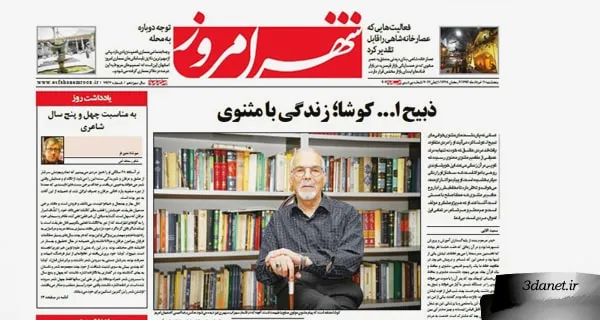
Saeed Aghaei / Isfahan-e Emrooz: “My late father was one of the founders of education in Shahreza, and at a time when there were seven or eight people running the first schools, he was one of them, while also being a poet and a dervish. On the mantelpiece of our house there was an old radio, the Masnavi, Hafez, and a leather-bound Quran. The Masnavi and Hafez were small print editions that my father would read aloud; he would sing the Masnavi in the Shur mode with a vocal melody and had a passion for it. I remember a few nights before his passing, when I was fourteen or fifteen years old, he told me to choose one of these two professions: either teaching or medicine. These two professions are not comparable in terms of income, and there is nothing in common between them; what they share is service to the people. My father saw it from this perspective. My mother was also very simple; she did not understand accounting, yet she knew the dates in the Gregorian, solar, and lunar calendars—what date it was today—but she did not know the difference between eight tomans, eight thousand, and eight million. That is, she was truly very simple in material matters and did not know formalities and such fancy talk. She paid no attention to worldly possessions at all.”
Zabihollah Kousha, a teacher of the Masnavi and author of a book on Rumi’s ghazal-like poems, who was born on June 2, 1949, speaks thus of his family background and recalls his elementary school days with a touch of regret: “I am sorry that in the elementary school we attended—and all elementary schools were like this at that time—at an age when we could have been influenced, they could have assigned us to memorize one ghazal of Hafez every week instead of the nonsensical essays we wrote. But they did not do this because they themselves did not know how, and they themselves were not inclined to it. I remember that the grammar book for the fifth and sixth grades of elementary school was by five masters. It was very rich; even though it was grammar, it was full of brilliant verses of Persian literature, and I read this grammar book for its poems because the poems were very beautiful and pleasant, as they were chosen by these great figures. After that, I went to high school, and because I was good at mathematics, I went into the mathematics track and studied economics at university, while my hidden passion was literature.”
Kousha continues: “In the late 1960s, when we were at university, the poems of political poets, or as they were called in those days, committed poets, were very popular, and people loved them and memorized them. I was not uninterested in them either, of course, especially the poems of Akhavan, which were epic and some also mystical. But the poems of Sohrab Sepehri were not very common, as they were mystical, and I remember at that time I was reading ‘The Sound of Water’s Footsteps’ and was fond of it, and I also learned of his passing in 1980. We then almost forgot about him during the war, and there was no mention of him.”
And now he moves a little further ahead, reaching the year 1988, and says: “In 1988, on one of those afternoons when I was browsing in bookshops as usual—which was my only pastime—I heard a tape playing: ‘I am from Kashan, but my city is not Kashan; my city is lost.’ I realized it was a poem by Sepehri with a beautiful voice. I asked, ‘Whose voice is this?’ They said, ‘It is Sepehri’s own voice.’ But I doubted it and said it must not be his own voice, and later we found out it was the voice of the late Khosrow Shakibai. In any case, after that, a kind of Sepehri-esque mysticism emerged in society. He was greatly influenced by Eastern mysticism, and these ideas were pursued in society. But I, due to my family background and the mindset I had, turned to the Masnavi from those years onward and studied various commentaries on the Masnavi. The tape of Shakibai’s voice and Sepehri’s poem was the beginning of a new chapter.”
The line “I am a poet from Kashan” reminds Kousha of concepts in poems from the Masnavi. On this, he quotes the Masnavi: “I who am ever at peace with this Father / This world is as Paradise to me, O son.” Kousha continues: “The Father here is existence. Rumi says I am at peace with all of existence, and therefore the world is paradise to me; I am at war with no one. Sephri says the same thing.” And he recalls Sephri where he says, “I do not know why they say the horse is a noble animal / the dove is beautiful / and why in a cage no one keeps a vulture / what does the clover flower lack compared to the red tulip?” In Kousha’s view, this too is peace. He says: “Many places in Sephri remind one of Rumi, but the overarching aspect is peace with existence and peace with creatures and nature, which is also in the Masnavi.”
Kousha says about understanding the Masnavi: “In 1992, I received Masnavi lessons in graduate and doctoral theology classes on tape. After the classes ended, I would go to Tehran myself.” And from here he turns to his book, “A Goblet from the Pure Water of the Nile,” and says: “There are places in the Masnavi where Rumi’s lyric mode flares up, and it is as if Rumi forgets he is composing a masnavi, and the fervor of Rumi’s lyricism emerges in the masnavi form. There is a group of poems in the Masnavi that I have named the ‘Ghazals of the Masnavi,’ and they are truly ghazals, belonging to those moments when the spirit of lyric composition overcomes Rumi. I looked more closely and saw that the late master Zarrinkoub had pointed out that in what relates to the themes of love and ghazal and the states of separation and union, some couplets of the Masnavi seem reminiscent of the ghazals of the Divan-e Kabir. Such rare couplets amid the mass of couplets and tales, of signs and discourses, are like flowers that have grown among rocks. These sentences are from the book ‘The Secret of the Reed,’ though they are not placed consecutively. I also saw brief material on this subject in the writings of the late Homa’i. For this work, I read the Masnavi from beginning to end twice, and each time I selected couplets that seemed to me to have the masnavi form and ghazal content. A ghazal has poetic content and has rhyme and radif, but in a masnavi the rhymes of each couplet match each other, and the content is mostly story, counsel, advice, and wisdom. In places in the Masnavi, Rumi unconsciously went into ghazal content using the masnavi form.”
Kousha, of course, continues with the same teacherly passion and enthusiasm born of the Masnavi: “The first thing I selected was the Ney-Nameh itself, which is the greatest ghazal. It came to about 2,000 couplets, which constitutes about eight percent of the total 25,000 couplets of the Masnavi. The collection of these became 100 pages. So I also brought the more difficult couplets and wrote annotations, and so that the annotations would not exceed the main text, I economized and reduced them, and its volume is roughly equal to the main text. I wanted to say that the annotations in this book are not sufficient. I worked on this book for two years. In 2000, I was undecided whether to publish it or not. At that time I was an employee, and publishing this book cost a little over a million, which I did not have. Someone who was interested and whose financial situation was not bad offered to help, whom I have also thanked here.” And then he says about the name of his book: “Rumi calls the Masnavi the water of the Nile, and says, ‘This life-increasing tale is the water of the Nile / O Lord, make it appear as blood in the eyes of the Copt.’ From the pure water of this Nile, I drew a goblet. But I also gave the book the subtitle ‘Ghazal-like Poems of the Masnavi’ to specify what it is.”
But what is Kousha’s most important teaching for his audience through the Masnavi class and lesson? He says: “The most important point is not teachable at all. The most important thing for me is for the audience to establish a connection with Rumi in such a way that it is an inner connection. I am not a literary scholar. I do not explain vocabulary. I define words to a minimal extent and do not go into the literary details of the poem. But what excites me is to feel that friends have connected with Rumi.”
When we asked him what he thought Rumi's most important message for an Iranian living today could be, Kousha says: "In fact, we have a message for Rumi: we kiss your hand for writing this book of mystical epic in the Persian language, and may his soul be blessed for doing so. In Rumi's time, 'nation' did not have its current meaning. Rumi said, the nation of the lover is separate from all nations. Therefore, Iran and non-Iran held no meaning for Rumi, and his message was one of unity, whereas Iran held meaning for Ferdowsi, who wanted to revive the Persian language, but Rumi has transcended borders, and Rumi's message is a message of unity."
.
.
PDF file of Isfahan Newspaper - 11 Khordad 96
.
.
Zabihollah Kousha: Living with the Masnavi
Source: Isfahan Newspaper - 11 Khordad 96 - Page 13
.
.



Discussion0 comments
No comments yet; let yours be the first voice.