Psychology
When Yalom Wept
At 86, from his hospital bed, Irvin Yalom continues to grapple with death. The psychotherapist who has spent decades teaching others how to face the fear of death now stands at its threshold, speaking of a life without regret.
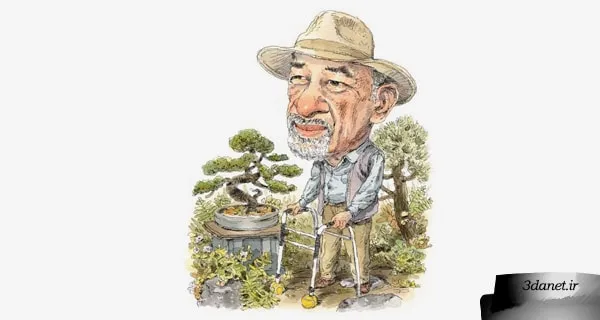
The name Yalom is familiar to Iranian readers, a psychologist whose books have sometimes been published in several different translations and whose novels have fans not only among psychologists but also among those interested in psychology and philosophy. One of the important issues Yalom has addressed throughout his professional life, and especially in his stories, is the issue of death; he has also provided psychological help to many people who were on the threshold of death. Now he is on a sickbed and preparing himself for death. Michel Smith has gone to visit him.
On a morning in May, Irvin Yalom, the existential psychotherapist, is spending his convalescence in a sunlit room on the ground floor of Palo Alto Hospital in California. He is wearing a green blouse and white trousers, though not the hospital uniform. He points out right away that his condition is not such that he needs to be in the hospital and under treatment so much. He says with a laugh: "I don't want [the piece you are going to write] to frighten my clients." Until last month, when he had knee surgery, he saw two or three clients a day, some in his office in San Francisco and the rest at his residence in Palo Alto. But, after the surgery, he feels dizzy and cannot concentrate very well. He tells me in a deep but calm voice: "They think the issue is neurological, but they don't know exactly what's going on." Despite all this, Yalom hopes to return home very soon; he turned 86 this June and is eagerly awaiting the publication of his latest book, Becoming Myself1, in October.
Several copies of the Times Literary Supplement and the New York Times Book Review magazine are on Yalom's bed, next to an iPad. In the hospital, he has been spending his time watching Woody Allen films and reading novels by the Canadian author Robertson Davies. Talking about one's own death is easy for someone who popularized the idea in American psychology circles that human conflicts can be the result of unresolved existential dilemmas, one of which is the fear of death.
Yalom says of his fear, the fear he has about his health condition: "Fear has not overcome me." Another of Yalom's specific ideas, which he has put forward in his books including Staring at the Sun2 and Creatures of a Day3, is that we can reduce our fear of dying by living without regret and remorse,
by thinking about our impact on future generations, and by sharing our death anxiety with those close to us. I asked Yalom whether his perennial preoccupation with death had made it easier to calm his thoughts, the thought that he might die soon. He replied: "I think this preoccupation makes it easier."
People from all over the world email Yalom daily hoping to resolve their existential fears. Yalom has created a label in his email called "Fans," which contains 4,197 emails from his admirers, admirers from various places: from Iran to Croatia and South Korea. He suggested I take a look at these emails, some of which were simple texts of thanks and expressions of appreciation for the insights Yalom's books had given them. In addition to textbooks and some non-fiction works, he has also written several novels and story collections. Some of these books have been bestsellers, including Love's Executioner (& Other Tales of Psychotherapy)4 and When Nietzsche Wept5.
As I was scrolling through the emails, he pressed a button with his cane to call the nurse. A voice came from the intercom, and he explained that he needed some ice for his knee. This was the third time he had called the nurses; he tells me his pain has made it hard to concentrate on anything, though he is trying.
Marilyn, his wife, who appears to be over 60, regularly brings him fresh reading material throughout Yalom's hospitalization. Georgia May, Yalom's colleague and friend and the wife of existential psychotherapist Rollo May, had visited him the day before. When he has nothing else to do, he works on his iPad or computer, and he handles all of this with dexterity.
Many of the fan emails are profound reflections on death. Some correspondents hope that Yalom can give them solace for their deep-seated problems. Most of the time, Yalom has replied to emails by suggesting they find a local therapist. But if someone has no therapist available and their issue is resolvable within a short timeframe—since Yalom, at this stage of his life, cannot work with a client for more than a year—he can make time for them remotely. He currently conducts his therapeutic work with clients from Turkey, South Africa, and Australia via the internet. In his view, if we set aside obvious cultural differences, remote clients are not much different from in-person clients. He says: "If we have lived a life full of regret and remorse, full of things undone, if we have lived an unfulfilled life, when death comes for us, it will be far more terrifying. I think this holds true for all of us."
Becoming Myself is specifically the memoir of a therapist's life. He reads the opening line to me: "I awake in the middle of the night, at three A.M., weeping into my pillow." Yalom's nightmare traces back to an incident in his childhood where he insulted a girl. Most of the book is about the influences and factors his adolescence had on his life, especially his relationship with his mother. Quoting Charles Dickens, he writes: "I travel in a circle, for the nearer and nearer I am drawn toward the end, the closer and closer I feel I have come to the beginning."
Yalom first gained his reputation among psychotherapists from the book The Theory and Practice of Group Psychotherapy6. Published in 1970, this book argues that group therapy is a microcosm of our everyday lives and that addressing the relationships within a therapy group can have significant therapeutic effects outside the group. Nurses come and go from the room, and meanwhile he tells me: "Next year I will do the sixth revision of my book." He sits in the chair by the window, fidgeting. His beard line seems longer without his usual Panama hat.
Although he stopped teaching years ago, he says that as long as he is able, he sees clients in the backyard of his villa. His villa is a scaled-down model of a human cave, filled with books by Friedrich Nietzsche and the Stoic philosophers. Outside this garden, there are bonsai trees; deer, rabbits, and foxes are occasionally seen around the garden. In Becoming Myself, he writes: "When I feel weary, I go outside and warm myself with my bonsai: pruning, watering, and admiring their beautiful forms."
Yalom sees every problem that arises in therapy as a puzzle, a puzzle that he and the client must collaborate to solve. He elucidated this process in Love's Executioner, a book containing ten stories of his clients in therapy: true stories from his work, in which the names have been changed but the other details remain largely unaltered. These stories focus not only on his clients' suffering but also encompass his own feelings and thoughts as a therapist. He tells me: "I want to highlight the human aspects of therapy to show that the therapist is a real human being."
At first glance it may not seem like a bestseller, but when it came out in 1989 it was a commercial success and has sold briskly ever since. In 2003, a critic named Laura Miller officially deemed it representative of a new genre. Love’s Executioner, as Miller wrote in the New York Times, showed that “psychological case studies offer readers something that today’s short stories do not: the search for secrets, the arousing of curiosity, deep emotions, plot.”
Today, people around the world who email Yalom know him mostly through his books, which have been translated into many languages. Yalom, like David Hasselhoff, may be more famous outside America than within it. Perhaps the reason for Yalom’s lesser reception in America is the religious prejudices of many American readers and their insistence on happy endings. Mondays with Yalom is not like Tuesdays with Morrie7. To religious readers, Yalom can be a frightening figure. He does not believe in an afterlife; he says his anxiety about death is soothed by the belief that what comes after life is the same as what existed before it. It is no wonder he tells me his religious audiences are disinclined to be drawn to his books.
Yalom is forthright about the hardships of old age, both in his personal life and in his memoirs. When two of his close friends recently died, he found that the consoling memories of their friendship were all that remained. He says with sadness, “The thought has sprouted in my mind that there is no reality beyond this. When I die, it will all be gone.” The thought of leaving Marilyn is agonizing for him. He is also terrified of his physical condition worsening. He now uses a walker with tennis balls on its legs and has recently become more frail. He coughs repeatedly during our meeting; when I emailed him a month after our visit, he was feeling better, but said this of his fear regarding his physical state: “Those few weeks were the worst days of my life.” He can no longer play tennis or scuba dive, and he fears the day will come when he cannot ride a bicycle. In Becoming Myself, he writes: “Growing old is losing one thing after another.”
In his book, he emphasizes that love can lessen death anxiety, and it does so in two ways: first, by providing a space for people to share their fears with one another, and second, by helping each other to live well. Marilyn is a capable feminist and literary scholar who shares a great intellectual affinity with Yalom. She is Yalom’s hope for life and makes him continue living as strongly as possible; this very fact has made death agonizing for him. At one point in our conversation, he says: “My wife is my equal, book for book.” Although he has a folder in his email titled “Writing Ideas,” he says he may ultimately run out of ideas for his books. Meanwhile, Marilyn tells me she recently helped her friend, the wife of a Stanford professor, write an obituary for her husband. Marilyn says, “That is the reality of where we live.”
Yalom, early in his existential psychotherapy career, was astonished by how much comfort people found in articulating their existential pains. In Staring at the Sun, he writes: “We are alone in dying, the loneliest event of life.” Nevertheless, empathy and forming connections can greatly reduce our human anxiety about death. In the 1970s, when he began working with clients who had a terminal form of cancer, he noticed they were heartened by the idea that they could be a model for others by dying with value.
The terror of death can strike anyone at any time, and it can have life-altering effects, whether positive or negative. Yalom wrote somewhere: “For those with a deep and entrenched resistance to openness—those who have always shied away from deep friendships—the issue of death can be a jarring experience and greatly alter their inclinations toward forming intimate relationships.” Those who have lived an unlived life can change their priorities in the remaining time they have. As one of the nurses brings his pills, he tells me: “The same was true of Ebenezer Scrooge.”
Existential psychotherapy, for all its dreadfulness, is profoundly life-affirming. Change is always possible. Intimacy can bring freedom. Existence is precious. Yalom, praising a metaphor the scientist Richard Dawkins used to illustrate the fleeting nature of existence, says: “I hate the thought of having to leave this life and this extraordinary world.” Imagine a ruler representing billions of years of this universe. There is a luminous point on this ruler that is the present moment. Everything to the left of this luminous point is over; and to the right of this ruler is an unknown future. The chance that we are at this luminous point—that is, alive and living—is infinitesimally small; yet, this chance has been granted to us, and here we are.
Yalom’s perception of death is soothed by the sense that he has lived well. He says quietly: “Looking back, I have had many successes and few regrets.” He continues: “There is an inner impulse in all of us that wants to survive, wants to live.” He pauses and says: “I hate to see life end.”
.
.
How to Die
As a psychotherapist, Irvin Yalom has helped others grapple with their mortality. Now he is preparing for his own end.
ne morning in may, the existential psychotherapist Irvin Yalom was recuperating in a sunny room on the first floor of a Palo Alto convalescent hospital. He was dressed in white pants and a green sweater, not a hospital gown, and was quick to point out that he is not normally confined to a medical facility. “I don’t want [this article] to scare my patients,” he said, laughing. Until a knee surgery the previous month, he had been seeing two or three patients a day, some at his office in San Francisco and others in Palo Alto, where he lives. Following the procedure, however, he felt dizzy and had difficulty concentrating. “They think it’s a brain issue, but they don’t know exactly what it is,” he told me in a soft, gravelly voice. He was nonetheless hopeful that he would soon head home; he would be turning 86 in June and was looking forward to the release of his memoir, Becoming Myself, in October.
Issues of The Times Literary Supplement and The New York Times Book Review sat on the bed, alongside an iPad. Yalom had been spending his stay watching Woody Allen movies and reading novels by the Canadian writer Robertson Davies. For someone who helped introduce to American psychological circles the idea that a person’s conflicts can result from unresolvable dilemmas of human existence, among them the dread of dying, he spoke easily about his own mortality.
“I haven’t been overwhelmed by fear,” he said of his unfolding health scare. Another of Yalom’s signature ideas, expressed in books such as Staring at the Sun and Creatures of a Day, is that we can lessen our fear of dying by living a regret-free life, meditating on our effect on subsequent generations, and confiding in loved ones about our death anxiety. When I asked whether his lifelong preoccupation with death eases the prospect that he might pass away soon, he replied, “I think it probably makes things easier.”
The hope that our existential fears can be diminished inspires people around the world to email Yalom daily. In a Gmail folder labeled “Fans,” he had saved 4,197 messages from admirers in places ranging from Iran to Croatia to South Korea, which he invited me to look at. Some were simply thank-you notes, expressions of gratitude for the insights delivered by his books. In addition to textbooks and other works of nonfiction, he has written several novels and story collections. Some, such as Love’s Executioner & Other Tales of Psychotherapy and When Nietzsche Wept, have been best sellers.
As I scrolled through the emails, Yalom used his cane to tap a button that alerted the nurses’ station. A voice came through the intercom, and he explained that he needed some ice for his knee. It was the third time he’d called; he told me his pain was making it difficult to concentrate on anything else, though he was trying. Throughout his stay, his wife of more than 60 years, Marilyn, had been stopping by regularly to refresh his reading material. The day before, he’d had a visit from Georgia May, the widow of the existential psychotherapist Rollo May, who was a colleague and friend of Yalom’s. When he runs out of other things to do, he plays on his iPad or his computer, using them with the dexterity of someone half his age.
Many of Yalom’s fan letters are searing meditations on death. Some correspondents hope he will offer relief from deep-seated problems. Most of the time he suggests that they find a local therapist, but if one isn’t available and the issue seems solvable in a swift period—at this point in his career, he won’t work with patients for longer than a year—he may take someone on remotely. He is currently working with people in Turkey, South Africa, and Australia via the internet. Obvious cultural distinctions aside, he says his foreign patients are not that different from the patients he treats in person. “If we live a life full of regret, full of things we haven’t done, if we’ve lived an unfulfilled life,” he says, “when death comes along, it’s a lot worse. I think it’s true for all of us.”
Becoming myself is clearly the memoir of a psychiatrist. “I awake from my dream at 3 a.m., weeping into my pillow,” reads the opening line. Yalom’s nightmare involves a childhood incident in which he insulted a girl. Much of the book is about the influence that his youth—particularly his relationship with his mother—has had on his life. He writes, quoting Charles Dickens, “For, as I draw closer and closer to the end, I travel in the circle, nearer and nearer to the beginning.”
Yalom first gained fame among psychotherapists for The Theory and Practice of Group Psychotherapy. The book, published in 1970, argues that the dynamic in group therapy is a microcosm of everyday life, and that addressing relationships within a therapy group could have profound therapeutic benefits outside of it. “I’ll do the sixth revision next year,” he told me, as nurses came in and out of the room. He was sitting in a chair by the window, fidgeting. Without his signature panama hat, his sideburns, which skate away from his ears, looked especially long.
Although he gave up teaching years ago, Yalom says that until he is no longer capable, he’ll continue seeing patients in the cottage in his backyard. It is a shrink’s version of a man cave, lined with books by Friedrich Nietzsche and the Stoic philosophers. The garden outside features Japanese bonsai trees; deer, rabbits, and foxes make occasional appearances nearby. “When I feel restless, I step outside and putter over the bonsai, pruning, watering, and admiring their graceful shapes,” he writes in Becoming Myself.
For all its morbidity, existential psychotherapy is deeply life-affirming.
Yalom sees each problem encountered in therapy as something of a puzzle, one he and his patient must work together to solve. He described this dynamic in Love’s Executioner, which consists of 10 stories of patients undergoing therapy—true tales from Yalom’s work, with names changed but few other details altered. The stories concentrate not only on Yalom’s suffering patients but also on his own feelings and thoughts as a therapist. “I wanted to rehumanize therapy, to show the therapist as a real person,” he told me.
That might not sound like the stuff of potboilers, but the book, which came out in 1989, was a commercial hit, and continues to sell briskly today. In 2003, the critic Laura Miller credited it with inaugurating a new genre. Love’s Executioner, she wrote in The New York Times, had shown “that the psychological case study could give readers what the short fiction of the time increasingly refused to deliver: the pursuit of secrets, intrigue, big emotions, plot.”
Today, the people around the world who email Yalom know him mostly from his writing, which has been translated into dozens of languages. Like David Hasselhoff, he may well be more of a star outside the United States than at home. This likely reflects American readers’ religiosity and insistence on happy endings. Mondays with Yalom are not Tuesdays With Morrie. Yalom can be morbid, and he doesn’t believe in an afterlife; he says his anxiety about death is soothed somewhat by the belief that what follows life will be the same as what preceded it. Not surprisingly, he told me, highly religious readers don’t tend to gravitate toward his books.
Yalom is candid, both in his memoir and in person, about the difficulties of aging. When two of his close friends died recently, he realized that his cherished memory of their friendship is all that remains. “It dawned on me that that reality doesn’t exist anymore,” he said sadly. “When I die, it will be gone.” The thought of leaving Marilyn behind is agonizing. But he also dreads further physical deterioration. He now uses a walker with tennis balls on the bottoms of the legs, and he has recently lost weight. He coughed frequently during our meeting; when I emailed him a month later, he was feeling better, but said of his health scare, “I consider those few weeks as among the very worst of my life.” He can no longer play tennis or go scuba diving, and he fears he might have to stop bicycling. “Getting old,” he writes in Becoming Myself, “is giving up one damn thing after another.”
In his books, Yalom emphasizes that love can reduce death anxiety, both by providing a space for people to share their fears and by contributing to a well-lived life. Marilyn, an accomplished feminist literary scholar with whom he has a close intellectual partnership, inspires him to keep living every bit as much as she makes the idea of dying excruciating. “My wife matches me book for book,” he told me at one point. But although Yalom’s email account has a folder titled “Ideas for Writing,” he said he may finally be out of book ideas. Meanwhile, Marilyn told me that she had recently helped a friend, a Stanford professor’s wife, write an obituary for her own husband.* “This is the reality of where we are in life,” she said.
Early in Yalom’s existential-psychotherapy practice, he was struck by how much comfort people derived from exploring their existential fears. “Dying,” he wrote in Staring at the Sun, “is lonely, the loneliest event of life.” Yet empathy and connectedness can go a long way toward reducing our anxieties about mortality. When, in the 1970s, Yalom began working with patients diagnosed with untreatable cancer, he found they were sometimes heartened by the idea that, by dying with dignity, they could be an example to others.
Death terror can occur in anyone at any time, and can have life-changing effects, both negative and positive. “Even for those with a deeply ingrained block against openness—those who have always avoided deep friendships—the idea of death may be an awakening experience, catalyzing an enormous shift in their desire for intimacy,” Yalom has written. Those who haven’t yet lived the life they wanted to can still shift their priorities late in life. “The same thing was true with Ebenezer Scrooge,” he told me, as a nurse brought him three pills.
For all the morbidity of existential psychotherapy, it is deeply life-affirming. Change is always possible. Intimacy can be freeing. Existence is precious. “I hate the idea of leaving this world, this wonderful life,” Yalom said, praising a metaphor devised by the scientist Richard Dawkins to illustrate the fleeting nature of existence. Imagine that the present moment is a spotlight moving its way across a ruler that shows the billions of years the universe has been around. Everything to the left of the area lit by the spotlight is over; to the right is the uncertain future. The chances of us being in the spotlight at this particular moment—of being alive—are minuscule. And yet here we are.
Yalom’s apprehension about death is allayed by his sense that he has lived well. “As I look back at my life, I have been an overachiever, and I have few regrets,” he said quietly. Still, he continued, people have “an inbuilt impulse to want to survive, to live.” He paused. “I hate to see life go.”
.
.
Notes:
* This piece was written by Jordan Michael Smith and published on September 22, 2017, under the title «How to Die» on the website of The Atlantic. The website Tarjomaan published it on September 25, 2017, under the title «When Yalom Wept» in a translation by Sajjad Sargoli. ** Jordan Michael Smith is the author of the book Humanity: How Jimmy Carter Lost an Election and Transformed the Post-Presidency. His writings have appeared in the Boston Globe, Foreign Policy, and The New Republic.
[۱] Becoming Myself [۲] Staring at the Sun [۳] Creatures of a Day [۴] Love’s Executioner & Other Tales of Psychotherapy [۵] When Nietzsche Wept [۶] The Theory and Practice of Group Psychotherapy
[۷] Tuesdays With Morrie: Tuesdays with Morrie is a book by the American author Mitch Albom, published in 1997, and was a bestseller. The main character of the story is ill; his disease gradually disables the body's organs and causes cellular death of the body's tissues and muscles. Morrie has accepted death; he will die, but in his final days, he seeks to attain perfection [Translator].
.
.
Jordan Michael Smith
Translation by: Sajjad Sargoli
Source: Atlantic
.
.




Discussion0 comments
No comments yet; let yours be the first voice.