Philosophy
A Collection of Errors in Translation
Mohammad Mehdi Ardebili reviews the Persian translation of Robert C. Solomon's French and German Philosophy. This edition is unchanged from the one published some eighteen years ago, and its mass of errors and omissions renders it unusable.
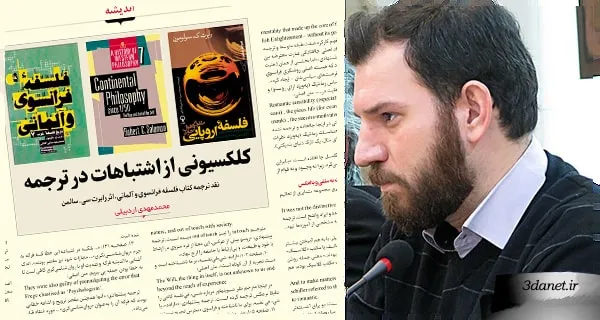

Mohammad Mahdi Ardabili
AuthorMohammad Mehdi Ardebili: A book has recently been published bearing the title “French and German Philosophy” by “Robert Ch. Solomon,” translated by Mohammad Saeed Hanaei-Kashani. Of course, Robert C. Solomon does not have a book with such a title, but with a little attention one can discern that this is the seventh volume of the Oxford History of Philosophy, which the Persian translator published about 18 years ago under its true name—if we overlook the error of translating continental philosophy as “European philosophy”—namely, “The Rise and Fall of the Self in European Philosophy.” The book was well received at the time, and the author of these lines himself read it eagerly and benefited from it, although many ambiguities and deficiencies were evident during its study.
Years later, when, at the suggestion of another publisher, I undertook a retranslation of this book, I naturally compared parts of my translation with Mr. Hanaei-Kashani’s translation, and the result was astonishing. The Persian translation of the book was full of editorial and translational errors, large and small, to the extent that one could scarcely find a page without glaring mistakes. Of course, errors in translation are inevitable in philosophical works, and the author of these lines has certainly committed them unintentionally as well. Some errors stem from carelessness and negligence, which must be rectified with extra diligence, and some arise from weakness in understanding the source language, which must be corrected by improving one’s language proficiency. Editorial errors also largely result from a lack of mastery of the target language. In any case, on the one hand, years had passed since the book’s publication, and it had long been out of print; consequently, I saw no need to write a critique of it, and on the other hand, I had no access to the esteemed translator to convey my critical points. After the reissue of this work in the winter of 2018, I had hoped that over these nearly two decades, the author would have at least undertaken a thorough rereading and editing of the work and would have compared the entire text against the English original at least once, rectifying the glaring and elementary errors. However, upon examining the recent edition, I realized that none of this had happened. The author, at best, merely replaced a few obsolete terms with some other terms and did not revise the main structure of the work at all. Even on the book’s cover, the incorrect spelling of the author’s name, “Robert Salman,” was not corrected, and only the first letter of the middle name was changed, and that too incorrectly. Evidence of this claim is that all the glaring errors, grammatical mistakes, and even omissions—from a single word to an entire sentence—unfortunately still appear in the text. In this note, I will confine myself solely to mentioning the most egregious of these grammatical errors and instances of negligence, and I will refrain from citing dubious cases or even suggestions for improving the text, so as not to give cause for my entire critique to be accused of being subjective or nitpicking and placed under the category of “translation critiques” that are overflowing with personal, factional, and group biases. Consequently, the present note, unlike my other critiques in the field of book translation, has nothing to do with the book’s content, its critique, or its introduction, and merely attempts to show that the recently published Persian translation, like its predecessor from the late 1990s, is riddled with errors and unusable. I will also refrain from critiquing the translator’s terminology, which has sometimes employed irrelevant words in translation (such as “European” instead of continental; “thought” instead of idea in Hegel’s philosophy; “reformist” instead of radical!; “quasi-mechanical” instead of mechanistic; “homogeneous” instead of organic; “correct” instead of orthodox; “tribes” instead of people, etc.). Ultimately, however, it must be boldly claimed that the roughly thirty selected instances below are merely a drop in the ocean of the translation’s numerous flaws. One could have confined oneself to mentioning only a few cases, but would it not then have been possible to evade criticism under the pretext that some errors are natural in translation? Even so, the errors below encompass only a small portion of the total flaws, and dozens more could be added to them.

To clarify the discussion, I have divided the criticisms into three categories: omissions, the conversion of positive themes and verbs into negative ones and vice versa, and carelessness and syntactical errors:
.
.
A) Omissions:
1. Page 5: "The method of the empiricists – however opposed to Descartes – had strengthened the emphases on experience and introspective reflection, and the emphases on the nature of the identity of the self." Original text:
The method of the empiricists – however opposed to Descartes – strengthened the emphases on experience and introspective reflection, on nature of the identity of the self, and on the importance of the first-person standpoint.
Suggested translation: "The method of the empiricists – however opposed to Descartes' method – intensified the emphasis on experience and introspective reflection, on the nature of the identity of the 'self,' and also on the importance of the first-person standpoint." It is clear that the translation of the entire phrase "and on the importance of the first-person standpoint" has been omitted from the Persian translation.
2. Page 17: "... gives us the main thread in the fabric of the story of modern European philosophy, even if these terms are not much used after the end of the nineteenth century. On the Enlightenment side, there is a heavy emphasis on science and universal principles of rationality. But what these two movements share is as important as their disagreements."
Original text:
... the main thread of the story of modern European philosophy, even if these terms are not much used after the turn of the nineteenth century. On the Enlightenment side is the heavy emphasis on science, universal principles, and rationality. On the romantic side are deep doubts about science, and reliance on intuition and feeling rather than reason. But what they share is as important as their disagreements.
This passage has two very glaring flaws. One is that the translator rendered the term "the turn of the nineteenth century" as "the end of the nineteenth century," whereas it should have been translated as "the beginning of the nineteenth century," consequently shifting the time by a century historically. But more importantly, the translator has precisely omitted one sentence. That is, the sentence "On the romantic side are deep doubts about science, and reliance on intuition and feeling rather than reason," meaning "On the romantic side, very deep doubts about science were raised, and reliance was placed on intuition and feeling rather than reason."
3. Page 61: "But this movement was also part of the same middle class and urban mentality that formed the core of the French and English Enlightenment." Original text:
But it was part of the same middle-class, urban mentality that made up the core of the French and English Enlightenment – without its political opportunities.
Regardless of the error in understanding the function of the adjective "middle-class" and translating it as an independent noun, the main flaw is the omission of the parenthetical phrase between the dashes. Suggested translation: "But it was part of the same middle-class, urban mentality that created the core of the French and English Enlightenment – albeit without their political opportunities."
4. Page 90: "... Romantic feeling (especially Rousseau's views) and the life arising from the motivation for success in..." Original text:
Romantic sensibility (especially the views of Rousseau) , the pious life (for example, of a Benedictine monk) , the success-motivated life of ...
It is clear that the middle phrase here has been omitted and not translated. Suggested translation: "... Romantic sensibility (especially the views of Rousseau), the pious life (for example, of a Benedictine monk), the success-motivated life of..."
5. Page 134: An entire sentence has been omitted: "Therefore, Meinong avoided idealism, because neither existence nor subsistence are features of consciousness."
ب) تبدیل مضامین و افعال مثبت به منفی و بالعکس
٦. صفحه ١٠: «جنبش روشنگری مجموعه متمایزی از تعالیم بود... اما...». متن اصلی:
It was not the distinctive set of doctrines … but …
جمله دقیقا معکوس ترجمه شده و ایراد واضح است. ترجمه درست: «هرچند روشنگری مجموعه مشخصی از آموزهها نبود... اما...».
٧. صفحه ٦١: «و هم او و هم شیلر، با به هم آمیختن بیشتر مطالب، خودشان را همانقدر مخالف با مکتب «کلاسیک» میدانستند که مخالف مکتب رمانتیک بودند.» معنی جمله روشن است: [گوته] و شیلر، هر دو، هم مخالف مکتب کلاسیک بودند هم مخالف مکتب رمانتیک! متن اصلی:
And to make matters more confusing, both he and schiller referred to themselves as ‘classic’ as opposed to romantic.
ترجمه پیشنهادی دقیقا برعکس است: «و برای آشفتهتر کردن اوضاع، هم او و هم شیلر در تضاد با رومانتیکها، خود را «کلاسیک» مینامیدند».
٨. صفحه ٨٤: «... از الگوی صرفا روشناندیش سلطنتِ مشروطه پروس استفاده میکند». یعنی سلطنت مشروطه پروسی، حکومتی صرفا روشناندیش است؟! متن اصلی:
… he follows the barely enlightened model of the Prussian constitutional monarchy.
مترجم با فهم نادرست قید barely جمله را حدودا معکوس ترجمه کرده است. ترجمه پیشنهادی: «از الگوی سلطنت مشروطه پروسی پیروی میکند که به زحمت میتوان آن را محصول روشنگری دانست».
٩. صفحه ٨٧-٨٨: «روسو بیش از هرکس دیگری این معنا از فرد بریده از خودش و طبیعت، و بریده از جامعه را گرامی داشت». حتی اندک آشنایی با اندیشههای طبیعتگرایانه روسو باید مخاطب را متوجه ایرادی در ترجمه کند. متن اصلی:
Rousseau more than anyone else celebrated this sense of the isolated individual in touch with himself and nature, and out of touch with society.
مترجم in touch را نیز out of touch دیده است. ترجمه پیشنهادی: «روسو بیش از هرکس، این معنا از فرد منزوی در ارتباط با خود و طبیعت، و بیارتباط با جامعه را ارج نهاد».
١٠. صفحه ١٠٢: «اراده، شیءفینفسه، بر ما ناشناخته است و دست تجربه از آن کوتاه است». متن اصلی:
The Will, the thing in itself, is not unknown to us and beyond the reach of experience
در اینجا مترجم نظر شوپنهاور درباره شیء فینفسه کانتی را دقیقا برعکس ترجمه کرده است. ترجمه پیشنهادی: ««اراده»، یا شیء فی نفسه، برای ما ناشناخته و فراسوی دسترس تجربه نیست»
١١. صفحه ١٠٥: «شوپنهاور... اصرار میورزد که ضمیر ناآگاه سطح محض ذهن است...». متن اصلی:
Schopenhauer … insists that consciousness is the mere surface of the mind.
مترجم با ترجمه consciousness به ضمیر ناآگاه (! ) معنای جمله را معکوس کرده است. ترجمه پیشنهادی: «شوپنهاور... تأکید کرد که آگاهی صرفا سطحِ ذهن است».
١٢. صفحه ١٠٧: «کسی نمیتواند پارسایی یا دمدمیمزاجبودن را برگزیند». متن اصلی:
One can no more choose to be saintly or not to be moody.
ترجمه پیشنهادی: «نمیتوان پرهیزگار بودن یا دمدمی نبودن را انتخاب کرد». در اینجا نیز بخشی از جمله منفی ترجمه شده است. نکته جالب این است که این عبارت در نسخه قبلی (چاپ ١٣٧٩) چنین آمده است: «کسی نمیتواند پارسایانه بودن یا دمدمی مزاج بودن را برگزیند». این امر نشان میدهد که در ویراست جدید نه به مقابله با متن اصلی، بلکه صرفا به روانترسازی فارسی بسنده شده است.
١٣. صفحه ١٣١: «... بلکه در اشاعه این خطا که فرگه به جرم «روانشناسینگری»... مجازات شود نیز مقصر بودند». اندک آشنایی با اندیشه فرگه و ضدیت او با روانشناسیگری کافی است تا به خطا بودن جمله پی ببریم. متن اصلی:
They were also guilty of promulgating the error that Frege chastised as ‘Psychologism’.
Suggested translation: “They were also guilty of promoting and disseminating the error that Frege criticized as ‘psychologism’...” 14. Page 136: “Stumpf... believed that truth is not a property of the contents of consciousness.” Original text:
Stumpf held that truth was a property of the contents of consciousness.
It is clear that the translator has once again rendered a positive verb as negative. Suggested translation: “Stumpf held the belief that truth is a property of the contents of consciousness.” 15. Page 143: “Dilthey’s historicism had already heralded a new era in which the incommensurability of world-views, rather than being a premise, became a dubious conclusion.” Original text:
Dilthey’s historicism already heralded a new era in which the incommensurability of world-views would become more of a premiss than hesitant conclusion.
Again, the second part of the sentence has been translated in reverse. Suggested translation: “Dilthey’s historicism already heralded a new era in which the incommensurability of various world-views would become more of a preliminary premise than a hesitant conclusion.”
C) Carelessness and Syntactic Errors
16. Page 7: “This claim... also justified unlimited tolerance for patriotism and self-righteousness.” Original text:
tolerance for paternalism and self-righteisness...
It is clear that, aside from the awkwardness of the Persian translation, the translator mistakenly read paternalism as patriotism. 17. Page 10: “Of course, it is true that the Enlightenment movement was often considered strange by Church authorities.” A moment’s reflection on the Persian meaning of this phrase would raise doubts even in a novice reader. Original text:
It is true that the Enlightenment was often at odds with Church authorities
The problem is clear. The translator has confused the idiom “at odds with” with the meaning of the adjective “odd” (meaning strange) and has consequently produced an entirely incorrect translation. Suggested translation: “It is true that the Enlightenment was often in conflict with the authority and power of the Church.”
18. Page 26: “And what is yet stranger is the scarcity of his natural and urgent wants, and the multitude of his intense desire for his passions...” Original text:
And what is yet stranger, the less natural and pressing his wants, the more headstrong are his passions …
The translator is unaware of the grammatical construction “the less … the more …” and has therefore translated the sentence completely incorrectly. Suggested translation: “And what is yet stranger: the less natural and urgent the object of his demand, the more headstrong his passions become.”
19. Page 31: “But in Germany the political situation was such that reform was everything but something that could not be conceived.” The meaning of the above phrase is truly vague and incomprehensible. Original text:
But in Germany the political situation was such that reform was all but unthinkable.
It becomes clear that the translator did not grasp the translation of the idiom “all but” (meaning almost) and twisted the sentence so much that it became incomprehensible. Suggested translation: “But in Germany the political situation was such that reform was almost unthinkable.”
20. Page 46: “Knowledge is important for Kant, but he summarizes his own philosophy because it is necessary ‘to limit knowledge in order to make room for faith’.” The meaning of this statement is that Kant summarizes his own philosophy in order to make room for faith! The sentence’s meaning is ambiguous and unintelligible. Original text:
Knowledge is important for Kant, but he summarized his own philosophy as the need to ‘limit knowledge in order to make room for faith’.
Suggested translation: “Knowledge is important for Kant, but he sums up his philosophy thus: the need to ‘limit knowledge in order to make room for faith.’” 21. Page 48: “Science and knowledge have their own abilities, and one of these abilities is the boundary of human action and deed.” That “the boundary of human action and deed” is one of the “abilities of science and knowledge” is not at all comprehensible. Original text:
Science and knowledge have their limits, and one of those limits is the boundary of human action.
It is unclear on what basis the translator rendered “limit” as “ability”? Suggested translation: “Science and knowledge have their limits, and one of those limits is the boundary of human action.”
22. Page 51: “Here we see especially his deep debt to Rousseau and also a similarity with the first Critique.” The second part of the sentence does not convey a very meaningful sense; at best, one can infer that here [practical reason], in addition to Kant’s deep debt to Rousseau, we also observe similarities with the first Critique. Original text:
Here especially we see his deep indebtedness to Rousseau, as well as a paralled with the first Critique
Suggested translation: “Here, as in the first Critique, we especially witness Kant’s deep indebtedness to Rousseau.”
23. Page 53: “Religion is just rational in a different way and is placed in a realm different from reason.” The meaning of the sentence is contradictory; on one hand, it claims religion is rational in a way, but it is not in the realm of reason. This contradiction is resolved by looking at the original text. Original text:
It is just rational in a different way, in a different realm of reason.
Suggested translation: “It is just rational in a different way, in a different realm of reason.”
24. Page 62: “Because Rousseau is not the champion of feeling against reason, that is, someone who is very relevant to this discussion here.” The sentence is ambiguous and the meaning has been conveyed incorrectly. Original text:
It is not rousseau the champion of sentiment against reason who is so relevant here…
Suggested translation: “It is not Rousseau the champion of sentiment against reason who is relevant to the present discussion.”
25. Page 65: “Free will should only be found in the realm of reason.” Original text:
Freedom is not to be found only in the realm of action.
Here, the translator has rendered “action” as “reason”! Suggested translation: “Freedom is not to be found only in the realm of action.”
26. Page 67: “There is no doubt that Fichte thinks he is in a superior position.” Original text:
There is no doubt which Fichte thinks is superior
The text has been translated absolutely incorrectly. Suggested translation: “There is no doubt which view Fichte thinks is superior.”
27. Page 88: “In this process, both of them learn that there is more to living than the surviving individual.” The sentence is absolutely incomprehensible, and even a Persian editorial glance could at least detect an error in the translation. Original text:
In the process both of them learn that there is more to life than survival
The meaning is very clear: “In the process, both of them learn that there is more to life than survival.”
28. Page 109: “One must first see through the illusions of individuality and desire, and then become a follower of asceticism, but seeing through these illusions once or twice is not enough.” Original text:
One must first see through the illusions of individuality and desire, and asceticism follows, but it is not enough to see through these illusions once or twice.
This sentence is a collection of translation errors. The translator has rendered "see through" literally, thereby rendering the first phrase meaningless. Also, the verb "follow," which here means to come after, has been translated as "to follow" by turning its subject (i.e., asceticism) into the object. Suggested translation: "One must first be freed from the illusions born of individuality and desire, and then asceticism will follow, but exposing these illusions once or twice is not enough."
29. Page 114: "Feuerbach... wrote with a clear style that was a great relief after the obscure prose of the idealists." The translator has taken "after" in its most commonplace sense here and conveyed the sentence incorrectly. Suggested translation: "Feuerbach's writing style was also clear and straightforward, which, of course, was a source of pleasure and consolation compared to the obscure and convoluted prose of the idealists."
30. Page 151: "Nietzsche... unlike Kierkegaard, has no interest in a redemptive Christianity in a renewed form." The original text:
Nietzsche … unlike Kierkegaard, has no interest in salvaging Christianity in a renewed form.
Suggested translation: "Unlike Kierkegaard, he had no interest in salvaging Christianity in a revived form."
31. Page 184: "Psychoanalysis is the disease for which the disease claims to provide the cure." The meaning of the sentence is incomprehensible. The original text, however, is very clear:
Psychoanalysis is the disease for which it purports to provide the cure.
Suggested translation: "Psychoanalysis itself is the very disease for which it purports to be seeking the cure."
.
.
Finally, it is necessary that the target of my criticism, more than the Persian translator, be the new publisher of the work. Publishers are one of the factors behind the publication of erroneous and flawed translations. A translator offers a book to a publisher to the best of their ability and within their time constraints, and they have the right to want their book published at whatever level it may be. It is the publisher's faculty of judgment, that is, its editors and evaluators, who must judge the text, collate the translations, and ultimately refrain from publishing texts that have not yet reached a standard level. If the publisher thinks only of generating income, the result will be nothing but focusing on the formalistic "beautification" of the book's cover design instead of professional and meticulous editing, and presumably, motivated by "higher sales," even changing (or arranging) the work's title in such a way that leads many readers to suspect they are encountering a different (and perhaps new!) book by Robert Solomon. And in the end, I add that similar criticisms can be raised regarding the other volumes of this series, including the history of Greek philosophy, medieval philosophy, Renaissance philosophy, and so on. Therefore, I suggest to the new publisher that perhaps, even if it incurs financial loss, it should observe professional ethics. In that case, the writer of these lines is willing, without any expectation, as they have done many times before, to provide the publisher with all the flaws and criticisms they have found in this translation so that they may be used in the final edit. It is obvious that this will result in this book, alongside the as-yet-unpublished translation by this pen, being presented to readers with a more serious and worthy presence in the book market in the future.
.
.
A Critique of the Persian Translation of the Book French and German Philosophy
A Collection of Errors in Translation
PDF file of this article in Shargh Newspaper
Author: Mohammad Mehdi Ardebili
Source: Shargh Newspaper, March 3, 2018
.
.



Discussion18 comments
آقای اردبیلی! از مطالب پیش گفته نتیجه گیری می کنم: جامعۀ علمی ما برای رشد و پیشرفت نیاز به نقد دارد. ما باید در مسیر گسترش فرهنگ نقد و نهادینه کردن آن حرکت کنیم. اگر از این زاویه به موضوع نگاه کنیم نقدی که شما نوشتید مفید است. اما متأسفانه این نقد ضعف هایی دارد که به آن آسیب زده است: اولاً با ادعای «فروش بیشتر» به مترجم و ناشر تهمت زده اید. ثانیاً در مورد دسترسی نداشتن به مترجم بی صداقتی نشان داده اید. ثالثاً در مورد تعداد اشکال ها ادعای گزاف کرده اید. رابعاً با تسری دادن نتیجه به سایر کتاب های مترجم دست به جوسازی و تخریب زده اید. این موارد نه از لحاظ علمی قابل توجیه است و نه از لحاظ اخلاقی. شما در این میدان تازه وارد هستید و هم در زبان مبدأ و هم در زبان مقصد اشکال هایی دارید که به برخی از آنها اشاره کردم. امیدوارم با برطرف کردن همۀ این ضعف ها و اشکال ها، در آینده شاهد نقدهای بهتری از شما باشیم.
آقای اردبیلی! شما نوشته اید: «انتقادات مشابهی در مورد سایر مجلدات این مجموعه، اعم از تاریخ فلسفه یونان، فلسفه قرون وسطا، فلسفه رنسانس و غیره نیز میتوان مطرح کرد.» شما در نقد خود به کتاب «فلسفۀ فرانسوی و آلمانی» نشان داده اید که اشکالاتی در این ترجمه راه یافته است اما بدون ارایۀ دلایل و شواهد نمی توانید این نتیجه را به سایر کتاب های مترجم تعمیم دهید. این کار مصداق جوسازی و تخریب مترجم است.
آقای اردبیلی! «انتقادات مشابهی . . . نیز میتوان مطرح کرد.» درست نیست. باید بنویسید: «انتقادات مشابهی را . . . نیز می توان مطرح کرد.»
آقای اردبیلی! ترجمۀ the turn of the nineteenth century به «آغاز قرن نوزدهم» دقیق نیست. معنای دقیق آن چند سالِ آخر قرن هجدهم و چند سالِ آغاز قرن نوزدهم است. البته در مورد این چند سال اختلاف نظر وجود دارد. برخی می گویند از 1795 تا 1805، برخی نیز کمتر یا بیشتر گفته اند. ترجمۀ پیشنهادی من «آستانه و آغاز قرن نوزدهم» است.
آقای اردبیلی! شما نوشته اید: «شاید کمتر صفحهای را بتوان یافت که اغلاط فاحش در آن به چشم نخورد.» در واقع ادعا کرده اید که در اکثر صفحات کتاب اغلاط فاحش وجود دارد. کسی که ادعایی را مطرح می کند باید بتواند آن را اثبات کند. آنچه شما در نقد آورده اید سی و یک اشکال در صد و هشتاد و چهار صفحه است، یعنی تقریباً یک اشکال در هر شش صفحه. این تعداد اشکال در این تعداد صفحه ادعای شما را اثبات نمی کند. شما برای اثبات ادعای خود باید (از باب مشت نمونۀ خروار) ده صفحه از کتاب را انتخاب می کردید و نشان می دادید که تقریباً در هر صفحه از آن، اغلاط فاحش وجود دارد. آنچه شما در این نقد اثبات کرده اید این است که ترجمۀ کتاب «فلسفۀ فرانسوی و آلمانی» عاری از اشکال نیست. اما این کجا و ادعای شما کجا!
آقای اردبیلی! در زبان فارسی حرف اضافۀ «نیاز»، «به» است نه «برای». برای مثال، نمی گوییم «من نیاز برای کمک دارم»، می گوییم «من نیاز به کمک دارم». باید بنویسید: «نیاز به محدود کردن دانش» نه «نیاز برای محدود کردن دانش».
آقای اردبیلی! شما نباید نیت خوانی می کردید. تغییر نام کتاب به انگیزۀ «فروش بیشتر» اتهام به مترجم و ناشر است. نقد اگر می خواهد اثرگذار باشد باید محترمانه و عاری از تهمت باشد. نقدی که در آن افترا وجود داشته باشد در درجۀ اول به خودش ضربه می زند و قدرت اثرگذاری اش را پایین می آورد.
آقای اردبیلی! شما نوشته اید: «به مترجم محترم دسترسی نداشتم که نکات انتقادی خود را منتقل کنم.» ما در عصر ارتباطات زندگی می کنیم و انواع و اقسام وسایل ارتباطی مانند تلفن و نامه و ایمیل و فیس بوک و تلگرام و سایت و غیره را در اختیار داریم. چگونه می توان باور کرد که شما مایل بودید اشکالات را منتقل کنید اما به مترجم دسترسی نداشتید؟ البته اجباری برای انتقال اشکالات نداشتید اما اگر می خواستید حتماً می توانستید.
آقای اردبیلی! «متن اصلی اما بسیار واضح است» درست نیست. باید بنویسید: «اما متن اصلی بسیار واضح است.» ابوالحسن نجفی در کتاب «غلط ننویسیم» می گوید: «آوردن "اما" در میان جمله برخلاف سنت زبان فارسی است.» از نظر ایشان کسانی که چنین می کنند می خواهند «از زمرۀ نوآوران به شمار آیند.»
دیدگاه مرحوم دکتر نجفی بقدر کافی مورد نقد قرار گرفته. این که بدون توجه به اون نقدها، سخنان و در واقع مدعیات دکتر نجفی ملاک و معیار درستی و نادرستی کاربرد زبان قرار بگیره، جز نشان دادن عدم آشنایی و خبرویت جناب عالی در این مباحث نیست.
آقای اردبیلی! در زبان فارسی آوردن «را» پس از فعل درست نیست. شما در نقد خود دو بار مرتکب این اشتباه شده اید. برای مثال «تمام ایرادات و انتقاداتی که در این ترجمه یافته است را به دست ناشر برساند» درست نیست. باید بنویسید: «تمام ایرادات و انتقاداتی را که در این ترجمه یافته است به دست ناشر برساند»
جملههای پیرو از نوع موصولی جزو وابستههای اسم محسوب میشن؛ بنابراین عبارت "تمام ایرادات و انتقاداتی که در این ترجمه یافته است" یک واحد نحوی و در واقع یک گروه اسمی است که نقش مفعول رو برای فعل "برساند" ایفا کرده! انتقاد جناب عالی وارد نیست.
لطفا بگویید خود آقای اردبیلی چه زمانی ترجمهاش را منتشر میکند و اینکه آیا فقط این جلد را ترجمه کرده یا همهی جلدها را؟
پاسخ نمیدهید؟
در تعجب ام چطور مترجم به خود اجازه داده متونی را ترجمه کند که چندین نویسنده آن ها را نوشته اند. اگر مطلب به این راحتی بود بی شک یک نویسنده آن را جمع می کرد اما می بینید که چندین استاد این امر را به دست گرفته اند. به همین ترتیب، چندین مترجم هم باید ترجمه این اثر را بدست می گرفت. این آثار سترگ کار یک نفر نیست. به #تاریخ فلسفه کاپلستون بنگرید. هر که در هر زمینه ای تخصص داشته همان جلد را برداشته. مترجم محترم و خوش کار بهترست چند متخصص را با خود همراه کند. کار گروهی ننگ نیست بلکه افتخار است و مایه قوت کار.
واقعا نقدی عالی و بدون حاشیه بود. من که 2 جلدش را احمقانه خریدم، اما با آقای پورفرخ موافقم که ناشر باید کتاب را با این وضع، از کتابفروشیها جمع آوری کند. کتابهای ما را هم باید پس بگیرد.
سلام به نظرم به ناشر مراجعه کنید و پرداختی خودتون رو مطالبه کنید دوست عزیز.
لابد به ناشر هم ارجاع دادید این اشتباهات رو . در هر مملکتی بود این اتفاقِ شرم آور ، کتاب رو از بازار جمع میکردن و یه عذرخواهی مکتوب ضمیمه !. به قولِ صحیحِ شما ، گناه ناشر بیشتر از مترجمه قطعا . بزرگی گفته بود و چقدر راست گفته بود : زبان بخونید و متون فلسفی رو به زبان مبدا مطالعه کنید که ترجمه در بلاد ما آشفته بازاری ست ...