Philosophy
A Critical Examination of the Problem of Divine Hiddenness in Light of the Meaning of Divine Guidance
The problem of divine hiddenness, which Schellenberg saw as incompatible with God's love, was reformulated around the attribute of guidance: greater divine manifestation would diminish the scope of human free will, and divine guidance suffices only to the necessary extent.
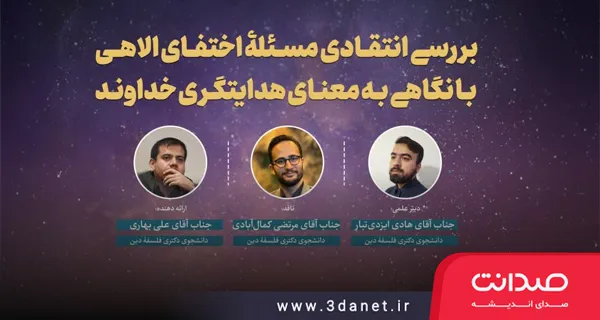

Ali Bahari
Presenter
Morteza Kamalabadi
Critic
Hadi Izaditabar
Scientific SecretaryDivine hiddenness was a challenge first articulated by Nietzsche, and after him, John Schellenberg restated it in an analytic vein and breathed new life into it. The substance of Nietzsche's argument is that divine hiddenness conflicts with God's absolute power, knowledge, and benevolence, but Schellenberg viewed it as conflicting with God's love and argued that a lover does not block the path for the beloved to communicate with them. Since we see in practice that this path is blocked and the efforts of many servants to communicate with God have met with the dead end of hiddenness, therefore, fundamentally, no God exists.
In this session, I attempted to restate the problem of divine hiddenness. I therefore claimed that this question and challenge should fundamentally be posed in terms of its conflict with God's guidance, not His love. For a "guiding" God must make Himself sufficiently clear to His servants, and overall, this attribute has a more suitable capacity for raising the challenge of hiddenness. The abundant capacities of Islamic religious sources regarding guidance also allowed me to frame the point of contention in this way and present hiddenness in a different mold. Thus, the difference between this formulation and Schellenberg's was that he saw hiddenness as conflicting with love, whereas we see it as conflicting with guidance. I further claimed that if the attribute of the Guide (al-Hādī) can be correctly interpreted, this challenge finds a fitting answer, and Schellenberg's argument is also critiqued. Then, by presenting two different meanings of guidance—minimal (necessary) guidance and maximal (possible) guidance—we stated that it is possible for God to actualize His guidance in two ways: one is to present the signs of the truth of religion and His own existence to the extent that the material world has the capacity and receptivity, and the other is to suffice only with the amount necessary for being guided and not go beyond that. To put it more clearly, if, for example, in the current world, it is possible to present fifty verses and signs for servants to find the truth, but only twenty signs are necessary to find the truth, God is not obligated to present anything beyond the twenty signs. Therefore, if He presents fifty verses or any number more than twenty, it is due to His grace, love, etc.; otherwise, the Guide qua Guide required the manifestation of only twenty instances.
It was then stated that a greater manifestation of God is tantamount to a reduction in the scope of human free will to choose faith or disbelief. Therefore, the less the hiddenness, the less the free will. Then, by dividing free will into minimal and maximal, we critiqued Schellenberg's response to the free-will-based rejoinders, in this manner: if Schellenberg's hypothetical scenario were realized, only minimal free will would result, whereas what God desires is maximal free will.
.
.
Organized by the Modern Atheism Academic Association of Baqir al-Olum University (AS)
A Critical Examination of the Problem of Divine Hiddenness in Light of the Meaning of Divine Guidance
Presenter: Mr. Ali Bahari PhD Candidate in Philosophy of Religion
Critic: Mr. Morteza Kamal-Abadi PhD Candidate in Philosophy of Religion
Academic Secretary: Mr. Hadi Izadi-Tabar PhD Candidate in Philosophy of Religion
Wednesday, February 26, 2025
.
.
Related Articles:
Guidance and Divine Hiddenness | Research Article Authors: Alireza Alebouyeh, Ali Bahari, and Seyed Mahmoud Mousavi
Divine Hiddenness, Human Free Will | Scientific-Research Article Ali Bahari, Alireza Alebouyeh, and Mohammad Javad Asghari
.
.





Discussion1 comments
خیلی ممنون