Philosophy
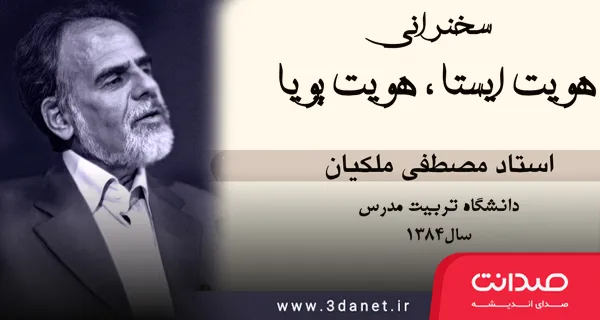
A Lecture by Mostafa Malekian Entitled Wisdom
Wisdom is a neglected concept in modern civilisation that, after four centuries, is once again receiving attention. A sage is someone who knows the components of a desirable life—a good, happy, and meaningful life—and lives by them. A report on a lecture by Mostafa Malekian.

One of the concepts and phenomena that existed in the ancient world and traditional cultures, but was forgotten and neglected with the emergence of modern culture and civilization, is the concept of sagacity or wisdom. After being set aside for nearly 400 years, this concept has been revisited for almost 40 years now.
Modern societies are administered by four groups:
1) Scientists
2) Political figures
3) Technocrats
4) Intellectuals
Modern societies, from 400 years ago until today, have been administered by these four categories. In a sense, these four groups constitute the four pillars of modern societies. The transformations and developments that have occurred in the last 400 years have been brought about by these four agents, and the presence of the wise is not seen among them. In the world of the past, there were sages such as Buddha and Confucius, and it was these wise men and women who guided and led societies. In Persian literature, too, it is frequently observed that people would take their problems to a sage so that he might show them a way forward. Note that the word 'sage' here does not mean physician or philosopher.
So when it is said that Buddha, Confucius, and Lao Tzu are sages, what is meant?
Wisdom is translated into Persian as sagacity and knowledgeability, with sagacity being the more conventional term.
A sage has two characteristics:
1) They know what needs to be known to lead a desirable life.
2) They act according to what they know.
It is the combination of these two characteristics that, if realized in an individual, makes them a sage. Therefore, a sage is someone who knows the knowledge required for a desirable life and acts upon this knowledge.
With this definition, it becomes clear that knowing many things is not necessary for leading a desirable life. When it is said that Socrates is a sage, it does not mean that Socrates knows physics and mathematics. One can have a desirable life without these two.
If one examines the lives of the wise, it is evident that they did not know many things, and this means that there are many knowable matters which, if we do not know them, our lot in life does not suffer.
The question that now arises is: What is a desirable life?
A desirable life is characterized by three features. Both in ancient times and in contemporary philosophy, especially after the Second World War, these three features have been central in defining a desirable life.
In answer to the question of what a desirable life is, there may be as many different answers as there are people. But to test the answers, everyone must refer to their own intuitions. Intuition means the knowledge that a person possesses apart from the clamor of school, history, culture, and educational tradition. Therefore, each individual must weigh the answer they hear against their own intuitions and see whether this desirable life is truly desirable for them or not. In other words, it is not a matter of argumentation but of intuition.
A life is desirable if it is:
1) Good
2) Pleasant
3) Meaningful
A good, pleasant, and meaningful life is a desirable life.
Being good, being pleasant, and being meaningful are three distinct things, and a life is desirable only if it possesses all three characteristics.
A good life means a life in which the individual has attained moral desiderata. A good life means a moral life. When a person has a good life, it means they have attained moral desiderata. That is, instead of arrogance, they have humility; or instead of deceit and hypocrisy, they have honesty; or instead of harming others, they do good to them. So the first condition of life is a moral life.
Plato was the first to call the moral life the good life. He said that whoever lives morally has fallen in love with the good that is living morally. Plato posited a form, an idea, an exemplar called the Good, and said that those who live morally have fallen in love with this Good.
A desirable life must also be happy. A happy life means attaining psychological desiderata. A psychological desideratum means that a person has tranquility, is joyful, has hope, has inner contentment (in the words of Jesus, is at peace with oneself). A human being wants tranquility instead of apprehension, anxiety, and stress.
Furthermore, a desirable life must also be a meaningful life. It is possible for a person to have a good and happy life, yet life seems meaningless to them. For them, life is not worth living. If life is meaningless, it is not desirable either.
Most people whose lives are meaningless do not commit suicide; this avoidance of suicide has various causes, including fear of suicide, thoughts of dependents, and the possibility of disgrace.
For most human beings, their lives are not worth living, but it is mainly for the three aforementioned reasons that they do not commit suicide.
Albert Camus says the greatest problem of philosophy is suicide. He goes on to explain that philosophy must be able to show human beings that life is meaningful, and if philosophy cannot accomplish this, it is useless.
If a person wants their life to be desirable, in addition to goodness and happiness, they must have a worthwhile life, not one where they constantly wish for death and have a worthless life.
If every individual assesses these three factors for a desirable life with their own intuitions, the result seems to be that these three conditions are necessary for a desirable life. Most human beings have a life akin to that of chicks and young roosters. When these chicks die, they die in the same condition as the chickens and roosters before them, having grown no further than their predecessors. Human beings, too, often live similarly to their predecessors and follow the same path they traversed, as if caught in a vicious circle.
Therefore, the sage knows what must be done to achieve a good, happy, and meaningful life, and puts this knowledge into practice. For example, after Socrates was condemned, he had many offers to escape from prison, but he accepted none of them, because he considered them contrary to his knowledge, and it is for this reason that Socrates is called a sage.
The question that arises is: what things must human beings know and act upon in order to have a desirable life? In other words, what are the components of a wise life?
The components of wisdom are numerous, but one need not be a philosopher or a top-tier scholar to discern or understand them, because these components precisely address the existential gaps and voids of the human being, and human intuitions confirm them. There are disagreements on some of these components, but each person confirms a component based on their own intuitions.
The book "On the Wisdom of Life" by Arthur Schopenhauer, translated by Dr. Mohammad Mobasheri and published by Niloufar Publications, is among the very good books on this subject.
Another book called "Wittgenstein and Wisdom" by Dr. Malek Hosseini, published by Hermes Publications, discusses wisdom from Wittgenstein's perspective. This book is not as fluid as Schopenhauer's work on the subject and, in some instances, has philosophical obscurity, but when it speaks of wisdoms, it is very fluid and comprehensible.
James Cutsinger is a top-tier professor of religious studies in America, and in addition to being a professor of religious studies, he is himself a Traditionalist and believes in the views of Schuon, René Guénon, Martin Lings, and others. These individuals, who are generally Muslim, are Traditionalists. In the introduction to his book, James Cutsinger says that because he is both a professor of religious studies and a Traditionalist, after class ends, students often ask him for life lessons. Cutsinger goes on to mention that he does not see himself in that position, but decides to extract wisdoms for life from the collected works of the twentieth-century sage, Frithjof Schuon (the Swiss-born sage). During his lifetime, Schuon wrote 34 volumes, and several more were published after his death. Cutsinger studied these 34 volumes and drew out Schuon's wisdoms from within them. The title of this book in English is Advice to the Serious Seeker. This book has been published under the title Wisdom from the Perspective of Frithjof Schuon.
Reading these three books has two particular points:
First point. The first book is written by Arthur Schopenhauer, an atheist, materialist philosopher and a pessimist. The second book unveils the views of Wittgenstein, a philosopher who believes in God, is optimistic, and non-materialist, and who differs greatly from Schopenhauer in other respects as well. The third book concerns the thoughts of Schuon: a Muslim mystic, the head of one of the Sufi orders in North Africa, Europe, and America, a scholar of religion, and an opponent of modern Western philosophy. These three individuals, with this extent of disagreements and differences, have arrived at almost identical conclusions regarding wisdoms for life.
Second point. Each of these three books contains material, some of which the audience accepts internally (in accordance with their intuitions) and some they do not. The material from these three books that aligns with people's intuitions is shared, and the rest, which the audience's intuitions also do not confirm, is the point of disagreement.
It is by reading works of this kind that one receives these wisdoms free of charge, without spending one's life and searching to find them.
And the stage after knowing and realizing these wisdoms is acting upon their requirements. In the book Wittgenstein and Wisdom, it is mentioned that in many of his writings, he reproached himself for why he had violated one of his own principles in one of his classes.
If one can extract the components of wisdom and act according to their requirements, one realizes that most of the things one has learned in life have been superfluous and that one has merely wasted one's life.
One of the components of a wise life is that a wise life for any individual must be independent and not reliant on others. Therefore, a parasitic life, dependent on others, is contrary to the first condition, namely the good (ethical) life.
So financial independence, learning a profession, and earning an income are necessary conditions. Also, an individual must accept a job that they can fully and completely handle.
In summary, if an individual wants to live wisely, they must be ethical, and to be ethical, they must have independence, and to have independence, the first condition is to have an income, and to earn this income, they must have a job, and to handle their job and not violate ethics, they must be an expert in their job and profession.
The conclusion that can be drawn from this section is that a person must know two things:
* The components of wisdom
* Their own field of study
Therefore, if an individual wants to live a wise life, they must know the components of wisdom and the matters related to their profession. For example, if someone knows philosophy and earns a living through it, they have no need to know history, because history is neither this individual's specialized field nor one of the components of wisdom.
These words do not mean opposition to the progress of sciences such as physics, mathematics, history, and so on; rather, the point is that if someone is a physician, they should know only medicine and the components of a wise life, and not waste their life on biology, physics, and the like.
Wittgenstein, as one of the most renowned and prominent philosophers of the twentieth century, along with a philosopher such as Schopenhauer, speaks of beneficial knowledge and non-beneficial knowledge. Beneficial knowledge is knowledge that either pertains to one's field of specialization or relates to the wisdom of life; otherwise, it is non-beneficial.
In the supererogatory acts following the noon and afternoon prayers, it is stated: "Allahumma inni a'udhu bika min 'ilmin la yanfa'" meaning, O God, I seek refuge in You from knowledge that does not benefit me. It is as if such knowledge is dangerous. Knowing the number of ants beside the carpet is a science, but is this knowledge of any use to a person?!!
Most people quickly affirm this example, but when it comes to the sciences taught in school, affirmation becomes difficult for them. Yet one must know that each of the sciences taught in universities and schools is beneficial for the specialist in that science and non-beneficial for others.
There is a group of students who are avid readers. One of the criticisms directed at this group is that they do not acquire books consciously and do not plan in advance what book they should read. They buy and read any book that is on display behind a shop window, and it makes little difference what book it is.
Another criticism is that there are fashions of the time for reading books. For example, a student goes and reads hermeneutics just to be present in the ever-heated discussions about hermeneutics. This is fundamentally wrong.
During the Pahlavi era, in my bachelor's program at the University of Tehran, I had a roommate with whom I shared a room for the first three years of my undergraduate studies. In those days, there was Herbert Marcuse's book One-Dimensional Man, and a person was considered an intellectual if they had read this book. This friend of mine would place this book on top of his other books every morning, carry them all, and enter the faculty, thereby announcing with this act that he too was reading this book, and therefore he too was an intellectual.
Non-beneficial knowledge does something to a person whereby they are a professor but do not know how to live and are left behind in their own life. It is possible for someone to be a tenured professor at the world's top university, to have dozens of articles and lectures, yet not practice ethical rules in their own life, be unable to overcome the small problems of their life, and find life absurd and meaningless.
After World War II, when de Gaulle came to power in France, he asked one of the thinkers of that era, André Maurois, to become his Minister of Education. Maurois set a condition, saying he would come but would change all the textbooks, because these books teach children things that most of them will forget when they grow up, and the things they do remember are of no use in their lives. Some time later, Maurois published a three-volume book (one volume has been translated into Persian). In this book, he says that there are lessons that, regardless of whether we are men or women, old or young, urban or rural, illiterate or literate, we must learn. These lessons of life are, in fact, wisdom itself.
Aquinas left a will that the following be written on his tombstone:
"Here lies someone who once intended to change the world, then realized the world could not be changed, and decided to change his country. After that, he understood he could not change his country either, so he resolved to change his family. Finally, he realized he could not change his family either, so he decided to change himself, and until the end of his life, he did not succeed."
Wittgenstein says:
"Life has taught me that the only thing I can do for society is to reform myself."
End of the lecture
-------------------------------------------------------------------------------------------
Questions and Answers
Question: Can religion help with the meaningfulness of life?
Answer: Yes. Attending to religious and spiritual texts is very effective in understanding the components of a wise life. A person should not live as if Jesus Christ or Muhammad ibn Abdullah had never been born. These figures are such that one cannot close one's eyes to them. Paying attention to their works does not mean that everything they said must be accepted. It is possible that when one attends to a saying, it may not even be understood, and subsequently, those sayings that are understood may not be accepted.
There are figures in history whom humanity cannot afford to neglect or ignore.
Thomas Aquinas was a prodigy in terms of the power of thought. He died at the age of 59 and is the greatest theologian in the history of Christianity. If his collected works were printed in a standard format today, they would amount to about 120,000 pages. Aquinas went to church every morning for a service and then returned to his teaching post. One day, while performing a religious ceremony, a state came over him. When he returned, he told his servant that he had seen something that day compared to which all his knowledge was like a straw caught in a whirlwind. After this event, Aquinas remained silent for 14 months. At the end of his last book, he placed three dots, signifying that the author did not continue writing.
All historians have written that one day Aquinas was teaching a lesson among Christian clerics. A Christian nun entered and said: Master, please come, a donkey is flying! Due to his heavy weight (about 153 kilograms), Aquinas moved with difficulty and went to the balcony to see the flying donkey. Naturally, there was no donkey, and he returned. The clerics said to Aquinas: It is unlikely of you, Master, with all your knowledge, to be deceived by the words of a nun. Aquinas replied that the more he thought about it, the stranger and more improbable the flight of a donkey seemed to him. And the more he thought about it, he realized that a nun telling a lie was stranger than a donkey flying! So, between the strange and the stranger, he preferred to accept the strange.
Aquinas says that if he had not read the works of Saint Augustine (the Christian scholar), he would not, through his own experience, have attained a particle of Augustine's findings in life. This means one cannot live in such a way as if Saint Augustine never existed. So, a fortiori, one cannot ignore the lives of Jesus Christ, Muhammad, Buddha, and Moses. It must be noted that this does not mean the suspension of reason and moral conscience. Paying attention to the prophets, mystics, and sages of history provides a shortcut for human beings, and if someone is inattentive to these individuals, they have only deprived themselves.
In the biography of Avicenna, it is stated that he read Aristotle's Metaphysics forty times and did not understand it. One day, a woman saw Avicenna in the market and told him that she was a widow with nothing to her name. Some books from her husband had come to her, and she asked if he could possibly buy them from her. Avicenna says that he had no desire to buy books, but his heart went out to her, and he bought her books.
He goes on to say that when he arrived home, he looked at the books and saw that among them was Farabi's Commentary on Aristotle's Metaphysics. He says that when he read Farabi's commentary, he understood Aristotle's book. If Avicenna had not read this commentary by Farabi, perhaps he would never have understood Aristotle's Metaphysics. And the like of this matter holds true for human beings in issues of wisdom.
Question:
In verse 151 of Surah Al-Baqarah, it is stated that We have sent among you a messenger whose signs purify you and who teaches you the Book and wisdom. The question is, what is this wisdom mentioned here? Does it have the same definition that was given in the lecture? Is wisdom truly teachable?
Answer:
The first point is that we must state what the word *hikma* (wisdom) means in the Arabic language, not from the perspective of religion. This is because the Quran did not assign new meanings to all words; only a few rare terms are used in the Quran with a new meaning not employed in the past. The Quran states, “Whoever has been taught wisdom has been taught a great deal,” and “This Quran teaches them the Book and wisdom,” and “Invite to the way of your Lord with wisdom and good instruction.” The word *hikma* appears about 8 times in the Quran.
In the language, *hikma* has two meanings:
First meaning. It means a firm, well-founded saying. Therefore, any saying that is firm is, in this sense, *hikma*. The Arabs considered proverbs to be an example of this kind of wisdom. A father and mother teach a proverb to their child; this child sees many ups and downs throughout their life that confirm the proverb they learned, and as a result, they, in turn, teach this proverb to their own children. The secret to the longevity of proverbs is that they have stood the test of time.
Second meaning. The second meaning of *hikma* is the very meaning mentioned earlier. That is, wisdom is something without knowing which one cannot live, an inescapable saying.
Now, which of these meanings the word *hikma* carries in its various uses in the Quran is a matter of debate.
Question:
In the empirical sciences related to one's profession, no matter how far a person advances, they do not reach the core of the matter. Also, one cannot devote their entire life to their profession. A person must learn other things for life as well. In my opinion, useless knowledge (*ilm-e la-yanfa'*) is knowledge whose benefit reaches neither ourselves nor others. In fact, it is as if we have knowledge and do not apply it. Also, every science has standards that everyone must know within their own field of work. Furthermore, for example, reading the Masnavi gives a person many practical lessons, and every Muslim needs to be a scholar of the Quran.
Answer:
You state that everyone must possess the standards of their own sciences and reach a point where, for example, a physician's conscience is at ease that their income from practicing medicine is lawful. I agree with you.
The definition you provided for useless knowledge (*ilm-e la-yanfa'*) is the definition of knowledge without action (*ilm-e bila 'amal*) found in Islam. Knowledge from which no use is derived for the individual or others is knowledge without action. Both useless knowledge and knowledge without action are condemned.
Suppose (and I stress, suppose) that there is something in the sayings of the Imams that is of no use to your life. In that case, are you still obligated to seek out the sayings of the Imams? No.
Also, suppose that in the sayings of non-Imams, there are matters that are useful for your life. Are you obligated to seek them out? Yes. Consequently, what is important is that a saying is useful for our lives, and the source of this saying is not important. Imam Ali and Prophet Muhammad have narrated that: "al-hikmatu dallat al-mu'min, aynama wajadaha, akhadhaha." Wisdom is the lost property of the believer. Wherever they find it, they pick it up.
When someone loses their ring, they post a notice saying, "Whoever finds it, wherever they find it, inform me." Not, "Whoever finds it among the flowers, inform me, and if someone finds it in a swamp or a bog, do not inform me." If we do that, it means we are not very interested in our ring.
One cannot say, "I love wisdom, but I only take it from specific sources!" We must take wisdom wherever we see it. The Prophet says: "khudh al-hikmata, wa law min al-munafiq." Take wisdom, even from a hypocrite.
Question
Is it correct that we must learn mathematics to strengthen our power of reasoning?
Answer:
Learning mathematics itself is different from the mathematical method. Yes, we must learn the mathematical method, learn mathematical logic. But knowing mathematical identities, for example, no longer serves our faculty of reasoning.
-----------------------------------------------------------------------------------------
Wittgenstein, after his father's death, was one of the wealthiest individuals in the world. Ney Publishing has released a book titled "Wittgenstein and Popper," translated by Hassan Kamshad. This book states that one of the items Wittgenstein inherited was 1,200 kilograms of gold, and Wittgenstein gave all of it to the poor. Several palaces and many farms were also among the inheritance he received. Wittgenstein says, do not think that I made a sacrifice; no. By giving away all this property, I removed a great obstacle from the path of living wisely. The Quran says: "الشیطان یعدکم الفقر" meaning Satan frightens you with poverty. Most of the things we humans do are out of fear of potential poverty. Throughout human history, rarely has anyone committed theft who would have starved to death if they had not done so. If someone is truly in need and will die if they do not steal, then their theft is no longer morally reprehensible. Most thefts committed by humankind have been due to the fear of future poverty.
When a person fears for the future expenses of their children's education, private university, marriage, and so on, they will resort to theft, taking bribes, lying, and any other act. The Quran says that Satan does not need to tell you to steal, take bribes, or lie. It is enough that Satan frightens you with future poverty. If a person becomes afraid, they will deem any reprehensible act permissible in order to overcome this fear.
----------------------------------------------------------------------------------------
Regarding changing oneself and changing others, there are two perspectives:
1) The psychological perspective
2) The metaphysical perspective
The psychological perspective says that if an individual becomes a pure human being, this purity is psychologically contagious and infectious; therefore, one's child, spouse, parents, colleagues, and so on learn this pure living from the person. A calm individual with inner tranquility brings about calmness and inner tranquility in those who associate with them. Hence, if someone wants to make others better, they must first make themselves better, so that through their own goodness, they cause change in others. To the extent that each individual becomes better, this betterness spreads to others, and society also becomes better.
The metaphysical perspective is the view of the mystics. If any goodness is to reach humanity from God, it arrives through pure and refined human beings. These pure humans are the channels of divine grace.
I have a friend who is one of the nation's luminaries, from whom I have greatly benefited and to whom I am devoted. In a gathering, the discussion turned to Rumi. I raised a point, and he offered a critique.
He said:
Rumi lived during the Mongol invasion, and at that time the Seljuks had committed the greatest injustices and left behind a corrupt government in Anatolia or Asia Minor (Konya)—where Rumi lived. All these injustices occurred at that time, yet Rumi, after meeting Shams, danced in the streets and alleys, recited poetry, and paid no heed to these injustices.
I replied that it is certain a person should not be oblivious to or indifferent toward the pain and suffering of the people. The mark of humanity is to be sensitive to pain and suffering. But 700 years after Rumi, how many people have become better because of him? Compare this with someone who, at that time, also fought against injustices. Both Rumi and those individuals who engaged in political struggles during that era served the people, but their paths were different, and in my opinion, Rumi was far more successful.
Question:
Does prioritizing changing oneself not harm one's social and political activities? Turning inward and neglecting political and social issues is, in most cases, what dictators desire. In your view, are working on changing oneself and changing others mutually exclusive?
Answer:
In most people, these two are mutually exclusive. When a person makes changing themselves the axis for changing others, they are moving in a more reliable but slower way. There are rare individuals who can advance both simultaneously, but advancing these two types of attitudes in practical life at the same time is not possible for the general public.
-----------------------------------------------------------------------------
One should not neglect the property of psychological osmosis (communicating vessels). Doing good is contagious and infectious.
I was once in a gathering at the home of Allameh Tabatabai. He said: When a person eats food, chews a morsel, swallows the softened and crushed part, and chews the harder part more, they think they are doing all of this consciously, whereas this is not the case. A person puts a morsel in their mouth and then comes to and finds themselves chewing the next morsel. Allameh used this analogy to explain friendly relationships. He said that in a friendly relationship, it is not the case that you say, 'I will learn his good virtues like honesty and loyalty from him, but I will not learn his irascibility.' After a few years, a person comes to and sees that even their hand gestures and way of speaking have become like their friend's. The person themselves may not notice that their speech and gestures have become like their friend's, but outside observers perceive it well.
During my childhood and adolescence, there were individuals in our neighborhood who were famous for being pure, clean, and refined. When I saw them in the streets and the marketplace, I would try to act a bit more orderly and keep my actions under more control. I was not afraid of these individuals, but there was a certain sense of modesty at work, whereas in dealing with other people, I was just ordinary.
Goodness leaks out from good people, and the extent of this leakage depends on the moral breadth of that individual.
Question:
You had mentioned that in an unhealthy society, individuals can have ethical and benevolent intentions, but the result of their actions is unethical. You gave the example that if an ant is moving on a crooked pencil, even if it takes the straightest path, it is still moving crookedly. In fact, your point was that if social institutions are corrupt, our ethical action is like pouring water into the mill of evil. Considering today's discussion, could you elaborate on this point a bit?
Answer:
We must not neglect the power of unhealthy and corrupt institutions. Unhealthy political, economic, legal, and educational institutions have the power to change our lives. How can these institutions be made healthy? If I were to possess all moral vices and simultaneously fight against those in charge of these institutions, nothing would change.
The important institutions, namely politics, economics, education, law, religion and denomination, and communications, if unhealthy, have a tremendous impact on the lives of each and every one of us. The concern for making these institutions healthy must exist within us.
Now, what is the way to change these institutions? The way to change these institutions is not for me, laden with a baggage of vices, to pull them down and then lean back upon their seats of power. The revolutionaries' conception is that if these institutions change, the problems will be solved.
The greatest error of revolutionaries is that they imagine the sole problem of society, or the cause of all causes of society's problems, or the greatest problem of society, is the political regime governing the society.
.
.
Audio of Mostafa Malekian's Lecture Entitled Wisdom
PDF file of Mostafa Malekian's Lecture Entitled Wisdom
.
.
Lecture on Wisdom
Mostafa Malekian
Mashhad, 2009
.
.


Discussion0 comments
No comments yet; let yours be the first voice.