Literature
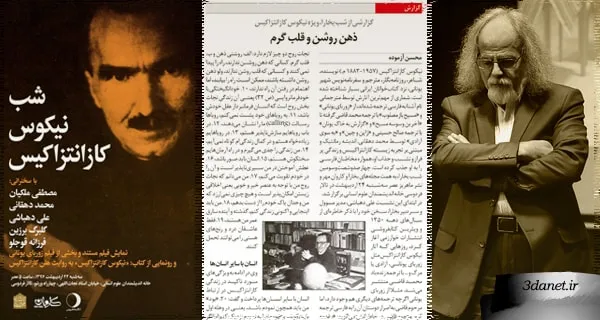
A Report on Mostafa Malekian's Lecture at Bukhara Night, Dedicated to Nikos Kazantzakis
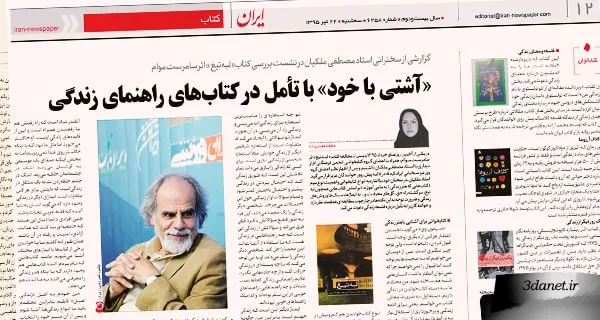
In his talk “A Clear Mind and a Warm Heart,” Mostafa Malekian drew on the memoirs of Kazantzakis’s wife to extract forty-three positive lessons for living. He argues that Kazantzakis is the twentieth century’s spiritual figure par excellence, and that we should absorb the life lessons of the sages.

Mohsen Azmoudeh
Report AuthorKazantzakis, One of the Spiritual Figures of the World
Mostafa Malekian's lecture, titled "A Clear Mind and a Warm Heart," was dedicated to a review of the memoir of Nikos Kazantzakis's second wife, Helen, about her husband Nikos. He began by stating: The chief merit of this book is that it is, in a sense, an autobiography, for it has been compiled from the letters Nikos Kazantzakis set aside and is documented; apart from the intervals between the letters, there is little explanation, and it gathers together his destiny through the letters he wrote.
Malekian described the only correct way to encounter one of the sages, philosophers, mystics, theologians, or scholars as finding and then absorbing the positive points and insights in their lives and thoughts, and said: In any other encounter with these great figures, there is neither rationality nor morality. In this regard, I tried to find the positive points of Kazantzakis's life, so that if we accept these points, we might absorb them into our own lives.
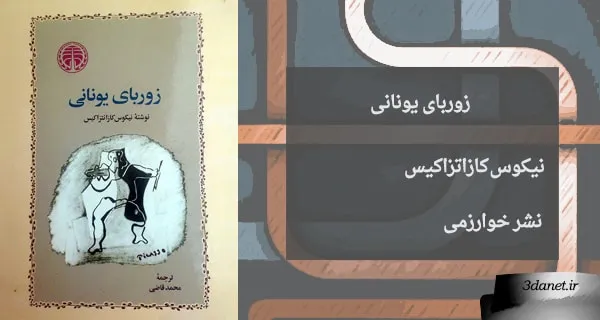
Of course, this book contains nothing of his ideas—which are found in his other works—and we see merely reports from his life. From this voluminous and instructive book, I have extracted 43 positive points from Kazantzakis's life. In my opinion, Kazantzakis is one of the spiritual figures of the twentieth century. He himself, in a letter he wrote to English thinkers, probably in 1946, called upon them to bring together spirituality and rationality.
Emphasized Features of Kazantzakis's Life in the Human Relationship with God
1- Kazantzakis was in search of a God who is just and safeguards human freedom (p. 19);
2- He emphasized the component of faith and considered one of the negative characteristics of the modern era to be the absence or lack of faith in the transcendent (p. 59),
3- In life, Kazantzakis preferred the uphill path (the path of God, in the mystics' expression) over the forward path, that is, the path of pleasure (p. 612),
4- Kazantzakis equated the search for comfort with selling one's soul to the devil and considered it an unworthy act; the buyer of our soul must be God (p. 26 and p. 355),
5- He believed that God governs the world according to necessary laws and that we face a kind of philosophical necessity; consequently, the correct behavior is a heroic and calm confrontation with the necessity of the world and accepting it (p. 161 and p. 355), 6- Gratitude for existence (p. 140), 7- Attention to the spirit and belief in the all-encompassing power of the human spirit (p. 2, 75, and 213).
Emphasized Features of Kazantzakis's Life in the Human Relationship with the Self
8- I have come only to save my own soul, and the salvation of my soul is the greatest responsibility I hold for myself (p. 131, 162, 164, 231, 352, and 468),
9- The salvation of the soul requires two things: a) clarity of mind and b) a warm heart. Those who lack a clear mind cannot find the path, and those who lack a warm heart, even if they have a clear mind, may find the path but lack the diligence to walk it,
10- Spontaneity (p. 637) or self-mastery (p. 32), meaning that life which saves the soul is one where a person is obedient to their own reason,
11. I do not turn my back on my dreams; dreams show us our calling (p. 16, 18, and 355),
12- I am uncompromising regarding my dreams (pages 16, 53, 83, 164, 291, 353, and 355),
13- I am excessive in my dreams (p. 16) and I do not settle for less than perfection in my life (pages 37 and 60),
14- I take life seriously and am hardworking in the path of my ideals (p. 53, 83, 291, and 401),
15- A person must be patient (p. 53, 475, and 485),
16- The thirst for learning in me is insatiable, and I strengthen it within myself (p. 141),
17- I know that the salvation of my soul is possible through attention to the element of good and goodness, that is, living ethically (p. 65 and 355), and nothing is worth losing my clear conscience over (pp. 367 and 368),
18- I must live here and now; the past and the future are thieves of my life (pp. 330 & 475),
19- Only lovers can endure the pains and sufferings of existence (pp. 363 & 368).
Emphasized Features of Kazantzakis's Life in the Human Being's Relationship with Other Human Beings
20- My being must be as my appearing; that is, I must first strive to bring my being closer to my appearing, but if I cannot, I must bring my appearing closer to my being (p. 16). Another interpretation of this feature is simplicity (p. 59). Honesty means the correspondence of the outer and the inner,
21- This is a consequence of the previous feature, meaning I only preach what I practice, and vice versa (pp. 16 & 18). In the words of one theologian, Christ did not tell us to preach; be the sermon yourselves!
22- A consequence of the previous feature is that I never lie (p. 33),
23- Humility and considering oneself equal to others (pp. 16, 37, 127, 354 & 431),
24- Helping the needy (p. 16),
25- Showing mercy towards human beings, meaning understanding the circumstances in which others act (pp. 23, 305, 367 & 368),
26- Being lenient towards others and strict with myself, to the point of demanding the impossible from myself (pp. 18, 231, 353 & 485),
27- Generosity, meaning I only use as much of my wealth as I need (pp. 426 & 461),
28- Forgiveness, meaning I must be able to forgive the injustice another has done to me; the greatness of a human being is measured by the extent of their forgiveness of others' injustices towards them (p. 355),
29- I am not ambitious and am not in competition with anyone (p. 123),
30- Absence of envy: when theoretical comparison and practical competition cease, I envy no one (p. 355),
31- I see everyone as my teacher, and something can be learned from everyone (p. 200),
32- The friendship of silence (pp. 244 & 245),
33- Just as much as I enjoy being in company, I also enjoy solitude, and fundamentally, solitude is my friend and I am a lover of my solitude (pp. 244 & 245),
34- I love all human beings, both the wrongdoers and the righteous, and I have unconditional love for humans (pp. 22, 23, 65, 79, 92, 123, 124, 257, 291, 355, 475, 495 & 635),
35- I am a lover of all but attached to none. Kazantzakis said this under the influence of Buddha: no attachment, yes to love. In love, I want myself for you, but in attachment, I want you for myself (pp. 66 & 83), 36
. In my relations with others, I am outspoken and speak the truth frankly (p. 37),
37- At the same time, I am intolerant of injustice and stand against the oppressor (p. 33),
38- Hospitality, which his wife greatly emphasizes (pp. 16, 355 & 461).
Emphasized Features of Kazantzakis's Life in the Human Being's Relationship with the Surrounding Nature
39- I pin my hopes on no phenomenon, neither natural nor human; I do the work relying solely on myself (p. 291),
40- Indifference to wealth: I never let objects become my masters (pp. 47 & 59),
41- Frugality,
42- I am not waiting for the world to change, and changing the world is not something that will happen through my wishes. Instead, I can change my attitude towards the world. This is one of the principles of Stoic thought, meaning when things are not according to your desire, make your desire according to things.
43- Wherever I can remedy a deficiency, it is my duty to remedy it (p. 82).
A Book for Becoming Better
According to what Kazantzakis's wife has shown, this kind of life—that is, a life based on the above characteristics—yields results that include: 1- one attains psychological equilibrium (pp. 61 and 162), 2- deep tranquility (61 and 65), 3- indescribable joy (pp. 367 and 368), 4- inner richness and indifference to outward poverty (p. 18), 5- inner depth and not seeing matters superficially (p. 61), 7- it is good for a person to be the conscience of others, meaning my very being invites others to their inner tribunal. In short, this book does not make us more learned, more philosophical, more scholarly, more of a thinker, more of a researcher, or more of an academic, but it does make us better human beings. Wittgenstein said, O reader, I hope my book makes you better, that is, that you become a better human being. In this book, to use our poet's expression, the wind blows, and this wind can somewhat transform our state.
.
.
Audio of Mostafa Malekian's Lecture at Bukhara Night, Dedicated to Nikos Kazantzakis
PDF file of the text published in Etemad newspaper from Mostafa Malekian's lecture
.
.
A Report on Mostafa Malekian's Lecture at Bukhara Night, Dedicated to Nikos Kazantzakis
Under the Title: A Clear Mind and a Warm Heart
Hosted by Bukhara and organized by the House of Humanities Thinkers
On the Date of 14 Ordibehesht 1398
Source of the report text: Mohsen Azmoudeh, published on page 8 of Etemad, Thursday 26 Ordibehesht
.
.

Discussion1 comments
«یگانه راه درست رویارویی با یکی از فرزانگان یا فیلسوفان یا عارفان یا الهیدانان یا عالمان را یافتن و سپس جذب نقاط و نکات مثبت در زندگی و اندیشههای ایشان خواند و گفت» الهی دان و عارف در این زمانه در کنار فیلسوف و عالمان. دوتای اول چه نسبتی با دوتای آخر دارند. آیا مخلوطی از انها هستند؟ و به دیگر سخن هیچ کس و همه کس هستند.