Philosophy
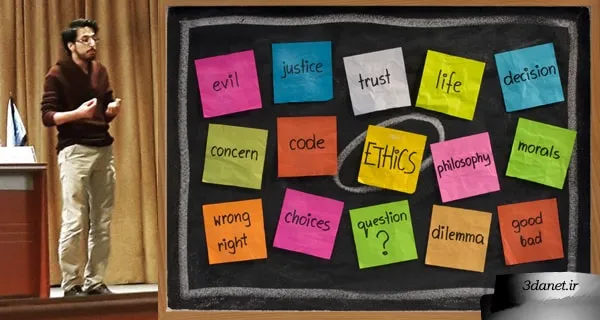
Amir Saemi's Lecture: 'Reasoning in Moral Epistemology'
By distinguishing between emotional and rational systems, Amir Saemi explains the role of reasoning in validating moral beliefs. Critiquing Street, he shows that trusting our feelings is a mistake and that we must assess the validity of evolutionary beliefs through reflection.

Psychologists have concluded that, at least within our rational system, there are two distinct systems of cognition, which they have labeled System One and System Two. System One is a system that decides very quickly and is heavily based on emotion and feelings. System Two is a system heavily based on reasoning and logic, and often the everyday decisions we make are carried out by System One because we do not have much time to deliberate over everything. Psychological research also shows us that, in most cases, the majority of people making a moral decision use System One.
This has led some to think that in our moral system, System Two plays no role. Today, I want to talk about the role of System Two and its importance in the moral system, because to know whether the moral principles you use are valid or not, you must ultimately use System Two.
The way I will develop my discussion begins with a famous argument put forward around 2005 by Ms. Street. She claims that moral realism is mistaken. I will delve into Street's argument, and ultimately I hope we can understand where this ancillary argument stands. Moral realism, at least as Street and I use the term, means you think that moral facts exist independently of our desires, feelings, and beliefs. In this view, morality is independent of my emotions and feelings, and what I want is not necessarily moral.
Before explaining why this claim is made, I will first point something out. There is a concept in English that Dr. Soroush has translated as the "motive and motivated fallacy." This fallacy means that if you know someone's motive, that is not a reason to conclude their statement is false. That is, you cannot determine the truth or falsity of someone's statement from their motive, and those who judge in this way commit the motive and motivated fallacy. Nevertheless, there is one correct thing: drawing a distinction between knowledge and truth or falsity. Knowledge, in its traditional sense, is justified true belief. If someone sometimes—and not always—shows you that the genetics of your belief are problematic, they may show you that you no longer have knowledge of that belief, and this act may well destroy our knowledge because it destroys our justification.
Moral Beliefs and Moral Facts
Street claims that moral realism is false with the argument that if you are a realist, you also accept that you have knowledge of moral facts. She says that if you are a moral realist, you can no longer speak of moral knowledge. In fact, moral realism precludes moral knowledge.
Whereas moral realists tend to say we also have moral knowledge, what Street more or less aims to do is say that the roots of our moral beliefs are bad roots, and for this reason, it calls our moral knowledge into question in principle. Among the factors playing a role in this is that we have certain beliefs, including beliefs that benefit us, increase our fitness, and allow us to reproduce more easily. For example, creatures that believe they should care for their children will be more successful in procreation and child-rearing, and therefore there is a direct evolutionary preference for such beliefs. But on the other hand, according to Street, the moral facts claimed by the realist are not subject to evolutionary changes.
Therefore, a miracle would have to be at work for us to be so fortunate that moral beliefs, influenced by evolutionary forces, correspond to moral truths independent of those evolutionary forces. For example, imagine a tornado sweeps you up; a miracle would have to be at work for this tornado to ultimately deliver you precisely to your intended destination. In the same vein, if our moral beliefs are shaped by evolutionary forces but moral truths are not, the realist cannot explain why there is a correspondence between moral beliefs and moral truths, and thus the realist cannot account for our moral knowledge. However, not all of our moral beliefs increase the likelihood of reproduction. For instance, egalitarian moral beliefs or our moral beliefs about compassion for the weak or distant individuals have no evolutionary preference and have emerged despite evolutionary forces favoring the formation of contrary beliefs. It is as if reasoning is another effective force in shaping moral beliefs. Therefore, our moral beliefs are not confined solely to those for which there is an evolutionary preference. In other words, the relationship of our moral beliefs to evolution is not like the tornado example, where we have no agency whatsoever in the face of it.
Reasoning can play an important role in correcting and directing our moral beliefs. Reasoning can assess the validity of moral beliefs influenced by evolution. Hence, Street's argument to demonstrate the impossibility of moral knowledge ultimately fails. Contrary to Street's claim, the realist can state that reasoning, through moral cognitions that have not been directly influenced by evolutionary forces, can assess and examine the validity of moral beliefs directly influenced by evolution, and therefore the correspondence between our moral beliefs and moral truths need not be merely a product of chance or miracle. Nevertheless, the failure of Street's argument is instructive for us. From reflecting on this argument, we learn that when we know some of our moral emotions, such as disgust, have been influenced by evolutionary forces, we should then view beliefs originating from such emotions with skepticism.
It is true that many of our moral beliefs are rapidly formed by System 1. But we must pause before some of them. We should only trust those beliefs formed by System 1 whose validity has previously been confirmed by System 2. Complete trust in System 1 is a mistake. When we know that, for example, we have formed our moral beliefs under the influence of disgust, and the feeling of disgust has a direct evolutionary explanation, we should view beliefs formed by this emotion with skepticism. We must, by employing System 2, or in other words through reflection and reasoning, be able to assess the validity of moral beliefs formed based on emotions such as disgust.
.
.
Reasoning in Moral Epistemology
Amir Saemi's Lecture at the Conference on Rumi's Ethical System, 2016
Amir Saemi (Faculty Member, Institute for Research in Fundamental Sciences)
.
.




Discussion0 comments
No comments yet; let yours be the first voice.