Philosophy
Attaining the Sacred Experience: A Conversation between Mojtaba Pourmohsen and Arash Naraghi
Edited by Arash Naraghi, On Love is a collection of philosophical essays defending earthly love against extreme rationalism. Naraghi sees love as a phenomenon that, beyond instinctual attraction, intertwines with language and belief to create a shared world.
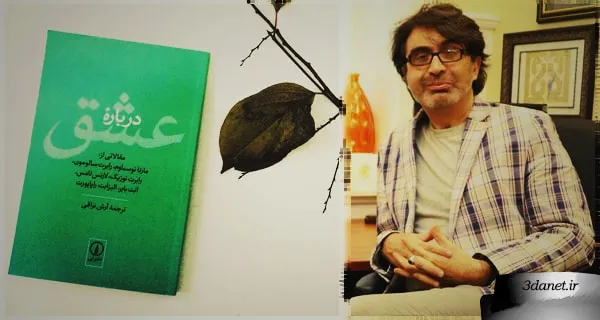
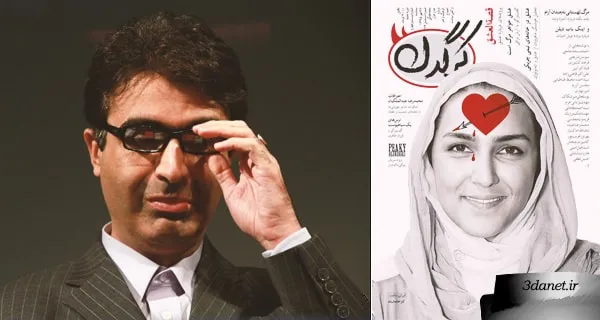
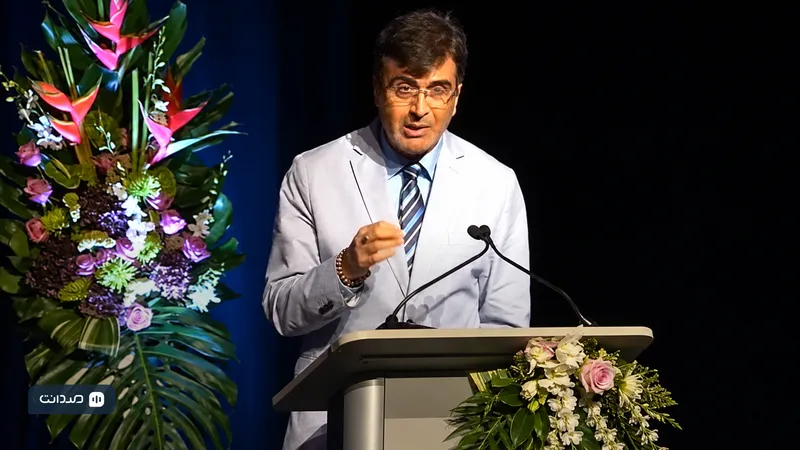
A book edited and translated by Arash Naraghi, titled “On Love,” has recently been published. This book is a collection of six philosophical essays on the virtue of love, in which the authors endeavor to examine various aspects of the phenomenon of love. Naraghi himself has also written an introduction to the book, in which he addresses the roots of love in our Iranian and Islamic tradition. Dr. Naraghi is a thinker in the fields of epistemology and religion, and an assistant professor of religion and philosophy at Moravian University in Pennsylvania, USA. I spoke with him about the book “On Love.”
Mr. Naraghi, it seems that the compilation and translation of this book is a spirited defense of earthly love, and likewise a rehabilitation of the term “romantic love”; is that not so?
If you read this collection of essays within the context of Iranian-Islamic culture, then these essays should be seen as a defense of what has traditionally been called “metaphorical love” (as opposed to “true love”). But if you read these essays within the context of contemporary Western culture, then they should be seen as a defense of love and emotion against extreme rationalism—that is, a kind of view that considers the role of emotions in human life to be harmful or at least trivial.
Upon reading these essays, a question arises, and that is whether the thought behind this book is, on the whole, a defense of the erotic aspect. Metaphorical love, as seen by some philosophers, is a condemned and despised matter, lacking much standing, but in a self-sufficient form, it is sometimes defensible and even praiseworthy. However, one of the criticisms of romantic love has been overlooked. A criticism that is not rooted in the various readings of Plato’s Symposium, but has a radical nature and considers “romantic love” a primitive stage of the sexual matter. Don’t you think that including an essay on this subject would have made the book more complete?
In my opinion, it is a mistake to equate the phenomenon of love with the sexual matter. Of course, figures like Schopenhauer and Freud ultimately considered love to be nothing but a repressed and distorted form of sexual desires. But this view ignores important parts of the phenomenon of love. Undoubtedly, physical attractions play an important role in the formation and continuation of romantic relationships. When Hafez says: “Be a servant to the countenance of one who possesses that charm,” this “charm” that is the bait in the snare of love is certainly related to outward and physical attractions. Romantic love begins from this starting point, but goes far beyond that limit. Love results from the interaction of that attraction (which is instinctual) and language (which is cultural). While we must acknowledge and recognize the biological foundation of the phenomenon of love, we should not neglect its linguistic character.
The phenomenon of love, built upon those instinctual attractions, cultivates a network of deep human emotions, and those emotions are thoroughly intertwined with our system of beliefs and values. “Belief” is among the constituents of emotion, which is fundamentally a linguistic matter. At least in this sense, love must be considered a phenomenon deeply interwoven with human language. This is why mere physical attraction cannot be considered a romantic relationship. A romantic relationship takes shape and flourishes in the context of dialogue, companionship, shared memories, and mutual understanding. Individuals gradually build a shared world with one another, and in this shared world, they become so intertwined and close that, in the words of Robert Nozick, they gradually create a “we.” If your point is that the relationship of love should be connected to the physical matter in this sense, then I think almost all the authors in this collection have done just that.
What we see in Martha Nussbaum’s essay is that metaphorical love, in all three readings of Socrates, Alcibiades, and Aristophanes, is a stage of a transcendent, bottom-up spiritual journey. It is true that Alcibiades and Aristophanes challenge Socrates’ reading, which is very closed, but even in theirs, metaphorical love is implicitly a subordinate matter, isn’t it?
If by “physical love” you mean purely sexual love, you are right. For example, in Aristophanes’ view, love is the yearning and desire that a human being has to recover their lost half. The lover attains perfection by finding the beloved; the lover is like a lost soul who, in this odyssey-like quest, has finally found “home.” This yearning, which is the essence of love, is “for” the attainment of perfection, and finds peace only in the state of union. Of course, from Aristophanes’ perspective, the state of union is accompanied by physical connection. Therefore, unlike the Socratic-Diotiman model, corporeality is not banished from the realm of love. But physical connection is not the entirety of the experience and perfection of the amorous quest. This connection must transcend the physical and also lead to a spiritual union. For Alcibiades as well, the beloved, that is, Socrates, is not confined to his physical aspect.
He loves the entire uniqueness of Socrates, including his unbeautiful body. In all these cases, the physical is a necessary condition for the amorous experience, but it is not a sufficient condition. Therefore, in their view, corporeality in love is not, to use your term, “secondary.” The “secondary” is often considered something of little importance, whose absence does not harm the essence. But for Aristophanes and Alcibiades, the physical is not “secondary” in this sense—that is, the beloved’s body is a part of them, and love for the beloved is not complete unless it is directed at their entire uniqueness, including their body. Therefore, in my opinion, neither Aristophanes nor Alcibiades, unlike Socrates, considered the physical to be a “secondary” matter in the amorous experience, but rather saw it as a necessary condition of love.
In the article The Virtue of Love, Robert Solomon says that romantic love is not inconsistent with the precondition of equality. He also challenges the views of people like Shulamith Firestone and Marilyn French, who today bring new accusations against love. Isn’t this view somewhat unrealistic? Because egalitarian women’s movements in the modern era often criticize romantic love on the grounds that woman is objectified within it.
As far as I understand, Solomon considers equality a condition for healthy romantic love. Therefore, not only does he see no contradiction between romantic love and equality, but beyond that, he considers equality a necessary condition for a healthy romantic relationship. However, some radical feminists have believed that romantic love, by its very nature, negates equality between men and women, and that men, through the artifice of this type of relationship, try to once again enslave women, but this time with the golden thread of love. In the structure of a patriarchal society, men, who are in the superior position, cannot sincerely fall in love with a woman who is in the inferior position; therefore, they are compelled to cultivate an idealized image of women in their minds, and through this imaginary image, elevate women and make them their equals, so that love becomes possible for them.
Under these conditions, women, of course, know that they fall short of that ideal and imaginary image, so they are constantly in anxiety and worry, lest the man emerge from his illusion and see them as they truly are, and consequently, they be deprived of the advantages that, in a patriarchal society, are only obtained through men. This type of romantic relationship, from the perspective of feminists and many others, is pathological and leads to the perpetuation of women’s degradation and inferiority. But Solomon is more optimistic and believes that by reforming discriminatory political and social structures, equality between men and women, and consequently the possibility of experiencing a healthy romantic love, is attainable. Therefore, Solomon also opposes the objectification of women, but believes that romantic love (especially within the context of a reformed political and social structure) can be a source of flourishing for both men and women.
Let me also add that one of the important characteristics of the experience of romantic love is that the lover becomes deeply “dependent” on the beloved. This dependency makes the individual profoundly vulnerable. When your entire being hinges on the desires and decisions of another, that other gains a very dangerous power and dominance over you. This one-sided dependency is a sign of pathological love; and particularly in patriarchal societies, this dependency is largely a one-sided dependency of women on men, thus placing women in a position of double weakness. It is on this basis that many thinkers believe that although the romantic experience cannot be separated from this experience of dependency, healthy love is based on the mutual dependency of the lover and the beloved on each other. Healthy love is reciprocal and symmetrical. That is, it is two-sided (both parties, for instance, are dependent on the other), and it is also symmetrical, meaning both love each other in the same respect and with the same meaning (for example, it is not the case that one loves the other as a spouse, and the other loves them as a sibling.)
One of the interesting points Solomon raises is that in erotic-romantic love, the element of choice plays a very important role. He says that familial love is, in this sense, pre-prescribed and destined. But in the article on the bond of love, so many conditions are set for the realization of the “we” that it seems as if romantic love, even if not predetermined like familial love, has so many conditions set for its aftermath that it appears destined thereafter.
To better understand Solomon’s claim, one should compare romantic love with, for example, a mother’s love for her child. Upon the child’s birth, the mother involuntarily and instinctively loves her child. This love is, so to speak, natural and unconditional, and does not depend on the child’s beauty or perfection. But your romantic love for your beloved is not of this type. That is, it is not the case that you are programmed to fall in love with a specific person. Romantic love is a product of the will. Of course, you cannot decide, for instance, to fall in love with a certain person tomorrow at 10 a.m. But in romantic love, free will manifests itself clearly in at least two situations. The first manifestation is before falling in love. You can freely place yourself in circumstances where you are exposed to falling in love. In this respect, falling in love is similar to becoming convinced of a belief.
For example, if I see Ali on the street, I almost involuntarily become convinced that “That person is Ali.” But if I am truly eager to see Ali, although I cannot summon him at will at any moment, I can place myself in a situation where the probability of seeing him is higher. The second manifestation of free will in the realm of love pertains to the stage after falling in love. The romantic lover is not deprived of free will even after falling in love. That is, they can be sensitive to the invalidating factors that call their love into question. Of course, the lover has difficulty seeing the beloved’s flaws, or is strongly inclined to interpret them in the beloved’s favor. But beyond a certain point, if the accumulation of countervailing instances (i.e., the beloved’s flaws) exceeds a limit, the lover can reconsider their love, and even detach entirely from their beloved and give their heart to another.
A person who is completely indifferent to such “invalidating” factors, or who acknowledges them but cannot make a considered decision based on them and act upon that decision (for example, severing ties with the beloved if necessary), is most likely psychologically “addicted,” and to leave their unsuitable beloved, they must seek the help of a psychologist and use addiction-withdrawal methods to exit that unhealthy relationship. Of course, I do not mean to say that, for example, a father or mother cannot reconsider their love for their child, and if their child is deeply wayward, disown them, but this task is extremely difficult in cases where love is deeply rooted in natural instincts. And I also do not claim that romantic love has no roots in human nature and instinct, but I think the role of cultural elements in it is far more decisive than in maternal love.
Solomon, in his essay on the virtue of erotic love, says that we can even say that the "truth" of emotions is their recalcitrance and their resistance to efforts made to change them. Can we conclude from this that love is, in some respects, more fundamentalist than reason?
I am not sure that the term "fundamentalism" is the most appropriate expression in this context. It is true that a lover shows greater resistance to the defeating conditions of their love, and does not easily surrender to so-called defeating conditions for changing, modifying, or leaving the beloved. The reason for this resistance is, among other things, that the lover and the beloved, through their romantic relationship, have, in Nozick's terms, created a "we" together, and any stain that settles on the beloved's character will also settle on that shared "we." Therefore, it is natural for the lover to show intense resistance to factors or evidence that threaten the foundation of the "we" identity. Here, the collapse of that "we" will also shatter the structure of the lover's identity. But reason, too, is necessarily bound to the principles of its own domain.
It is not the case that reason is indifferent to the principles, foundations, and premises of its arguments. Reason, as long as it is reason, is also bound to its own principles (i.e., the principles of logic and rationality), and resists defeating conditions as much as possible. But, of course, the nature of principles, defeating evidence, resistance to defeating conditions, and so on, is not necessarily the same in the realms of love and reason. In scientific and rational projects, the critique and refutation of a theory does not, in most cases (at least seriously), endanger the identity of the theory's proponent, and perhaps this is why a scientist, compared to a lover, reacts with less passion to the defeating conditions of their theory and is more open to them.
Annette Baier, in her essay "Unsafe Loves," after examining the views of theists like Descartes, Kant, and Spinoza, and naturalists like Hume, says that there is no such thing as safe love. It seems that Baier is more in tune with Hume, who says that for those for whom well-being and security are the most important things, the mother's womb or the grave is the best place. And in the interval between these two, such a person should seek a place that has the greatest affinity with these two locations.
I think this is a correct statement. When you fall in love, your level of vulnerability rises dramatically. The lover lowers their defensive shields before the beloved, and as a result, any arrow shot at their ramparts can severely wound their soul. You are more hurt by the words of someone you love than by someone who is not very important to you. In romantic experiences, a person opens up to their beloved, and therefore, their weaknesses are revealed to their beloved. On the other hand, their dependence on the beloved will confront their life and happiness with new risks. If a danger befalls my beloved, it is as if it has befallen me too, and since a large part of their life passes outside my control and will, my happiness and misery are doubly dependent on factors beyond my control, and this further increases my vulnerability as a lover. On the other hand, the essence of love is a kind of passion, and passion, in Kierkegaard's terms, is inseparable from risk-taking. Where greater danger lies, greater passion is also required. Love or sincere passion, in Kierkegaard's terms, is evaluated based on the degree of risk-taking of the parties involved.
In the same essay, it is said that theistic thoughts, such as those of Plato, Saint Augustine, and Descartes, are pessimistic about love and say that one should direct one's love toward that which is worthy of love, namely God. But in Islamic theology, even permissible physical love, such as the love between husband and wife, is affirmed. Can it be said that these thoughts of Western theists are rooted in a Catholic reading of Christianity?
I am not sure that Islamic culture is an exception to this rule.
So it is condemned in Islamic culture as well?
is not blameworthy, but its role is secondary. In Islamic culture, the element of the body and corporeality is, in one sense, recognized. For example, marriage, which entails sexual relations between the parties, is encouraged and even, in a sense, deemed obligatory. Our culture is replete with references to this. The noble Prophet of Islam also condemned monasticism. In this respect, it seems (at least from a somewhat superficial view) that Islamic culture, compared to, say, Christian culture, takes a more favorable view of physical love and corporeality in general. But this appearance should not make us overlook a more fundamental point. The encouragement of marriage or physical pleasures does not necessarily signify a positive view of the issue of the body and corporeality (including physical love) in Islamic culture. Let me clarify my claim with an example. In our religious and mystical literature, the relationship between the human soul and body has been allegorized as the relationship between Jesus and his donkey.
The monastic culture attributed to Christianity (especially the Catholic Church) utterly despised that donkey, and saw the only correct way to deal with it as ridding oneself of its evil through torturing and killing it. This idea is also reflected among some of our Sufis in the form of the idea of "killing the self" (nafs). But in Islamic culture, the best way to deal with that donkey (i.e., the body and corporeality) was to throw some hay or straw and alfalfa before it so it would be sated and calm, and not be unruly, so it could carry its rider to the destination. In both images, there is a common element: the body and corporeality reside at the lowly level of animality. This issue is deeply woven into the fabric of Islamic culture. In Islamic culture, of course, you choose a spouse and form a family to fulfill your social responsibilities (such as continuing the lineage, raising righteous children, etc.), and also to benefit from the psychological advantages of this bond (such as a sense of security and tranquility, as well as physical and emotional satisfaction), but ultimately, all these benefits are for a transcendent purpose, namely, nearness to God.
It is for this reason that a first-rate jurist like Ghazali advised the wayfarers on the path that if they could, and had no fear of falling into sin, they should not marry, for they would be lighter in burden and would reach their final destination, which is God, more easily. In the Quran, romantic love, in the story of Moses and the daughter of Shuaib, is recounted with an approving gaze. But on the whole, in Islamic culture, romantic loves (or permissible metaphorical loves) have held a secondary and instrumental status. That is, at best, they were a bridge to bring the individual to true love, and therefore they merely had the aspect of being a pathway.
In the introduction I wrote for the book "On Love," I have proposed that we must reconsider the spiritual-wayfaring role of romantic love or permissible metaphorical love, and instead of considering it a "bridge" to reach the Truth, we should consider it a "mirror" for reflecting the Sacred. When the mirror of the lover's and beloved's hearts are placed before each other, the Infinite is revealed between them. Here, romantic love is a necessary condition for true love, not a bridge that must be crossed and then left behind. Metaphorical love is a necessary condition for the experience of the Sacred, and therefore, its negation will lead to the negation of that sacred experience. That is, metaphorical love has significance in and of itself.
My understanding from the introduction you wrote for the book was that if an individual has faith and engages in romantic love, these two need not be mutually exclusive.
My claim is stronger than that. Our mystics rightly believed that love is the gateway to faith, and the experience of love must begin from these very earthly and human loves. But of course, as I have explained in the book "Hadith-e Hazer va Ghayeb" (The Discourse of the Present and the Absent), in the view of many contemporary philosophers, the experience of love in the modern age has encountered a kind of blockage or at least a kind of crisis, and this blockage or crisis, assuming the mystics' theory regarding the relationship between love and faith, inevitably manifests itself in spiritual realms as well. But this crisis in the experience of love cannot be overcome unless we first have a more precise understanding of the nature of that experience and the roots of this crisis. The book "On Love" can, from this angle, be relevant for those concerned with spiritual wayfaring.
Muslim neo-thinkers have fortunately engaged systematically in reconstructing the theological and legal system of Muslims, and they are still seriously occupied with this task, but unfortunately, they have not yet paid serious attention to the reconstruction of mystical thought and conduct in the modern world. In my opinion, among the most important pillars of neo-thinking in the realm of mystical thought and conduct are two things: first, in the position of reconstructing mystical thought, an accurate picture of the structure of the world of meaning in the new world should be given—a structure whose most important feature, at least in my view, is a phenomenon that can be referred to as the "occultation of the divine"; and second, in the position of reconstructing mystical conduct, the issue of the crisis of love in the modern era should be considered, and the relationship between the experience of love and the experience of faith should be re-understood and reconstructed, taking into account the transformations and crises of love in the modern era. The book "On Love," in addition to having an independent identity and being able to enhance our general understanding of the phenomenon of love, and thus being useful for all those interested in this subject, can also be instructive from this particular perspective for those concerned with the world of meaning.
Hume, without any further ado, reduces human love to reproduction and marriage. In the final essay of the book "On the Future: Rousseau and the Radical Feminists," Elizabeth Rapaport addresses the views of radical feminists like Atkinson Firestone, as well as Rousseau. Atkinson holds precisely the opposite view of Hume and believes that reproduction is the foundation of the politics and culture of sexual repression. Strangely, the ultimate impossibility of love between "women" and "men"—who, according to all feminists, must be destroyed—and especially Atkinson's emphasis against reproduction, raises the suspicion that perhaps radical feminism, albeit through a different path, has arrived at the same place as Kant, no?
The emphasis of Hume and his followers is that the natural and biological aspects of love should not be forgotten. The experience of love is deeply related to our hormonal, neural, and brain structure, and of course, it also plays an important role in reproduction and the continuation of the human species. Therefore, according to Hume, the root of love should not be sought in the heavens; its root is in human nature itself. But the phenomenon of love, as I mentioned earlier, although it has a biological basis, goes far beyond that limit, deeply intertwines with language, and acquires a profoundly cultural identity. But Kant, as far as I understand, is not opposed to love. For Kant, love that is merely the product of inclinations is pathological love.
But he also believes in healthy romantic relationships, which are realized at the equilibrium point of two specific emotional-moral states: "love" and "respect." For Kant, the essence of "love" is "coming close," and the essence of "respect" is "keeping distance." Love incites the lover to come ever closer to their beloved, to the point where our mystics considered its ultimate goal to be "becoming one," that is, the negation of any distance with the beloved. For Kant, this type of love that does not observe the distance or privacy of the beloved ultimately distorts the independence of their identity and that of the beloved, and is therefore pathological.
Therefore, the wise lover, in order to keep the love between themselves and the beloved healthy and flourishing, must learn which distances to observe with their beloved so that, while being close to them, they do not distort their own and the beloved's independence and identity—that is, while desiring to come close to the beloved, they must respect them and observe the sanctity (or the necessary distances between them and the beloved). Thus, for Kant, "love within the realm of reason" (i.e., love accompanied by respect) is possible, but the position of Atkinson and some radical feminists was that romantic love, which is based on the one-sided dependence of women on men, leads to the reproduction of structures that repress women, and is fundamentally unhealthy and undesirable. In any case, I doubt that Kant would have agreed with these more or less extreme positions and their resulting conclusions.
But Kant does not prescribe healthy love either.
On the whole, Kant does not hold a very favorable view of love. This is both because, in his view, the dominant aspect of love is emotion, and he considered emotion to be disruptive to reason (and in this respect his position resembles the anti-love stance of some Muslim philosophers), and also because most human beings apparently lack sufficient skill in the art of discovering the golden point of balance between love and respect, and consequently, when they fall in love, they violate their own dignity or that of the beloved. It is as if human beings can rarely honor the necessary distances between themselves and their beloved when in a state of infatuation.
.
.
Attaining the Sacred Experience: A Conversation between Mojtaba Pourmohsen and Arash Naraghi
Mehrnameh, Issue 15 - September 2011
.
.

Discussion0 comments
No comments yet; let yours be the first voice.