Sociology
Audio of lectures by Abazari, Towfigh, and Ferasatkhah at the Social Sciences and the University conference
Maghsoud Farasatkhah defined the university's mission as the socialization of knowledge and the production of the public good, warning that merging the logic of the university with the state or the market strips it of its identity; six dominant paradigms in Iranian universities over the past eight decades and a critique of academic capitalism.
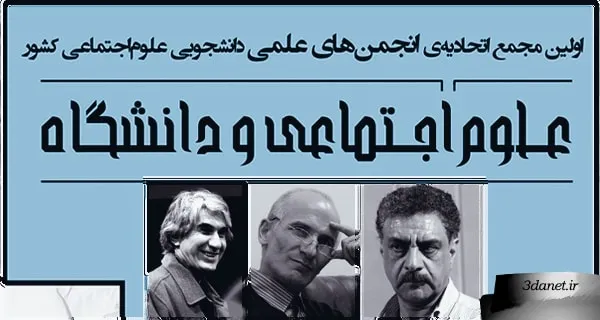
The Union of Student Social Science Associations of Iran, with the aim of defending the social sciences and expanding independent and critical social science discourses within the university and society, commences its activities with the broad participation of student scientific associations from various social science disciplines at universities across the country. It is hoped that the birth of this new institution and its activities will foster greater solidarity within the social sciences family nationwide and reduce the growing inequality between the center and the periphery. A gap that, it seems, independent civil institutions, more than any other current, have the power and competence to take a step toward reducing.
.
.
Maqsud Ferasatkhah: I must first share my assumptions with you, and you can also challenge all the foundations of my discussion with your critique. My conception of the university is that it is a social and cultural institution of a knowledge-based type. The existential philosophy of the university is the production of the public good and social welfare; this can also be understood from the historicity of the university. But the university, as a social institution, seeks to pursue this production of the public good and social welfare through scientific endeavor, science education, and scholarship. My assumption is that if the university is integrated into the logic of the state or the logic of economics, wealth, and profit, its intrinsic cultural-social identity is stripped away, meaning it loses its structural-functional nature. The four entities of the state, the market, society, and the university—in the terms of Foucault or anyone else—each have a technique. The technique of the state is power, and this technique gains legitimacy when it is lawful, consensual, and regionalized, and when there is circulation, questioning, public space, and so on within it. The technique of the market is profit, and it has legitimacy when there is competition, social welfare, and quality of life, and redistribution becomes possible. The technique of society is the Self, meaning society wants to express symbolic interaction and itself. But the technique of the university is science education, the pursuit of scientific truth, questioning, and reflection. The legitimacy of the university is also achieved through its social responsibility. University knowledge must have an impact on social welfare, must share itself in social transformation, must have a share in human development and welfare and in the sustainability of the ecosystem, and must define its share in responding to and understanding the silent mandates of society. A university that cannot thoughtfully understand the silent mandates of society in its doctoral dissertations, in its classrooms and lessons, and pursue them through scientific endeavor and science education, in my belief, is compromised in terms of the existential philosophy of the university phenomenon.
The University's Task is the Critique of Enlightenment, Not Academic Capitalism
Two inseparable traditions exist within the university; one is rationalism, which holds that the university must be capable of discovery and be depth-oriented, but the other tradition is humanism, which can be pursued through the university's cultural and social commitments at the local, national, regional, and global levels. My basic premise, then, is that the central mission of the university is the socialization of science, not its commercialization, and I feel this consideration is lacking in our society. We have become too entangled with the concept of commercialization, whereas the university's task is the critique of enlightenment, not academic capitalism; it is social entrepreneurship, not economic entrepreneurship in the strict sense of the word. In my view, the greatest trap laid in the university's path by the dominance of neoclassical economics is a trap that has cast the shadow of purely economic criteria and New Public Management over the university, and it is highly ironic that New Public Management pursues the same matter in a different form, the result of which is the McDonaldization of the university, which affects the student's questioning, their doubt and skepticism about the world, humanity, relations, the status quo, the future, the universe and mankind, and every interpretation as a contingent matter. The university's responsibility is the liberation of knowledge and its popularization, the social effectiveness of knowledge, and the democratization of science as an important human and public asset. That knowledge be freed from the monopoly of specific groups, that the democratism of knowledge occur as a decentering of knowledge, that all social stakeholders have access to knowledge and can use it to reduce hardships and improve their social life. Cognitive justice is the university's greatest mission. Instead of instrumental social sciences, we need transformative social sciences. The existence of the region and the future of our country require emancipatory social sciences, and students, having fewer attachments, are better able to pursue silent social demands and this logic, which possesses semantic legitimacy.
Six Dominant Paradigms in Eight Decades of University Activity
Over eight decades of university activity in Iran, six paradigms have cast a shadow over the university; in the first decade up to the 1950s, state-led modernization was the dominant paradigm, and academic elitism, a kind of French Napoleonic model, cast its shadow over our university. During this period, the university was largely alienated from the fabric of society. In the second period, the 1960s and 1970s, the dominant paradigm was state technocracy, and the Anglo-Saxon model replaced the French one. At this stage, the university was reduced to a machine for producing specialized human resources for the state apparatus. The third period, the threshold of the revolution, saw the paradigm of politicization and the othering of the state become dominant over the university. In this period, the university was absorbed into politics. In the 1980s, a kind of strategic shift—relative to the pre-revolution era—replaced Westernization; the paradigm of the Cultural Revolution became dominant, and the university was absorbed into the state. In the 1990s, massification and a kind of vague and appropriable social demand cast the dominance of quantity over the university, and in the midst of this, the apparent winners were the geographically marginalized groups who gained access to the university; income groups and gender groups entered the university, but ultimately, this action backfired on them because quality declined, patriarchy also existed and instituted gender quotas, and so on. In the 2000s and the sixth decade, whose consequences we still bear, the strange paradox of the overt and covert state-led monetization of the university became dominant. The dominance of the paradigm of entrepreneurship and revenue generation by the university caused its social responsibility and social capital to be tarnished.
The Comprehensive Entanglement of the University with State Bureaucracy
After this historical review, let us turn to the current situation. At present, we have five million students and 150,000 faculty members in universities, which, including their personnel and staff, means our higher education population alone equals the population of countries like Bahrain, Qatar, and Kuwait. The mass of our higher education is itself a country, but a country where about two thousand eight hundred higher education units, called universities, institutes, and so on, are strangely scattered across a territory and all entrusted to an entity called the state; a state that itself lacks cohesion, consisting of parallel apparatuses and organizations that are neither efficient nor have any lawful convergence among them. The important point is that the scattered academic realms—in terms of Iran's university atlas—exist as an obscure mass that cannot organize itself, are dispersed, and are tied in every respect to a state bureaucracy. A state that is itself a site of tense exchange between theocracy and technocracy, and all these realms have their eyes fixed on these sites and are dependent on them in every respect: for budgets, directives, and so on. Here we realize that the university and the social sciences are caught in a trap that I have called the "vicious cycle of all-state and statelessness." That is, in Iran we have an all-state situation and a stateless situation; we pay the full costs of centralization, yet we also suffer from chaos. This is our paradoxical situation in the university. This is where my main argument takes shape: that the mainstream twists and turns of power and interest continue to reproduce themselves through the apparatuses and dispositifs that are the subject of my discussion. The hegemony of the state and the market and their apparatuses re-presents its own knowledge system; that is, the identity of the social sciences, without being present and as an absent entity, is defined, re-presented, and reproduced. The university, the academic, and the student who are docile subjects. The apparatus even tends toward the dissolution of the subject and de-differentiation of the subject in the Bourdieusian sense, and in this way re-presents the knowledge system. These docile subjects are us; the student comes to the university to postpone military service, to obtain a degree from this degree shop. The professor must get promoted within this new public management, so is busy with calculations on how to organize the volume of their CV. The university president seeks to lobby in state corridors for securing budgets and decision-making, and for the next term of presidency and being elected, and so on... either lobbying on factional sidelines or in bureaucratic corridors. On the other hand, they resort to an existing monopolistic market to also run enterprises from there and make money. The employer, meanwhile, sits up there and sifts through the graduates.
The state should hand over science to the people of science
In these circumstances, too, the academic-student associations are either extracurricular appendages of the university and this situation, a marginal note on the main text of the political society, or job placement offices. There are two ways out here; one is for the state to hand science over to the people of science themselves. This is where the need for a network of universities and academics to form arises. Academic realms, as the second way out, must also free themselves from this state bureaucracy and market technocracy and recover their academic and social identity, which is currently not possible through the faculty. The organizational situation of the faculty in the university, in organizational spaces, is not so easy that this can happen through them. In my view, it is only possible through the scientific community and social hope in the third place of science where you are – this is the third place. The first place is in your privacy or the faculty's seclusion; in the second place, you take exams, pass courses, and it is the formal bases of the faculty; the third place is in this public sphere. The public sphere of science means the social interactions of science, the public domain of science, scientific journalism, the promotion of science, the popularization of science, the pursuit of the social responsibilities of science, and, in the words of Dr. Ghaneirad, the president of the Iranian Sociological Association, rising up and doing something, and through that, studying again, thinking, reflecting, and again working understandingly and critically, and through that, discovering, interpreting, explaining, elucidating, and showing solutions to reduce sufferings. It is this social hope that, in my opinion, happens in the third place, and this is made possible through the scientific, professional, and specialized associations of academics outside the organizational and bureaucratic university systems, with voluntary membership, and through student scientific associations. Outside the system and outside these political and state machines and the new public management that governs the university, this must happen.
In our society, social action has failed
The capacities of this third place are as follows; what is not in the structure exists in this space as capacity – in the Bourdieusian sense of the word. De-differentiation is in the system, and differentiation is in this space. Ethics is in the system, and morality is in this space. If I may borrow properly from Foucault; what enters society through discourses and institutions is ethics, but what, in Foucault's terms, is moral perception, experience, and sense tells me to think about human sufferings, to understand social responsibility, to fundamentally understand the responsibility of a reflective and critical understanding of conditions, requires a free practice and a personal self-awareness, which in Foucault's terms is the "technology of the self," and it is here that morality, instead of ethics, becomes relevant. This is made possible through the third place. Only through these free, self-aware activities within the realm of possibilities, voluntarily and with personal choices, can you develop yourself and become a useful and effective scientist for future generations. This moral experience through these places is important to me because I speak of moral experience in a society where we face the danger of moral failure and the failure of the institution of ethics. It is necessary, through third places and the social hope that exists within them, through practices, feelings, and experiences of participation, humanism, compassion for humanity, and having and experiencing concern for human beings. My perception is that in our society, social action has failed, and it is only through these public spaces that it can be repaired again, and social hope lies in these spaces and the public sphere, and this is what helps the classes, the theses in which there is concern, and the research that has social impact. ***
Yousef Abazari: I had prepared a text beforehand and intended to speak about society and schools of sociology. But events occurred here that make it better to address them as well. In 1956, when the East German Communist Party suppressed the workers, Brecht wrote that night, "I wish I were a member of the Communist Party." That is, Brecht would go and get his party card. At a very critical moment, when the party was busy suppressing the workers, he says he wishes he were a member of the party. Why does Brecht, who speaks so much in defense of the proletariat, say at this juncture that he wishes he were a party member and could suppress the workers?
Brecht believed that the workers were coddling themselves; they should wait for the party to get organized and prepare themselves against the imperialist camp. What does this have to do with today's meeting? The first student who spoke here disparagingly stated that professors would come here and hold forth on neoliberalism and the university. He himself later gave a speech about what a calamity neoliberalism has brought upon the university. What is the matter? If the speakers wanted to talk about neoliberalism and the university, you yourself did the very same thing. The issue is not about speech, logic, or that some people here will deliver reasoned arguments. The issue is that I must speak. Because the person who came here said nothing more than that the university and some officials have become neoliberal. Perhaps those who were invited could have offered deeper and more informed remarks. Must the connection between neoliberalism and the university be articulated exclusively by you? If someone else says it, are they serving the system of domination and acting as a safety valve, and only you are not? The very same things you say are also said by others, so you are not worried about them not talking about neoliberalism and the university. But you yourself hastily made a series of remarks about individuals, not a mechanism.
Learn
The last book I read was by Žižek. In that book, Žižek tells a joke to this effect: Marx, Engels, and Lenin are asked, do you prefer a mistress or a wife? Marx, who was very conservative, said wife; Engels said mistress; and Lenin said both. Marx and Engels asked Lenin, why both? Lenin said, so I can tell my wife I'm with my mistress, tell my mistress I'm with my wife, and then go read Hegel. Žižek's whole point there is: learn, and learn. He says that after the revolution, Lenin's entire focus was that we must somehow bring this Western bourgeois culture into Russia. Socialism in one country and building socialism were not Lenin's concerns. The whole point Lenin emphasized was: learn, and learn. Learn what? Western bourgeois culture. He believed that if you did not learn this Western bourgeois culture, we would be doomed to perish—and they did perish. Because they did not learn. At the beginning of Pedagogy of the Oppressed, Paulo Freire says that if the oppressed seize power, because they know no other world, they will do what the oppressors did, only in a different way. Because they know nothing else and only recognize the world in which they lived. Indeed, the previous world matters to them. They try to become like it. The difference being that this time they themselves are at the top of the power structure and others are at the bottom. Why did Lenin, when the World War began in 1917, imprison himself and start reading? Some also believe that the better theories he later presented were influenced by that very reading of Hegel's Logic. Where does the event come from? Now that everything is in disarray, allow me to state with all due respect that I completely disagree with Mr. Ferasatkhah's views and this ethical perspective. He himself concluded by saying that ethics, the state, etc., have failed, and yet we return to the world of ethics. If all of these have failed, where do we return to? Just as there are some supporters of the Islamic Republic who accept neither the war period, nor the reform period, nor the period of compassion, nor any period in the history of the revolution. While considering themselves the most radical individuals, in practice they accept no period at all. Yet in their own view, they consider themselves the most faithful. They speak as if they alone are loyal to the Islamic Republic, and others who defend some aspects and criticize others are hypocrites or deceivers intent on trickery. Where does this radicalism, which emerges in this sense and is opposed to learning, come from? Precisely from the very place Mr. Ferasatkhah spoke of, and with whose conclusion I disagree. The idea that everything has failed and I have nothing to fall back on gives me a strange radicalism that enables me to critique the entire world. This radicalism arises from a very intense despair regarding real human beings. Incidentally, one of the figures I wanted to mention was Badiou. Badiou is a Platonist. He considers the mathematical method the best mode of reasoning, and Plato pursues truth. He attacks all present schools—whether hermeneutics, analytic philosophy, postmodernism, etc.—on the grounds that they lead to sophistry. What is important? Truth. Truth in politics manifests itself in the event. How the event arrives is not clear. The event arrives on its own. What must we do? We must only prepare ourselves. Christian Jambet is an old Maoist who has become a proponent of Corbin and an advocate of Sufism. He has written an article in which he claims that Badiou took the concept of the event from Corbin. Those who defend the idea of communism are him and Žižek. They are people who, without embarrassment, consider themselves communists and believe that the new world has, in a sense, reached an absolute fall, because religious thought also exists in Žižek. In Badiou's view as well, the new world is ruined, and since Greece, sophistry has reached its peak. There is nothing objective for radicalism.
There is no deception at work!
One of the components of mass societies is mass ressentiment. For Nietzsche, the man of ressentiment is someone who, as it happens, desires that very power and so on, but because he cannot attain it, he theorizes it. If your point (protesting students) was that the free market and the university are two incompatible patches and should be criticized, they are expressing your point here. But you say that those criticizing here are not saying anything at all. Your statement has only two forms: one, that only I should speak, and two, that by holding these meetings, the problem of the university's link to the free market is being whitewashed. That is, again, the mass's fear that some might think and theorize. The very West from which Bourdieu, Žižek, and Lenin emerge is a master of theorizing. The student objects that a certain university official has said, "I will privatize the university." Mr. Rouhani's government has said from the beginning that we are a free-market government, and that certain official has been placed there to privatize the university. Then they also state that we will not give you any concessions, because we do not want to spoil you. Why should I speak as if they do not understand what they are doing? They understand very well what they are doing. It is a global program. As it happens, it is also in decline globally. The US presidential election shows that this system is dragging America toward destruction as well. Here, however, they have succeeded in establishing it as a theory of development. There is no concealment or conspiracy; they always say it officially. I do not mean that those who do not accept this economic system should not engage in activity or criticism, but their presupposition should not be that there are some who are deceiving others. There is no deception. This government defends these positions very openly and clearly, and they know everything. From the time of the Economic Adjustment Program onward, and when the mayor wanted to create an "Entrepôt Laurent" and so on, it is all a proper and orderly program. Some constantly object that... (a certain military institution) has been brought into the economy. The whole affair was entirely a free-market affair. They told that non-economic institution to become independent. All of this is a specific program that has been going on for 25 years, but you complain as if they were supposed to do something else and have undertaken a different task.
Let us confront the horror of issues
There is a childishness in us Iranians that I wish the free market would cure, because the free market has another side that says, like it or not, I leave no room for complaint. It was the former regime that wanted to offer appeasement, and of course it also had violence. The free market says you either perish or you survive. It is not for nothing that Mr. Ferasatkhah’s remarks emerge suddenly. These talks are in pursuit of an ethics that, in my opinion, does not exist. As it happens, the ground for these talks is a proud bourgeoisie, aware of its own interests, which has arrived in Iran and stands on no ceremony with anyone. It brings with it its own philosophy, which is the ethics of absolute ends and Kant. It constantly declares that the university is a place for science, and such talk. The university is an ideological apparatus of the state, and I, who work in it, am responsible for this apparatus. Open up the system, let us see where we stand, and then let us talk. This softening, spiritualizing, and moralizing is something else. I hope this institution takes root and works. Let the person who is at the University of Baluchistan speak for themselves about the issues of that province, and let me not decide from here for Baluchistan, Kurdistan, and so on. I have nothing to do with science and this talk; what matters to me is that the person in Baluchistan writes about what is happening there. The students themselves must also do this. Their elders, such as myself, are up to our necks in projects and so on. Let me also add that there is nothing wrong with getting a project. How is a university professor with several children supposed to live, when their salary is not equal to two days’ income of a grocer? It is obvious they must get projects. My point is that when you have taken this project, present it in society in such a way that others can also comment on it. We implore you, do not consign it to the archives where no one will see it. My meaning is simple. Mr. Ferasatkhah, do not present issues in a black-and-white, moralistic, Les Misérables-like manner. Matters are far more horrific and agonizing than what you describe. Come to terms with this horror. The free market demands that we have a Stoic ethics. Articles have been written saying that workers should accept this wage so that entrepreneurs can add to the world’s wealth. These are jokes and mockery. But the other side is the wage of the worker and the professor. My meaning is clear. There is no complaint. The state is what it is. The duty of the rest is not to complain and to do what they think is beneficial for their own lives and for their fellow human beings, with reason and prudence (not the prudence the state speaks of).
.
.
The first assembly of the Union of Scientific Student Associations of Social Sciences in Iran, titled “Social Sciences and the University,” was held on Monday, April 11, 2016, in the Ibn Khaldun Hall of the Faculty of Social Sciences at the University of Tehran. Those interested can download the full audio of this conference from the link below.
Audio of lectures by Abazari, Towfigh, Ferasatkhah, and Zandrazavi
.
.
With lectures by:
Dr. Yousef Abazari Dr. Ebrahim Towfigh Dr. Maghsoud Ferasatkhah Dr. Siamak Zandrazavi
Time: Wednesday, May 11, 2016, 5:00 PM to 7:30 PM
Location: Tehran, Jalal Al-e Ahmad Highway, Faculty of Social Sciences, University of Tehran, Ibn Khaldun Hall
.
.

Discussion0 comments
No comments yet; let yours be the first voice.