Sociology
A Critique of the Book 'Theatrocracy in the Constitutional Era' with Sepehran, Abazari, and Towfiq
The book 'Theatrocracy in the Constitutional Era' was discussed in a session attended by Abazari. While praising the book's research methodology, he called the history of thought a 'hook' and, in his critique of postcolonial currents, argued that equality is not a matter of welfare policies but a foundational declaration.
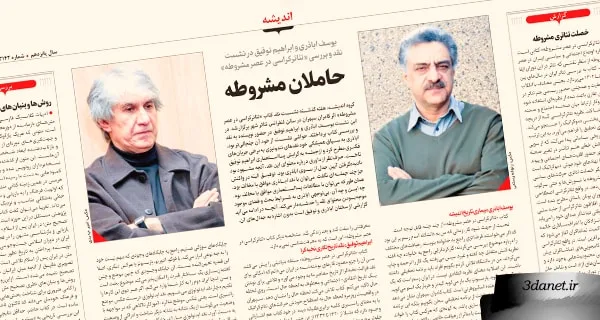
Last week, a critique session for Kamran Sepehran's book Theatrocracy in the Constitutional Era was held at the City Theater conference hall. At the session, Yousef Abazari and Ebrahim Towfiq reviewed and critiqued the book in the author's presence. The session's sidelines proved more controversial than the event itself. Abazari, in his usual manner, launched sharp, biting criticisms at certain intellectual currents, among them attacking Ebrahim Towfiq's postcolonial leanings. Regardless of any judgment on the content of this critique, what was evident was Abazari's disregard for the rules of disputation. Towfiq, for his part, said little in response beyond a few sentences. One may agree or disagree with Abazari's critique, just as one may agree or disagree with postcolonial studies. Be that as it may, Abazari's disregard for the conditions of the discussion and the prevailing atmosphere undermines the validity of the critique's content. What follows is a report of Abazari's and Towfiq's remarks, without reference to their altercations.
Yousef Abazari: The Malady of the History of Thought
The book Theatrocracy in the Constitutional Era is noteworthy from several aspects; first, in terms of its method. When I came to the university, the custom was that if someone wanted, for instance, to write a thesis on the family, they would examine various approaches to the subject: what functionalism said about the family, what interaction theory said, and so on. Then they would go and translate a work and publish it. At the university, I tried to argue that individuals must have a research program. This is by no means a reference to critical theory. In Iran, it is customary for someone to mention Parsons one time, Giddens another, and a different name each time. This phenomenon indicates schizophrenia. Kamran Sepehran's book demonstrates that one need not speak explicitly of a research program; rather, this program must flow and permeate within the book, such that anyone reading it understands whether the book is Foucauldian or influenced by a specific approach. After all, we must draw from somewhere, since we are not ourselves authorities. In this respect, this procedure became a model. From then on, I strongly emphasized to friends and colleagues that Sepehran's book should be their model. In this book, no more than three pages are written about Rancière's view, yet afterward, it is well developed, and an excellent, considerable empirical research has emerged from it. This was striking to me. Theatrocracy in the Constitutional Era avoids digression, and that is its merit.
The second point relates to the book's content. I once wrote an article for Mr. Khatami titled "Utopia and Politics," which I now think was a great mistake. In that article, I also wrote some things about Rancière. At the time, I did not fully grasp the subject, but when I read Theatrocracy in the Constitutional Era, I better understood that the declaration of equality is very important from the very beginning. In that article, I had included this Rancièrian concept that those who participate in a collective movement declare equality at the very outset, and later the police or whoever takes this equality away from them. For me, the issue of equality had always been: what should we do so that individuals become equal? That is, which welfare and justice-oriented policies should we pursue so that people become equal? In this regard, from any perspective you approach equality, there is a flaw in it, because equality is deferred to a utopia where individuals are equal. But in Rancière's view, equality is always declared from the very beginning, but later it is taken back from us. This was an important concept for me, which is pointed out in this book.
The third point concerns the final section of the book, which critiques the history of ideas. I share Sepehran's view from this perspective, because I have always detested something called the history of ideas and it always struck me as a bogus concept. The historiography of ideas, even in its best liberal example, Isaiah Berlin, has a simple Weberian thesis: the plurality of values. Values are plural and cannot be combined. If you want liberty, you lose justice, and if you want justice, you lose liberty. Berlin wrote the history of ideas on the basis of this Renaissance idea. He began with the Renaissance and not, say, with Plato and Platonic ideas, because he had no need to do so and was not obliged to perform a balancing act. Berlin does not stitch everything and everyone together, like Mr. Tabatabai and his ilk, to produce a bizarre narrative from Iran's prehistory to the present and future. In this respect, I agreed with Sepehran that writing the history of ideas throws everything, even contemporary history, into chaos.
He brilliantly demonstrates that changes in the distribution of the sensible and sensibility are accidental. I believe part of it is accidental, but part of it is not, just as the writing of this book is not accidental. The history of ideas assumes that there is a body of thought that explains the world. Rancière shows that there is no such thing as thought in principle; rather, there is a set of actions and praxis in everyday life. This does not mean, of course, that no thought is implicit in these actions. The most important tradition for us Iranians dates from the Constitutional era onward. Before that, we have nothing, or very little that is of any use. In the modern age, two traditions emerged: postmodernism and postcolonial studies. Within postmodernism lay the very neoliberalism of late capitalism. These set in motion the farce of the history of ideas: Was the Constitutional Revolution modernity, or tradition, or a link between modernity and tradition? Futile debates of which no trace remains today, which had no function whatsoever and were never meant to solve any problem.
Postcolonialists are divided into three groups: 1) Nativists; people like Mr. Kachouian, who resort to religious traditions. The basis of postcolonial studies, influenced by Marxism, rests on the differences between types of capitalism—for instance, Indian capitalism differs from Western capitalism because this capitalism was imposed on us by the West, and consequently missions such as bringing democracy and hegemony to all classes were not accomplished. From this premise, they conclude that we have categories that must be considered in the observation of colonialism and postcolonialism, because the emergence of capitalism was incomplete and remnants of feudalism and slavery persist within it. They then claim that reason comes up to our doorstep but does not enter. Mr. Kachouian says exactly this and believes that in opposition to Western science, we must have an Eastern science, which we will establish in the next 300 years. 2) The Iranshahri monarchists, represented by Seyyed Javad Tabatabai; 3) The identity-less, represented by Mr. Towfiq.
This last group is indecisive; it is unclear what they are saying. When I read his book 'The Knowledge System,' I saw that he is postmodern and postcolonial. On the one hand, he does not refer to religious tradition (the first group), and on the other, he is a critic of Iranshahri monarchy (the second group). This is where epistemology enters the picture, which Mr. Soroush set in motion in Iran. If you read Adorno's 'Against Epistemology,' you will realize that Heidegger was right to say that epistemology is characteristic of periods of crisis, and a nation that does not know what to do thinks it must first firm up its knowledge and then live. Another characteristic of the book 'Theatrocracy in the Constitutional Era' is that it does not engage with epistemology.
Ebrahim Towfiq: A Critique of Elitist Historiography
The book 'Theatrocracy in the Constitutional Era' raises a fundamental issue. I consider it among the few works written in Iran that creates a possibility for critiquing the elitist reading of our contemporary history and is an attempt to write a critical-social history oriented toward the present moment. I emphasize the present moment. The book tries to show the present moment. In the everyday reality of the present moment, Sepehran has seen what he calls theatocratic movements, or in the Rancièrean sense of the word, egalitarian movements. There are also references in the book itself that, for example, from 1941 to 1953, there were moments of this kind.
If we go further, we arrive at the description Asef Bayat gives of the 1979 revolution, calling it a council revolution. In fact, in the early years of the revolution, before the establishment of the existing order, the theatocratic moments are precisely what Bayat describes as a council revolution. I set theater aside because I have no expertise in it. After the early years of the revolution, we repeatedly witnessed the emergence of theatocratic moments. Similar to what Sepehran presents in his reading of the Constitutional Revolution. He, in his own words, genealogically and retroactively seeks to find where the moments we now face (the most recent one is so close that we may still be in it) began and how far back it can be traced. In a sense, the things happening now and the intervals mentioned are apparently repetitions of that inaugural moment he traces back to the Constitutional Revolution.
It is true that 'repetition' is a problematic word, but they are nonetheless different repetitions of an emergence whose beginning seems to lie in the Constitutional Revolution. It thus enables another reading of the Constitutional Revolution which, as Sepehran says, is not based on a reading of failure, a reading that is not founded on writing a history of absence (meaning we lacked reason). The history of absence today, as Mr. Abazari notes, is seen in Tabatabai's thought-centered perspective. It is not reflected only in Tabatabai; it began in the 1960s with Fereydun Adamiyat and reaches a new peak in Tabatabai. All of this apparently renders impossible something that Sepehran seeks to highlight, and with which I sympathize: a historical reading of the theatocratic emergences that occur around it, and tracing and finding its point of origin. As he describes it, this origin is not so distant—a hundred years have passed since then.
Let us address the subject with regard to the situation we are in. Mr. Abazari, in his article 'Utopia and Politics,' which he apparently no longer endorses, also makes references to this subject. I highlight the moment in Sepehran's work where an attempt is made to trace it. What he has called theatocratic apparently possesses one characteristic: problematization. I want to focus on that and, in doing so, offer my critiques of your work. That is the gaze we cast from Tehran and from the center upon these movements. When I cite Asef Bayat as an example, or the events from 1941 to 1953 and the subsequent movements, the most recent of which is close to us, the gaze directed at these movements—and which has a prominent presence in our expression, mind, imagination, and feeling—is that once again the backward masses of the peripheries are causing trouble and disrupting what we are approaching. Long before this, Fereydun Adamiyat, referring to the Constitutional Revolution and the provincial, state, and city anjomans, called them 'the rabble.' The continuation of 'the rabble' can be seen in the terminology and interpretation offered by Tabatabai. I think this continuity is something whose inaugural moment also goes back to the Constitutional Revolution. That is, even in the Constitutional period, we encounter a reading that gazes from the center upon the periphery as backward elements who should play a different role but are spoiling the game.
Opposing the power structure and scratching it are the moments that explain the distribution of the sensible in Sepehran's work. When we identify the bearers of theatrocracy among women, ethnic and religious minorities, workers, and peasants, the author immediately tells us he is not using sociological classifications but rather the mode of presence of these various groups who have become out-of-place. Perhaps it is better to say a specific place is prescribed for them, and when they step out of that place, they make visible a power structure that is not visible in itself—that is, that power structure has made possible a distribution of the sensible in which women and minorities remain in their place. Mr. Sepehran says these events are contingent and event-like. I agree with both. Events in this sense are ahistorical or anti-historical, meaning they do not allow history, or an order historically formed, to continue as it is. But in my view, they cannot be placed outside the historical calendar, nor are they forces that have suddenly fallen from the sky.
My objection to the book is that it does not follow through to its logical conclusion. In this sense, in its historical reading, despite appearances, it is not radical because it leaves two things unclear for us. First, how did the distribution of the sensible become possible at that historical juncture, how did the forces involved in this matter emerge onto the scene, and what confrontation is taking place? Second, once this distribution of the sensible is established (since we are talking about the moment of beginning and rupture), how did its continuation and reproduction become possible, and within this very context, what are the forms of expression that reflect this distribution of the sensible? They are no longer in a position where they can only be criticized epistemologically. That is, to say that a certain interpretation is wrong and to provide better knowledge in order to, for example, bring Tabatabai down from the heavens to earth.
When we discuss a discursive apparatus and a knowledge system that reflects a power structure, we are in fact talking about subject positions, about existential positions where it does not matter how one expresses oneself, whether through Foucault, Adorno, Parsons, or anyone else. This is not at all decisive. That existential position which makes such a stance and such a discourse-formation of a power structure possible is the subject of discussion, and here I raise my second objection to your work. If we do not do both of these things, we fall into the trap of ideology critique. Ideology critique is the exact opposite of the Rancièrian position, that is, the opposite of the position of the ignorant schoolmaster who, in confronting a situation, tries to gain knowledge and understanding of the situation from one sign to another. Ideology critique places us in a position where we step out of the position of the ignorant schoolmaster and assume the position of the omniscient one who tells others, 'You have misunderstood.' If the matter were this simple, we would have left the likes of Tabatabai behind long ago. Contrary to Mr. Abazari's opinion, the problem is much more fundamental.
The moment that Sepehran describes as the inaugural moment of our current situation is, in a sense, a foundational situation. At this moment, a serious transition and historical rupture occurs that is two-sided, with two different tendencies. Our historiography has so foregrounded one tendency that nothing is visible beneath it. The art of Sepehran and those like him lies in striving to understand the underlying layers. The two tendencies are: 1) A transition from the Guarded Domains. The Guarded Domains is not what Katouzian calls our historical despotism, but rather a relatively decentralized structure guarded by a central power; 2) This tendency stands in opposition to becoming a nation-state. There are also two ideas: one seeks to build a nation-state that compensates for our backwardness and, under specific historical conditions, sees the elimination of backwardness as possible only by completely dismantling the entire structure of the Guarded Domains, creating something from the center that transforms the people into a nation. I call this 'Tanzimat,' which plays a very strong role in the Constitutional Revolution.
Therefore, I harbor no illusions about the Constitutional era. The force that led the Constitutional Revolution and later declared it defeated finds another solution: it pursues an enlightened dictatorship, which I call regulatory politics. From the reforms of Amir Kabir to the Tanzimat of Sepahsalar, they are part of this current. The second tendency has not been discursively formed in our historiography. One of the significances of Sepehran's work lies in his effort to discursively form a praxis that has not been discursively formed and is therefore always lost. It emerges at certain moments but is always lost under the dominant Tanzimat discourse. That tendency manifests itself in the anjomans, to which Sepehran refers. The anjomans were not only in Tehran and the major cities but existed with varying degrees of strength and weakness throughout the Guarded Domains. For instance, it was stronger in Azerbaijan and Gilan, because its bearers traveled to Baku and the Russian Social Democratic movement, and so on. It must be historically examined how, in the Constitutional Constitution, one of the principles that was immediately proposed and not subject to debate is the provincial and state anjomans. Our critical historiography does not recognize how this principle, alongside the other important principle that 'the king must reign, not rule,' comes to sit at the heart of the constitution. But in our historiography, it is pushed aside, and only the principle that 'the king must reign' becomes the determining one. We can call this tendency the nation-state organization of the Guarded Domains or the modernization of the Guarded Domains.
The conditions after the Constitutional Revolution until Reza Shah's rise to power constitute a transitional period in which the idea of modernizing the nation-state of the Guarded Domains, with all its theocratic manifestations, is gradually pushed back. In his previous work, 'Traces of Tremor,' Mr. Sepehran, referencing the historical novel, raises an important discussion. There, a genre of tremor is demonstrated. At that moment, dualities are formed, such as the duality of Tehran and non-Tehran, city and village, man and woman, and so on. On one hand, we see a technocratic-bureaucratic tendency in the state, which is the heir to a long-standing despotism that has turned the country into a patchwork of tribal fiefdoms. If we want to join the caravan of civilization, we must abolish this legacy of tribal fiefdoms and transform the population into a single nation. This is the ideal figure upon which the state is formed.
Sepehran attempts to oppose the narrative of failure regarding the Constitutional Revolution, but we do not have a single narrative of failure. Our discourse reproduces its own counterpart of power. From the time of the Constitutional Revolution until Reza Shah's rise to power, a discourse of failure emerges, suggesting that the Constitutional Revolution was not successful in its mission and therefore we need an enlightened dictatorship. This is not the narrative of failure in which we currently live. The current narrative of failure is different and historically took shape gradually from the 1960s onward. This narrative is academic and manifests itself through figures such as Fereydun Adamiyat, Katouzian, and Ashraf in historical sociology and scientific historiography. In the second narrative, an ideal of failure is constructed from the Constitutional Revolution, an ideal that was supposed to extract us from a historical despotism of several thousand years and was the result of the awareness of certain elites among the rulers and intellectuals who did not implement the constitution, for instance, as it was implemented in England. That is, they were not good elites. This is constructed in hindsight, as a result of the Pahlavi regime's consolidation of power in the 1960s. In this account, a long history of several thousand years is linked to the present moment.
In the book 'Theatrocracy in the Constitutional Era,' there is a danger of offering a historical explanation of the various moments in which theatocratic uprisings occur. The uprising within which we still live is related to the Constitutional uprising, but we cannot say it is the same. There are serious differences that must be explained in their proper place, just as the period from 1941 to 1953 must be explained separately. Although we see repetitions, they are different repetitions, the understanding of which requires a critical historiography.
.
.
PDF file of the Shargh newspaper report
.
Audio of Kamran Sepehran's speech
Audio of Yousef Abazari's speech
Audio of Ebrahim Towfiq's speech
Audio of Q&A session
.
.
A Critique of the Book 'Theatrocracy in the Constitutional Era' with the presence of Kamran Sepehran, Yousef Abazari, and Ebrahim Towfiq | 4 May 2018
Text source: Shargh Newspaper - Issue 3142 - 8 May 2018
Audio source: Sociological/Anthropological Files Telegram Channel
.
.

Discussion0 comments
No comments yet; let yours be the first voice.