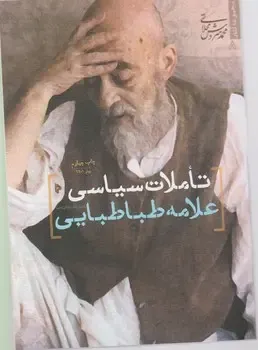
Why this book?
- This book presents a coherent picture of the foundations of Allameh Tabatabai's political thought.
- This work addresses the relationship between Sharia, reason, ethics, and government in Allameh's thought.
- The book examines Allameh's view on freedom, justice, and religious despotism.
- This research is useful for those interested in Islamic political philosophy and the social interpretation of the Quran.
About the book
"Political Reflections of Allameh Tabatabai," written by Mohammad Soroush Mahallati, is an attempt to illuminate the less-examined dimensions of Allameh Seyyed Mohammad Hossein Tabatabai's political thought. In this work, the author delves into topics that, within Allameh's exegetical and philosophical works, have provided important grounds for discussing politics, government, and society.
In various chapters, the book addresses topics such as the philosophy of government, justice, the relationship between jurisprudence and ethics, the domain of religion, religious despotism, freedom, the implementation of Sharia, and the relationship between revelation and opinion. In this analysis, Allameh considers a government desirable that is connected with human rights, reason, and the moral education of society.
Among the central points of the book is the examination of Allameh's view on the role of the people in government, his critique of religious despotism, and his emphasis on the place of ethics in a religious society. Soroush Mahallati also shows that Allameh presented noteworthy and distinct views on certain political issues, including the relationship between religion and government and the concept of freedom.
This book is worth reading for researchers of Islamic political thought, those interested in Allameh Tabatabai, and anyone interested in the relationship between religion, politics, and society in the contemporary Islamic world.