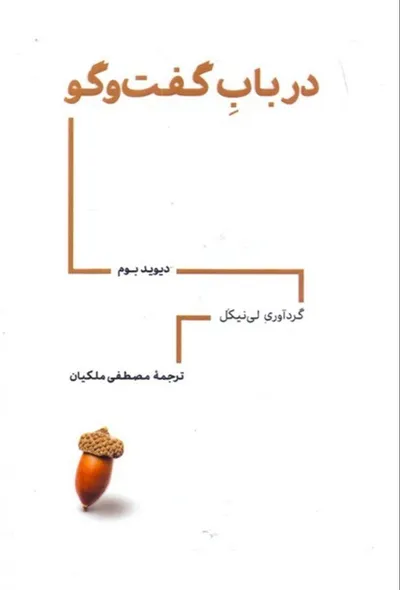
Why this book?
- To become acquainted with David Bohm's conception of dialogue as a way of forming shared understanding.
- To understand the role of assumptions and thought patterns in creating misunderstanding and conflict.
- For those interested in the relationship between individual thought, human communication, and collective understanding.
- This edition is published with a new and revised translation by Mostafa Malekian and three introductions by the translator, Peter Senge, and Lee Nichol.
About the book
On Dialogue is one of David Bohm's important works on human communication, thought, and collective understanding. Bohm, best known as a theoretical physicist, addresses a problem in this work that lies beyond the realm of physics: why, despite speaking with one another, do humans so often fail to reach a shared understanding, and how can the conditions for a different kind of communication be created?
In Bohm's view, dialogue is not merely discussion, negotiation, or an attempt to persuade another. Dialogue is an opportunity in which individuals can observe their own assumptions, judgments, and thought patterns and see how these very patterns affect their perception of others and the world. From this perspective, the issue is not just the content of what we say, but the process through which thought takes shape in the individual and the collective.
This subject is linked to Bohm's broader concern with wholeness, thought, and fragmentation in human experience. The book's significance lies precisely in this shift of perspective: instead of being merely a skill for better speaking, dialogue becomes a way of observing thought and the possibility of a shared understanding emerging.
The present edition has been published with a translation by Mostafa Malekian by the cultural institute "The Endless Path of Dialogue." The book also includes three introductions by Mostafa Malekian, Peter Senge, and Lee Nichol, which explore the context and significance of Bohm's thought on dialogue from various angles.