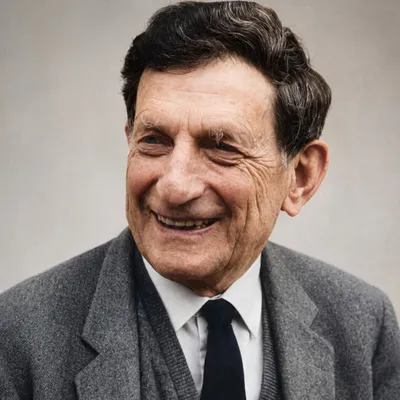
Foreign thinker
David Bohm
David BohmTheoretical Physics, Quantum Mechanics, and Philosophy of ScienceAmerican-British1917–1992
Life and Thought
David Bohm was an American-British theoretical physicist and philosopher of science, and a major figure in twentieth-century research on the foundations of quantum mechanics. Through his causal and realist interpretation of quantum theory, as well as concepts such as the implicate and explicate orders, he influenced discussions in the philosophy of physics, mind, and consciousness.
David Joseph Bohm was born on 20 December 1917 in Wilkes-Barre, Pennsylvania, in the United States. He studied physics at Pennsylvania State University and later completed his PhD at the University of California, Berkeley, under J. Robert Oppenheimer. Early in his career, Bohm conducted research on plasma physics and the collective behavior of electrons; he later became one of the leading researchers on the foundations of quantum mechanics.
Bohm is best known for the causal interpretation, or de Broglie–Bohm interpretation, of quantum mechanics. In 1952, he proposed a theory that offered a realist and deterministic picture of quantum phenomena in contrast to the conventional Copenhagen interpretation. This work later influenced discussions of quantum nonlocality and John Bell’s research.
From 1961 to 1987, Bohm was Professor of Theoretical Physics at Birkbeck College, University of London. In his later years, his interests extended beyond physics to the nature of reality, consciousness, thought, and language. He introduced the concepts of the implicate and explicate orders to explain a fundamental wholeness in reality, and collaborated with Basil Hiley on the theoretical foundations of physics.
His major works include Quantum Theory, Causality and Chance in Modern Physics, Wholeness and the Implicate Order, and, with Basil Hiley, The Undivided Universe. Bohm also reflected on dialogue as a means of observing and moving beyond entrenched patterns of thought, an approach later known as Bohmian dialogue.
David Bohm died in London on 27 October 1992. His legacy lies at the boundary of theoretical physics and philosophy, and his work continues to attract attention in debates on the interpretation of quantum mechanics, wholeness, consciousness, and the relationship between thought and reality.