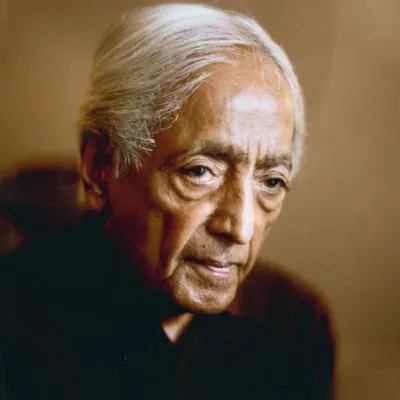
Foreign thinker
Jiddu Krishnamurti
Jiddu KrishnamurtiPhilosophy of life and spiritualityIndian1895–1986
“Truth is a pathless land.”


Life and Thought
Jiddu Krishnamurti was an Indian philosopher, speaker, and writer who became globally known for his critique of traditional structures of thought, spiritual authority, and the search for individual truth. He emphasized psychological freedom, self-knowledge, direct observation of the mind, and liberation from conditioned patterns.
Jiddu Krishnamurti was born on 11 May 1895 in Madanapalle, southern India. As a child, he attracted the attention of members of the Theosophical Society and was presented by some followers of that movement as a figure associated with the idea of a “World Teacher.” In 1929, however, he dissolved the Order of the Star and argued that truth cannot be attained through organizations, fixed doctrines, or obedience to external authorities.
After that, he devoted his life to lectures and dialogues on subjects such as consciousness, fear, freedom, relationships, education, and the nature of the mind. His thought emphasized that human beings can become free from cultural, social, and psychological conditioning through careful observation of themselves and understanding the mechanisms of the mind.
Among his works are Freedom from the Known, The First and Last Freedom, and writings on freeing the mind from the past. He generally avoided presenting a systematic philosophy and instead emphasized inquiry, observation, and direct experience. He died on 17 February 1986 in Ojai, California, and his intellectual legacy remains influential in philosophy of life, education, psychology, and studies of consciousness.