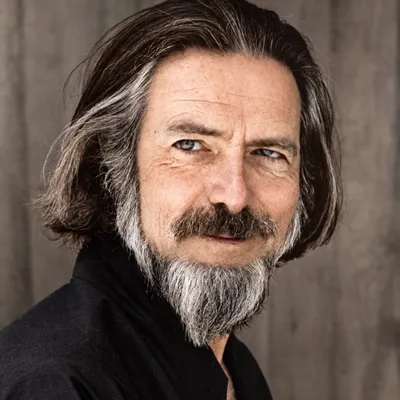
Foreign thinker
Alan Watts
Alan WattsComparative Philosophy and Eastern MysticismBritish-American1915–1973
The only way to make sense out of change is to plunge into it, move with it, and join the dance.


Life and Thought
Alan Watts was a British-American writer, lecturer, and philosopher who, in the mid-twentieth century, interpreted and popularized Eastern thought and mysticism — particularly Zen Buddhism, Taoism, and Hinduism — for a Western audience. His book "The Way of Zen" (1957) was one of the first bestselling works on Buddhism in the West and made him a spiritual figurehead of the 1960s counterculture.
Alan Wilson Watts was born on January 6, 1915, in Chislehurst, Kent, England, to a middle-class family; his father was a sales representative for the Michelin Tyre Company and his mother a teacher. From childhood, he was captivated by Far Eastern art and ideas, inspired by Oriental objects that missionaries had given his family.
Watts moved to the United States in 1938 and began Zen training in New York. He earned a master's degree in theology from Seabury-Western Theological Seminary and was ordained an Episcopal priest in 1945, but left the ministry in 1950 and moved to California, where he joined the faculty of the American Academy of Asian Studies in San Francisco.
Through the 1950s and 1960s, Watts became one of the most widely known interpreters of Eastern philosophy and mysticism in the West via radio broadcasts and a prolific body of books, including "The Way of Zen" (1957), "Nature, Man and Woman" (1958), and "Psychotherapy East and West" (1961). He conveyed Buddhist, Taoist, and Hindu philosophy in clear, literary prose accessible to general readers, and helped establish the Esalen Institute alongside figures such as Aldous Huxley and Gregory Bateson.
Watts's thought blended Taoism, Zen Buddhism, Jungian psychology, and Western philosophy, emphasizing the unity of self and world, the dissolution of mind-body dualism, and living fully in the present moment. He also explored psychedelic experience as a means of investigating consciousness, notably in works like "The New Alchemy." Watts died on November 16, 1973, in Marin County, California; his legacy continues through the Alan Watts Organization, directed by his son Mark Watts.