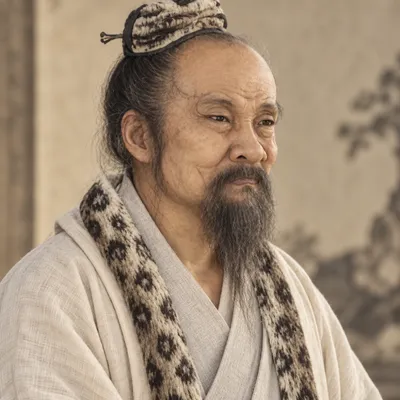
Foreign thinker
Zhuang Zhou
Zhuang ZhouTaoist philosophyChinese369–286 BCE
My life has a limit, but knowledge has none; to pursue what has no limit with what has a limit is dangerous.


Life and Thought
Zhuang Zhou (c. 369–286 BCE) was a Chinese philosopher and one of the principal founders of Taoist thought; the book attributed to him, the Zhuangzi, stands alongside Laozi's Tao Te Ching as a foundational text of the tradition. Through storytelling, humor, and paradox, he explored the relativity of human knowledge, freedom from social convention, and spontaneous harmony with the Tao.
Zhuang Zhou was born around 369 BCE in the state of Meng, in ancient China's Song territory, and lived during the tumultuous "Warring States" period of Chinese history. Aside from a handful of scattered anecdotes — including his refusal of an important political post in order to preserve his personal freedom — little documented information survives about his life.
The main work attributed to him, the Zhuangzi, is a collection of parables, allegories, and philosophical dialogues; scholars generally attribute only part of it, especially the "Inner Chapters," to Zhuang Zhou himself, regarding the rest as the work of followers and related schools. Together with the Tao Te Ching attributed to Laozi, it is one of the two foundational sources of philosophical Taoism.
Zhuang Zhou's thought centers on the relativity of human perspectives, the invalidity of fixed judgments about right and wrong, and liberation from the constraints of conventional language and logic. The famous "Butterfly Dream" parable — in which, after dreaming he was a butterfly, Zhuang Zhou could no longer tell whether he was a man who had dreamed of being a butterfly or a butterfly now dreaming of being a man — brilliantly illustrates this approach. He located true freedom in spontaneous accord with the Tao (the natural way or flow of existence) and in freedom from social artifice and convention, an approach he set against Confucian moral formalism.
Zhuang Zhou left a lasting mark on Chinese intellectual tradition as well as on world philosophy and literature, and is remembered as one of the most profound and poetic figures of ancient philosophy.