Why this book?
- Shows how a kind of psychotherapy can be extracted from Spinoza's philosophy.
- Examines the relationship between our beliefs and interpretations and our emotions and mental suffering.
- Explains the three kinds of knowledge—imagination, reason, and intuition—in relation to human life.
- Establishes a link between human identity, cultural conditioning, and emotional freedom.
- Provides a basis for critiquing the role of culture and society in the formation of psychological disturbances.
About the book
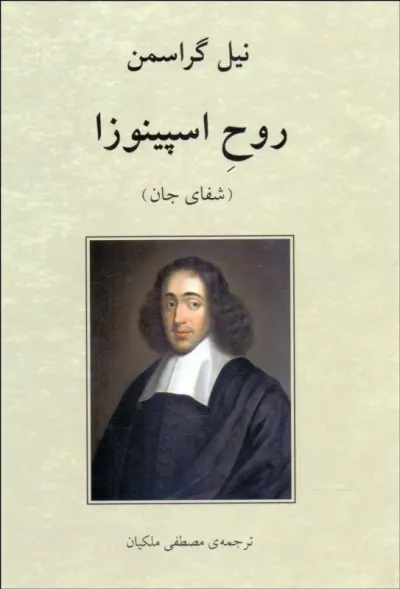
"The Spirit of Spinoza (Healing the Soul)" by Neal Grossman is an attempt to read Baruch Spinoza's philosophy from the perspective of practical life and mental health. The book's central question is whether a method for liberation from certain sufferings and mental disturbances can be extracted from Spinoza's philosophical system, especially his theory of human beings and emotions.
To answer this question, Grossman begins with the foundations of Spinoza's philosophy. The structure of the discussion moves from metaphysics and Spinoza's conception of God and the world to the nature of the mind and the human being, and then examines desire, emotion, liberation from the bondage of emotions, and transcendence. In this way, the psychotherapy the book envisions is not separate from Spinoza's philosophical foundations but is the result of the picture he provides of God, nature, humanity, and necessity.
One of the book's key axes is the examination of the origin of emotions and the role of beliefs, interpretations, and social and cultural conditioning in their formation. Grossman also addresses the kinds of knowledge and the difference between the everyday personality and the deeper identity of the human being, using these discussions to explain the possibility of liberation from emotional bondage.
This work follows Grossman's research interest in Spinoza's philosophy, but instead of offering a purely academic exposition, it tries to connect his ideas with the tangible problems of life. The conversational style and attention to practice and reflection also make the book accessible to audiences beyond specialist philosophy students.
"The Spirit of Spinoza" is suitable for those interested in Spinoza's philosophy, the relationship between philosophy and psychology, the origin of emotions and mental suffering, self-knowledge, and the meaning of freedom. The Persian translation of this work has been done by Mostafa Malekian.
"Thus, the sole and primary purpose of this book is to present a method of psychotherapy derived from the philosophy of Spinoza. However, Spinozistic psychotherapy is entirely based on his philosophical theory of human emotions, and this, in turn, is completely based on his theory of human nature, and this one is fully dependent on his theory of God and God's relation to the universe in general and to humanity in particular. Therefore, the author of this book had no choice but to, first, report and analyze Spinoza's view on God and God's relation to the universe and humanity, then his view on human nature, after that, his view on human emotions, and, finally, his method of psychotherapy."
From the table of contents
- 1Metaphysics
- 2Mind
- 3Desire and Emotion
- 4Liberation from Bondage
- 5Transcendence