Why this book?
- It clarifies the relation between economics and ethics from Gandhi’s perspective.
- It introduces the intellectual roots of the idea of universal welfare in Gandhi’s thought.
- It offers a concise and fundamental critique of conventional economics and its neglect of the human being.
- It is helpful for understanding nonviolent politics, self-rule, and social justice in the Gandhian tradition.
About the book
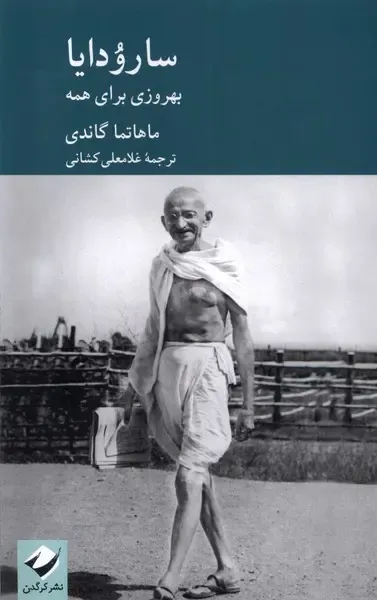
Sarvodaya (Welfare for All) is Mahatma Gandhi’s adapted text from John Ruskin’s Unto This Last; a book that appears to deal with political economy and the question of labor, but in Gandhi’s reading becomes an ethical, social, and spiritual proposal for collective life. In this work, Gandhi seeks to show that economics, when separated from humanity, empathy, and justice, turns into a rigid and unjust mechanism.
The importance of this book in Gandhi’s thought goes back to the effect Ruskin’s text had on his life. After encountering it, Gandhi moved closer to the ideas of simple living, equal labor, self-reliance, small communities, and decentralized social organization. This is where Sarvodaya finds its meaning: the welfare of all, not the prosperity of a special group or economic gain detached from ethics.
The book stands against a form of conventional economics that sees the human being mainly as labor power, a consumer, or a number in the equation of supply and demand. Against this view, Gandhi and Ruskin emphasize the dignity of work, moral responsibility, justice in economic relations, and the possibility of alternative forms of living. In this sense, Sarvodaya is not merely an economic text; it is part of Gandhi’s broader thought on nonviolent politics, self-rule, and ethical life.
This book is useful for readers interested in Gandhi, critiques of development, ethical economics, social justice, and the relation between politics and spirituality. It is also suitable for those who want to think about alternatives to the dominant logic of the market and the centralized state.