Economic Sciences
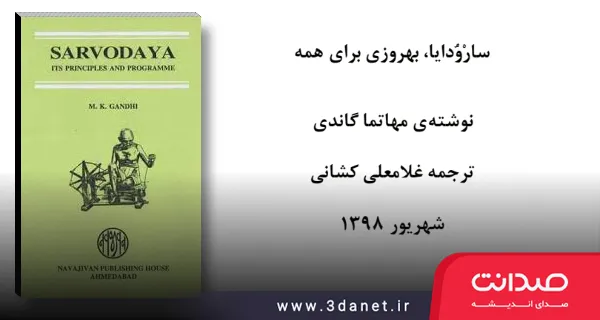
Sarvodaya: The Welfare of All by Mahatma Gandhi
Sarvodaya, a concept drawn from the thought of John Ruskin that transformed the course of Gandhi's life, critiques conventional economics and offers ethical solutions for universal well-being and the reform of labour relations.

Sarvodaya: The Welfare of All by Mahatma Gandhi
Gholamali Keshani,
Kargadan Publishing
A book for life!
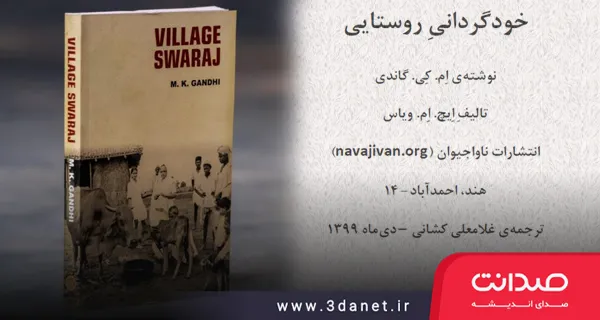
The initial subject of Gandhi's adapted book is apparently political economy and surplus value, but John Ruskin, followed by Gandhi and, later, the translator, expand it to human welfare, alternative economic-governance-spiritual solutions arising from washing one's eyes anew (a paradigm shift), paths born of rejecting mainstream ideas, with a critique of mainstream development and the critical perspective of post-development in its earliest appearances.
The book "Sarvodaya, The Welfare of All" discusses the great flaw of conventional economics, which overlooks spirituality and human ethics in economic calculations and plans, seeing the human as a mechanical puppet whose only physical labor is accounted for in the production process, devoid of human affection, empathy, and dynamism, and merely a silent parameter in the equations of supply and demand; consequently, in the author's words, it breeds human injustices and miseries. In the simplest language and manner, we become acquainted with the accumulation of wealth and surplus value on one side of economic relations, and then we arrive at seeking remedies.
What is Sarvodaya?!
Karl Marx (1818–1883), philosopher, sociologist, historian, philosopher of history, economist, politician, social activist, and one of the most epoch-making thinkers of the modern era, offered highly challenging views in all his fields of interest in the second half of the nineteenth century; and among them, the theory of "surplus value" in political economy and the recognition of the rights of "labor power" was one of the most important, elaborated in detail in his book "Capital." Since then, this theory has been considered in all schools of political economy.
Among those who have thought about "surplus value" and had a different view of it, the preeminent critic of Victorian art and architecture, art patron, skilled watercolorist, prominent thinker of social economy (relying on charitable organizations, cooperatives, and other NGOs and the foundation of the welfare state), and great philanthropist, the Englishman "John Ruskin" (1819–1900), who, like Marx, also had various other interests. But in one of them, he shared common ground with Marx: in "political economy."
Marx wrote the first volume of "Capital" in 1867, and Ruskin wrote "Unto This Last" in 1862, that is, 5 years earlier. The main subject of this work by Ruskin is also the recognition of labor rights, but in his own way. Unlike Marx, he seemingly does not see an inherent and intrinsic struggle between the owners of labor power (wage earners) and capital (or employers), but he sees clear injustice and unfairness in capitalist exchanges in the specific contemporary historical sense, as well as in its general sense (the ancient, prevailing law of supply and demand), and offers a solution to remedy it. Ultimately, the book "Unto This Last," unlike Marx, does not frame the problem as a win-lose for one class and strives to propose a win-win solution by introducing the intervention of ethics into the self-evident assumptions of conventional market economics.
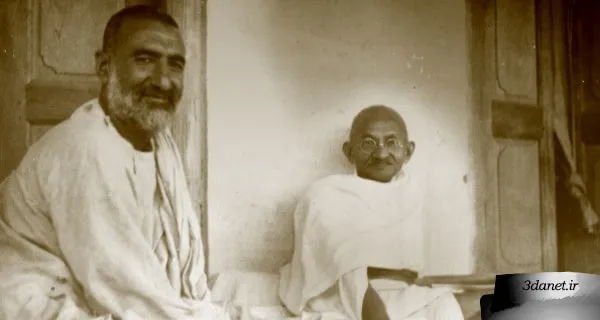
Gandhi – this social activist, the politician-god-man, the god-man-politician, and the philosophical anarchist activist who, contrary to popular perception, for most of his active life, turns towards the most practical form of a step-by-step movement towards non-violent anarchism (that is, the reconstruction of India's villages and the establishment of a healthy society, arising from an archipelago of proud and contented villages, with a self-governing, decentralized, and voluntary organizational structure, along with ceasing to expect services from the stupid giant of the state, the large, highly centralized, and inefficient government) – in his youth and by chance, in South Africa, comes across this very book and reads it.
He, unlike most intellectuals and mental workers, was not much of a reader; he was no pedant; and it is well known that in his later years, he owned no more than six books. He had no knowledge of philosophical debate whatsoever; he read less and insisted more on reading what he had already read with greater depth and acting upon it better. Gandhi reads this book over the course of a day and night on a train journey and devours its meaning. And thus, another Gandhi is born.
From the following day, he resolves to change his entire being, but for this inner change, he must alter "labor relations" so that through this outward change, he might also sense inward transformations within himself. He establishes a "commune" named "Phoenix" in South Africa, to put into practice what he had read; he also publishes a summary of the book itself in Gujarati, under the name "Sarvodaya," in his journal "Indian Opinion." Later, he organizes another commune bearing the name of Tolstoy.
Now, the paper edition of the translation of this work by Gandhi is presented to interested readers who:
day and night, in alleys and streets, media, and social networks, witness all manner of disruptions, deficiencies, and injustices that appear irremediable, untouchable, eternal, and primordial.
Proudhon, Feuerbach, Marx, Ruskin, and many others have claimed to offer remedies for unjust "labor relations," the "free market," and "supply and demand," but this time, we will read a remedy in the words of Ruskin-Gandhi, injecting ethics into the rigid, mechanical framework of market economics. And, of course, we will become acquainted with highly diverse appendices that not only introduce us to a Gandhi of a different sort but also offer dozens of new ways to think about alternative paths to today's mainstream economics and way of living, yet along the very same trajectory as Gandhi and Ruskin.
All of these appendices, which bring the book's volume to 700 pages in the second volume, are available for download on the Non-Violence website.
Appendix: The book «Sarvodaya: Marx, Gandhi, and Ruskin!» on the Non-Violence website


Discussion0 comments
No comments yet; let yours be the first voice.