Political Science
Mahatma Gandhi, Abdul Ghaffar Khan, and Palestine Today
As hope for peace between Palestine and Israel endures, the experience of Gandhi and Ghaffar Khan shows how nonviolent resistance overcomes fear and the cycle of revenge. Bidding farewell to arms in the face of blood enemies is the contemporary lesson of the satyagraha strategy.
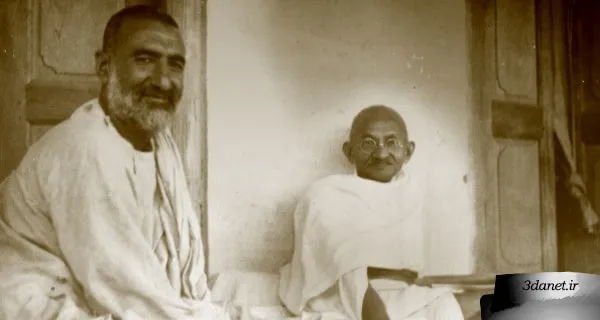
Notes: Rajmohan Gandhi, a former member of the Rajya Sabha (the upper house of India's Parliament), is a visiting professor with the Program in South Asian and Middle Eastern Studies at the University of Illinois at Urbana-Champaign. His latest book is Ghaffar Khan: Nonviolent Badshah of the Pakhtuns. He is also the author of The Good Boatman, a biography of his grandfather, Mohandas (Mahatma) Gandhi. This article is a translation by Gholamali Keshani, completed in 2006. Rajmohan Gandhi, a former member of the Rajya Sabha (the upper house of India's Parliament), is a visiting professor with the Program in South Asian and Middle Eastern Studies at the University of Illinois at Urbana-Champaign. His latest book is Ghaffar Khan: Nonviolent Badshah of the Pakhtuns. He is also the author of The Good Boatman, a biography of his grandfather, Mohandas (Mahatma) Gandhi. This article is a translation by Gholamali Keshani, completed in 2006.

The Clouds of Arab-Israeli Enmity Are Parting, Momentarily
The clouds of Arab-Israeli conflict are, at least for these moments, moving aside. The newly elected Palestinian president, Mahmoud Abbas, has opened his hands to welcome the formerly warlike prime minister of Israel, Ariel Sharon, who now seems reborn as a cautious peacemaker. Prisons have been emptied, Israel has ceased demolishing the homes of terror suspects, and Islamic radicals are accepting the call for a ceasefire. One can reasonably hope that enemies on both sides grasp the importance of the present moment for rethinking the cycle of strife and revenge, a cycle that has deepened and prolonged their conflict.
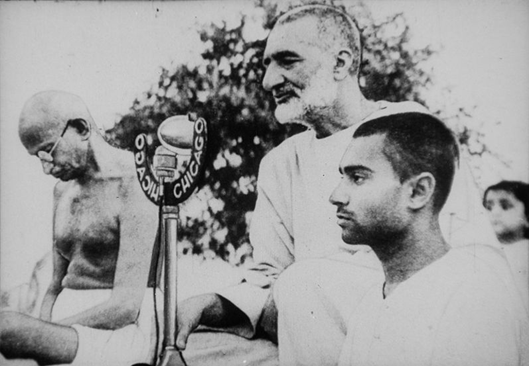
It is in such an atmosphere that I have tried to answer a pertinent and timely question: Were they alive, how could India's great messengers, the Hindu Mohandas Gandhi and the Muslim Abdul Ghaffar Khan, explain the benefits and advantages of bidding farewell to arms against today's bloodied and weary enemies? The temporary ceasefire and the fresh interest in civil resistance to address the Palestine-Israel issue justify a review of the arguments proposed by these two South Asian leaders—who, in a not-so-distant era, put effective nonviolent strategies into practice.
Abdul Ghaffar Khan (1890–1988), a Sunni Muslim from the North-West Frontier Province of the Indian subcontinent who more than once triumphed in battle against British power in his region and later, during Pakistan's independence, fought against the difficulties of self-determination for the Pashtuns, is less well-known than Mahatma Gandhi (1869–1948)—the Gandhi who came from a merchant class in Gujarat and led India's struggle for independence. Yet his thoughts are as relevant to the independence movement as Gandhi's.
Before looking at the arguments of these two, it is important to recall that the subcontinent's independence was achieved fundamentally, though not solely, through civil resistance. Indians who believed in violence also participated in this, just as the exhaustion and weariness of post-World War II Britain aided the cause. Moreover—despite the efforts of Gandhi, Ghaffar Khan, and their allies—it is also true that Hindu-Muslim violence influenced the independence and partition of the subcontinent.
Nevertheless, the effectiveness of Badshah Khan's nonviolent movement (Badshah, or King of Kings, was a respectful Pashto term appended to his name) is recorded in the memory of an English officer named Bacon during his 1930 struggle in the North-West Frontier Province, when thousands of Pashtuns rose up nonviolently against the British. Eight years later, when Badshah Khan's followers, known as the Red Shirts, gained power in the provincial elections, Bacon discussed the events of 1930 with Ghaffar Khan's son, Ghani Khan. Ghani Khan recounts:
Beacon said: Ghani, I was assistant to the commissioner of "Chahar Sada." They would bring the Red Shirts before me. I had been ordered to give each of them two years' imprisonment with hard labor. I would say to them: Let me see, are you a Red Shirt? They would say, Yes. I would say, Do you want freedom? They would say, Yes, we want freedom. I would say, If I set you free, will you do that again? They would say, Yes. Beacon said I should have stood up and embraced them, but instead I wrote: "Two years."
In that same year, 1930, soldiers of the Garhwal Rifles of the British Army refused the order to open fire on unarmed protesters in the Qissa Khwani Bazaar in Peshawar, and this news reached everyone. But more striking than these were the psychological victories of Ghaffar Khan and Gandhi against the British. The points that inspired nonviolent resistance were these:
Victory over Fear
That civil resistance was able to overcome fear was the first point. In the same period when Beacon was in conversation with Ghani Khan, his father told Gandhi: We were very cowardly and lazy. The sight of an Englishman terrified us. The movement breathed fresh air into us and made us much more industrious. We cast off fear and from then on, we do not fear the Englishman, and for that reason, we fear no man. The British are terrified of our nonviolence. They say:
"A nonviolent Pashtun is more dangerous than a violent Pashtun."*
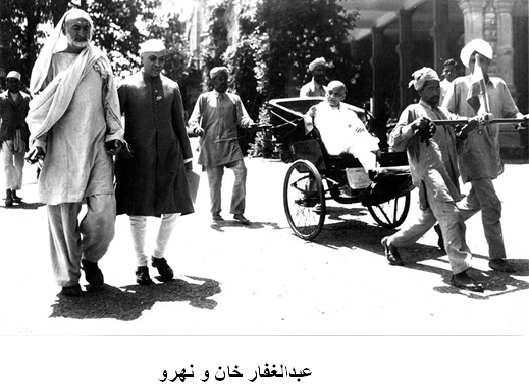
Victory over fear is what Jawaharlal Nehru, Gandhi's political heir and Prime Minister of India from 1947 to 1964, identified as the chief achievement of Gandhi's nonviolent strategy: "Fearlessness—yes, I believe fearlessness was his greatest gift. And the fact that a handful of weak, frail bones, in every respect, both physical and mental, was fearless, was an extraordinary thing that spread to other people, and lowered their fear."
Overcoming the Unwritten Law of Revenge
If nonviolence overcame fear, it was because it was the antidote to the rule of revenge. Revenges that were the bane of Pashtun society. In the summer of 1940—when, together with Ghaffar Khan, he was defending the strategy of nonviolence (in Gandhi's terms, Satyagraha)—before some of his companions deviated onto a militant path, Gandhi emphasized that: Ghaffar Khan is a Pashtun, and it may be said that a Pashtun is born with a weapon or a sword in hand. But Ghaffar Khan consciously asked his Servants of God to cast aside all weapons in order to join Satyagraha...
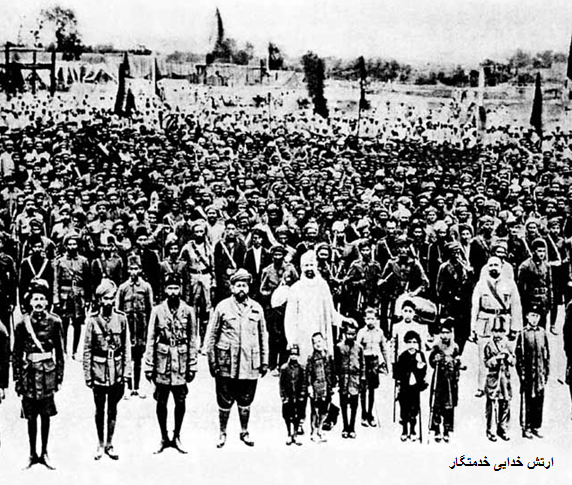
He saw that the conscious relinquishment of militant weapons had a magical effect. This path was the sole cure for the blood feuds that were inherited from father to son and had become part of the normal life of every Pashtun. With their own hands, they had destroyed many families. But nonviolence, in Ghaffar Khan's view, was like a promised salvation that had arrived. Otherwise, the violent blood feuds would have no end and would only cease with the end of the Pashtuns' existence.
Preemptive Revenges
Since the strategy of nonviolence did not welcome unbearable retaliation, it therefore gained sincere support from the common people, people who were setting aside the ruthless revenges that were the result of violent attacks. Harold Gould contrasts the methods of Gandhi and Ghaffar Khan, which "shattered empires" in South Asia, with the method of "moving bombs" in the Middle East and Kashmir, methods whose "self-seasoning" imposes devastating retaliatory attacks on innocent citizens.
In his autobiography—alongside recollections of his childhood in the North-West Frontier region in the late 1890s and the violent uprisings that had devastated people’s lives—Ghaffar Khan recalls, with justifiable pride, the contrasting outcome of the movements he led in the early 1930s: The British would promptly suppress a militant movement, but a nonviolent movement, despite severe repression, would flourish … . If an Englishman was killed, not only was the perpetrator punished, but the entire village and the whole region would suffer hardship and deprivation because of it. People held the violence and its perpetrator responsible for the repression. In the “nonviolent” movement, however, it was we (the Khudai Khidmatgars) who consciously courted suffering, not the common people. The masses did not bear the suffering; rather, they benefited from its outcome. That is why the movement attracted the love and sympathy of the people.
Disarming and Winning Over the Enemy
Since a “nonviolent” movement can baffle, disarm, and stun the opponent (as Ghaffar Khan claimed), adherence to a nonviolent approach draws support from elements within the adversary’s camp. When, in February 1922, demonstrators were shouting “Long live Mahatma Gandhi,” and some of them, in a remote corner of India, lost their temper and hacked to pieces 22 constables fleeing their burning police station, Gandhi immediately suspended the nationwide struggle—a struggle that had, until then, awakened India and terrified the British.
A few days earlier, Gandhi had delivered an ultimatum to the British Viceroy in India, after which the campaign was to be intensified. But he halted the campaign, even though an inner temptation told him: “It is better not to appear a coward who backs down from his word after making loud threats to the government and giving promises and pledges to the people.”
When Gandhi suspended the campaign, thousands of his comrades who were in prison for their civil resistance were bewildered by what they called his retreat. The people of India, in general, seemed despondent and stunned for a time. However, critics of the suspension later understood that the movement had been slipping into unreliable hands, and that by his temporary suspension, Gandhi had managed to salvage his standing among both Indians and the British.
Thus, in 1931, when Gandhi went to London to negotiate with His Majesty’s Government, the British welcomed him with warmth and affection, even though he was the very man who had led a nationwide nonviolent movement the previous year, as a result of which, in Churchill’s words, the British had experienced such humiliation and defiance as they had never known since setting foot on Indian soil. After the mutiny and defiance of the Bengal Army in 1857, a tale of Indian cruelty and savage British revenge, sentiments in England ran high against Indians. By contrast, in 1931, despite even more intense Indian defiance of British rule, thanks to Gandhi’s nonviolent approach, the public mood toward Indians was friendly. He had expressed the secret of success in remarks made in 1919, the year the worst event in the history of British rule in India occurred. In the Amritsar massacre, government infantry, accompanied by the violence of Indian mobs, massacred defenseless people. The secret of success lay here: “The government went mad, but our people also went mad. My view is, do not answer madness with madness. Instead, answer madness with wisdom and sense; then the situation will be under your control.”
Safeguarding the Future
The fifth benefit of the nonviolent strategy was that it made it harder for the nation to slip into the quagmire of the vicious habit of violence. In 1908, after a bomb thrown by Indian revolutionaries at a British office in Bihar killed two English women, Gandhi predicted: "The bomb that was thrown at the English today will, after the English leave, target Indians themselves." Gandhi saw that it is in the nature of violence to reproduce itself ever more and to give birth to ever less freedom. Thanks to his presence, it was satyagraha*, not the bomb, that targeted Indians, and this very fact may have helped reduce violence in independent India. One can clearly see that groups like the Tamil Tigers of Sri Lanka and some tribal insurgents of the "Nagas" in Northeast India, who resort to violent acts for independence, probably take as many lives of their own people as they do of their opponents. Gandhi and Ghaffar Khan concluded that the ruthless elimination of the rival is a requisite of violent action for gaining power, whereas nonviolent strategies provide the space and opportunity for "dialogue" with one another.
Defining the Enemy
And finally, Gandhi and Ghaffar Khan understood that only a nonviolent campaign can be an affirmation of human unity or a guarantee that the current struggle is against injustice and not against a rival race or people. This teaching was raised with full force in one of Gandhi's early challenges to the Indian model of militancy. Discussions on this very matter arose following the assassination of Sir Curzon Wyllie, advisor to Lord John Morley, the Liberal Secretary of State for India, in London in July 1919.
Wyllie, who had attended a gathering at a hall in South Kensington at the invitation of the National Indian Association of Britain, was assassinated by an Indian student named Madan Lal Dhingra. Dhingra was influenced by Indian militants based in London. Another person killed was an Indian doctor named "Cowasji Lalkaka," who had tried to throw himself between Dhingra and Wyllie.
Gandhi happened to arrive in London eight days after the assassination, on a mission for Indians under pressure in South Africa. Upon learning that many Indian students residing in Britain supported Dhingra's act, he stated in the journal Indian Opinion, which he edited in South Africa:
"In defense of the assassination of Sir Curzon Wyllie, it is argued that just as the English would kill any German if the Germans invaded England, so it is the right of every Indian to kill any Englishman... This logic is sophistry. If the Germans were to invade England, the English would only kill the invaders. They would not kill every German they could lay their hands on. They would not kill every unsuspected German or German guest."
As Gandhi understood it, those who incited Dhingra were more guilty than he was, for he had shown courage in accepting death, but a courage "resulting from the intoxication of intellectual poisoning." Gandhi continues:
"Even if the English were to vacate India as a result of such deadly actions, who would rule in their place? Is an Englishman bad because he is English?! Is every person with Indian skin a good person?! If that were so, then no angry protest should ever arise against the tyranny of Indian princes. India can gain nothing under the shadow of a government of murderers. Regardless of whether the murderers have black skin or white, whether they are native or foreign—it is India that will be utterly distraught and uprooted."
Distrust of Civil Resistance
These days, more than is generally understood, more Palestinians and Israelis are protesting the occupation of Palestinian territories and engaging in civil resistance through hunger strikes in prison and other methods. But arguments questioning the effectiveness of civil resistance against the Israeli occupation are not few either.
For example, Jonathan Cook, in an article in the Cairo weekly Al-Ahram (2–8 September 2004), argues that Palestinian citizens of Israel think that “if nonviolent protest ends in your death, it is better not to protest.” Cook goes on to say: “Conversely, in the occupied territories, Palestinians say if nonviolent protest kills you, it is better not to protest, or better to go all the way with arms.” Here it is assumed that civil resistance invites death at the hands of Israelis, and the events of the first intifada bear witness to this claim. Nevertheless, one must ask whether this evidence is conclusive and beyond doubt. Cook, claiming that the “special conditions” that have arisen following the dispossession and dispersal of the Palestinians have rendered civil resistance unsuitable, presents a six-point list of these special conditions.
: First and foremost, unlike the British in the Indian subcontinent, Israel has “settled” a Jewish population in the region that is committed to the “Israeli” project and attached to the occupied land in a way that British officers on their tour of duty in India never were.
: Second, Israel has harnessed Western guilt over the Holocaust to its service.
: Third, while Washington views Israel as an effective bulwark against Arab nationalism and a threat to oil resources, Israel’s Middle Eastern alliance with America remains solid.
: Fourth, whereas South African racism directly offended African Americans, there is no large American group that feels an affinity and kinship with the victims of the Israeli occupation.
: Fifth, Israel, with a network of walls, movement bans, checkpoints, and Arab informants, has separated Palestinian neighbors from one another and has successfully managed to prevent Palestinians from gathering for collective action.
: Sixth, Israelis critical of the occupation of Palestinian territories, instead of aiming to engage global public opinion, address their compatriots in Hebrew for domestic consumption.
We cite these doubts and misgivings as Arab, Israeli, or other supporters of a peaceful solution might point to them, and also so that the likely response of Gandhi or Ghaffar Khan to this issue can be guessed. I think these two would have said that:
: Death in the path of peaceful “satyagraha” in Israel/Palestine is far more impactful, effective, and indeed more honorable than death and killing through suicide bombing.
: Moreover, they would have called for deep and precise thinking aimed at discovering new methods of civil resistance in which inviting death at the hands of Israelis is less likely and which would be more likely to attract global participation and attention.
: They might have pointed out that the salt tax was neither a fleeting nor a predictable issue, yet it was civil resistance against that tax that brought about the memorable results of 1930.
: But it was unlikely that these two would have limited the responsibility for action solely to Palestinians or Israelis. The Gandhi who, at the start of the salt tax defiance, said: “I seek world sympathy in this battle of right against might,” would today also ask all the people of the world, and foremost among them, Americans, to involve themselves in alleviating the endless misery of the Arabs and Jews of Palestine and Israel.
During his 21 years in South Africa, Gandhi was helped and supported by a large number of Muslims and Jews. Had it not been for Abdullah Sheth, a Sunni Muslim merchant from his hometown of Porbandar who had sought his legal services, Gandhi would not have gone to South Africa at all. Two of Gandhi’s closest friends and allies in South Africa were Henry Polak, an English Jew of Polish descent and the son of a rabbi, and Hermann Kallenbach, a brilliant Jewish architect born and educated in Germany. As for Ghaffar Khan—who, unlike Gandhi, had visited Jerusalem, and whose wife Nambata had died and was buried there in an accident—he was aware of the views of certain scholars who traced the origins of the Pashtuns to the Jews.
Both were unequivocally opposed to occupation. In 1929, in a message on the issue to the magazine The Crisis, edited by Du Bois, Gandhi wrote that “there is no dishonor in being the grandson of slaves; the disgrace lies in being a slave-owner.” With regard to today’s Israel/Palestine issue, he would undoubtedly have told the Israelis, “the infamy lies in being an occupier.” And he would have added that being a permanent occupier is infinitely costly and futile.
The British Viceroy and his senior officials almost always treated Gandhi with courtesy and even respect, but even before 1920, when Gandhi finally abandoned his belief that the British Empire was beneficial, he would lose his temper if the British treated ordinary Indians as suspect elements.
In his view, British rule was permissible in India only on the condition that it be India’s servant and trustee. In 1918, Gandhi wrote to his long-time confidant Mahadev Desai: “The first thing that comes to mind is that England should leave India entirely; but a deep feeling within me insists that India’s ‘good’ lies in connection with England, and so I compel myself to love them.
Regarding Hindus and Muslims, Gandhi admitted that “they cannot be regarded as ‘present brothers,’ but here too, something from within tells me that there is no other way open to them but to be brothers to one another. If we constantly recall the memory of past grievances and petty scores, we will feel that ‘unity’ is impossible, but there is no alternative; we must forget the past at any cost.”
It was in March 1947 that the British, as well as Gandhi and Ghaffar Khan’s colleagues in the Indian National Congress, agreed to the Muslim League’s demand, first raised in 1940, for “the separation of Muslims from India and the creation of a homeland called Pakistan.” Gandhi and Ghaffar Khan, with sorrow and only because no other way was in sight, acquiesced to a partition they vehemently and resolutely opposed. On March 16, 1947, Ghaffar Khan and Gandhi had gone to Bihar in an attempt to heal the wound of Hindu-Muslim violence. On that day, Ghaffar Khan said:
“I find myself surrounded by darkness, a darkness that deepens the more I think about India’s future. India is on fire. If the fire engulfs India, everyone will suffer. Hindu, Muslim, Sikh, and Christian. What can be achieved through love can never be achieved through hatred or force…… The Muslim League wants Pakistan. They can only obtain it through love and willing consent. A Pakistan established by force is a dubious blessing and destined to perish.”
A few days later, Gandhi and Ghaffar Khan made their final bold proposal to their Congress colleagues to prevent partition: that the prime ministership of a united, independent India be offered for the first time to Muhammad Ali Jinnah, the leader of the Muslim League. Their colleagues rejected the proposal, a proposal that was never put to Jinnah, but Gandhi and Khan had wished to engage Jinnah with all the inhabitants of India, not just with Muslims.
Years later, in South Africa, Nelson Mandela emerged as a man for all races, bidding farewell to his past as a radical anti-white militant. Palestine/Israel likewise calls out to self-made, determined, and ready-to-act individuals, heedless of past history, to address the fears and hopes of both sides, Arabs as well as Jews.
Acknowledging that the initiatives of Gandhi and Ghaffar Khan in the 1940s did not fully achieve their goals in the Indian subcontinent does not invalidate the meaningful relevance of those goals and initiatives for the Middle East today.
.
.
Download the article "Mahatma Gandhi, Abdul Ghaffar Khan, and Palestine Today"
Translator: Gholamali Keshani
Source: Non-Violence Website
.
.


Discussion0 comments
No comments yet; let yours be the first voice.