Economic Sciences
Village Swaraj, by Mahatma Gandhi, translated by Gholamali Keshani
In his book Village Swaraj, Gandhi goes beyond politics to emerge as a social activist and economic thinker who considers political independence worthless without village self-rule, and offers solutions for rural prosperity through decentralization.

Village Swaraj, by Mahatma Gandhi
Translated by Gholamali Keshani
Why are we hearing about Gandhi again?
In the outside world, there are many books by and about Gandhi, especially in English. But in Persian, very few books by or about him have been published. Even among these few books, most attention has been paid to Gandhi the politician and the father of Indian independence. Whereas he had other intellectual-practical dimensions that have received little attention. Alongside his almost unwilling involvement in politics, he was a social activist and a theorist on economics, education, development (material and spiritual flourishing), and especially rural development. This claim is clearly visible in the present book. Here, he finds the opportunity to address these primary concerns of his. In the book Village Swaraj, Gandhi precisely puts forward an economic theory, contemplates the flourishing and self-governance of villages, offers solutions, and also acts upon them. In these writings, we see that this different Gandhi once again links his conduct, just like his actions in the political arena, to his two fundamental intellectual-behavioral principles: compassionate non-violence (Ahimsa) and steadfastness in the path of truth (Satyagraha), and considers these thoughts and actions to be precisely influenced by these two principles and nothing else.
What does he talk about in this book?
It was upon seeing the deplorable condition of Indians in South Africa that Gandhi unwillingly shed the garb of a promising, prosperous, yet ethical and pure defense lawyer and transformed into a full-time, devoted, and again, pure political activist. But it was after reading John Ruskin's book "Unto This Last" that, while still involved in politics, he became convinced that individual-collective economics, contrary to mainstream modern economics, must take a different path, and this path begins first and foremost with the individual himself. For this reason, he founded the "Phoenix Settlement" so that he and his volunteer friends could live according to the economics he had discovered. From then on, Gandhi's activities, besides improving the objective conditions of Indians in South Africa (which unwillingly tied him to politics), became multifaceted.
He returned to India. Here, too, he adopted the same approach. Indians considered him someone who secured the rights of the deprived from the powerful. With the fame he had acquired, he could not remain indifferent to the suffering of the deprived who sought refuge with him. So, he became a social activist once again. This activism again drew him into politics. But whenever he found free time, he contented himself with that same social activism and action. Yet, the more he progressed and became more familiar with the politics of the rulers and the Indian elites opposing the British, the more he gradually began to see the root of the problems elsewhere.
Gandhi had now made a newer discovery: "A brown thief is no different from a white thief." He saw the brown thieves among the wealthy, the powerful, and the Indian politicians who were either for or even against British domination. It was for this reason that he realized the power to determine the people's destiny, which was centrally accumulated in the hands of these three groups, had to be completely dispersed and distributed so that everyone, while gaining the right to self-determination, could properly safeguard that power. He saw the solution in complete decentralization. For this decentralization, he envisioned India's numerous villages as an archipelago of independent entities that, with their own autonomous power, could push aside centralization and prevent the brown or white thieves from determining their destiny, and in this, he paid greater attention to the lowest class of the deprived in Indian society, namely the untouchables (Harijans). He believed that political independence from Britain was worthless without village self-governance.
In this book, which is a thematically organized collection of his writings on villages, Gandhi, in his scheme, endeavors to transform the face of India's villages through various measures, including the traditional but reformed five-member Panchayat councils. In practice, he also seeks to initiate complete decentralization from the villages and subsequently present the city with a fait accompli, so that the city both decentralizes itself and ceases its exploitation of the village—precisely the points emphasized today by the modern perspectives of the Zapatistas and Murray Bookchin[1]. He believes that, until now, the city has been engaged in exploiting the village. And now, by offering the knowledge it possesses in various fields, and through the self-sacrifice of its vanguard, it must repay its debt to the villages and take care not to place any obstacles in the village's path.
In the book, we see that he does not merely hold the image of independent, self-governing villages in his mind, but proceeds to action. Gandhi gathers specialists, experts, and those interested in these theories around him, establishes foundations for work in the villages, undertakes the training of the rural activist, and even discusses the details of the duties and powers of independent village councils and rural activists. In this way, he reveals himself as a pragmatic idealist. In these writings, he addresses his ideal economy and politics and explains their difference from other dominant political and economic currents of the world; in the realm of politics, he firmly believes in the self-governance of independent human units and direct democracy; and in the realm of economics, his view is a "trusteeship perspective," the more precise nature of all of which must be heard from him directly.
The book, in some instances, delves into details such as the method of compost production, the minimum diet of villagers, personal and environmental hygiene, natural healing, and the like, which are indicative of Gandhi's pragmatism. These details can be subject to doubt and debate, and some of them may even be unacceptable to the reader. But the essence of his argument is something else, and the reader can pass over those unacceptable and peripheral matters and simply reflect on the core of his message. He also does not enter into philosophical discussions, but rather, by his own discernment, pays attention to that which makes people's lives more humane. His entire endeavor in these writings is the simultaneous provision of spirituality, dignity, adequate food, clothing, and shelter through various means for those who are forced to live like animals in the seven hundred thousand villages of India at that time. Gandhi was considered a saintly person by the people. Yet, throughout the book, nothing of religion is seen, and only love for God is emphasized once or twice, which is necessary for activists so that, with the help of that love, they may transcend themselves and perform acts of self-sacrifice. In his own words, he only emphasizes the essence of all religions, which is love for God.
Gandhi has been criticized: some social observers believe that urbanization and the current speed of communications and movements are the inevitable destiny of all humanity, and there is no other path ahead. For this reason, the revitalization and flourishing of rural life is an unattainable and futile dream. We must practically resign ourselves to Brazilian beef in Pakistan, Pakistani mangoes in France, and New Zealand kiwis in Sweden. Everyone must benefit from this speed of communication and transportation, and it is for these very reasons that the current system cannot be tampered with. In this book, Gandhi provides an example of a theory contrary to this view and tries to prove it. Such theories cannot be immediately and easily labeled as medieval, backward, and dreamy. For the political, environmental, economic, social, and cultural calamities and problems, and the inequalities that have arisen for people during these great transformations, encourage us to also think about creative solutions outside the mainstream. It is here that our familiarity with these kinds of his theories becomes highly significant. And this is the essence of the book, not the correctness or incorrectness of his opinion about natural remedies or the method of making compost.
Gandhi has also been considered one of the first critics of Western-Northern style development, and an inspiration for post-development thinkers in the 1970s. This description is due to his raising of the very issues that can be seen in this book and his other books. When he critiques the machine, machinism, industrialism, the globalized economy, and modern transportation, the tone of his speech approaches that of renowned post-development figures such as Wolfgang Sachs, Arturo Escobar, Ivan Illich, Majid Rahnama, and others, and becomes worthy of reflection. On the other hand, when he repeatedly emphasizes the local economy, he becomes one of the pioneers of alternative economies and the currently implemented solutions of local economy.
On the other hand, environmental problems, the least of which is the strong possibility of wars over primary resources like oil and soil, including water wars and famine, and the contamination of all urban human life with highly complex chemicals, alongside climate change, global warming, and the phenomenon of peak oil (the maximum extraction and subsequent decline in its supply), make all of us worry about how long we can enjoy this smartphone that has brought the North Pole as close as a click to the equator. Gandhi's solutions in this book are such that their direction is an automatic avoidance of these problems, because he recognizes the village as the civilizational unit, not the city. So, listening more carefully to his words alongside other perspectives is not without benefit.
What does Gandhi have for us in this book?
Now the reasons for translating this book can be better understood. Our land, like all third-world countries, has moved towards urbanization; first-world countries have already done so, but with arrangements more orderly than the third world, with their own specific consequences. However, the destruction of villages in the third world is accelerating as time passes, pushing marginalization and its national problems in cities and nations to new heights. Remedies must be sought. Gandhian remedies can also be worthy of reflection for us alongside the dominant currents of thought and practice. Of course, it must be known that the place, time, and primary audience of Gandhi are distant from us, and for this reason, the assumption is not one of imitation, but the core of his speech can certainly be contemplated. The point is that Gandhi's theories were evolving over time, and we may see contradictions and developments in his views.
Another aim of translating the book is to show a new path for Iran's prosperity, freedom, and peace. At a time when governing an Iran with numerous metropolises has become an impossibility for any ruler, righteous or unrighteous, and the prospect of prosperity, freedom, and peace is very bleak, an alternative path is a return to the villages, or at least keeping the existing villages alive (although talk of reverse migration to solve the intertwined problems of Iranian society and similar societies has become a familiar prescription and is nothing new). The path Gandhi shows is how to strive to revive and keep villages alive with the help of the effective action of independent, genuine, and powerful village councils. He considers this in no way less than political independence. Reflecting on the discussion of rural development and revitalization, in the face of mainstream[2] solutions, is also a "must" for us. The important point in his words that is useful for us is his repeated emphasis on the motivational, moral, and behavioral qualities, adherence to principles, patience, and persistence of committed activists. Gandhi shows leaders and social activists how they must work if they want to act, what things they must value, and what things they must definitely discard. He tells the activist who and what the main target of their action should be. In sum, for villagers and activists, he describes the process of transforming the current human being into the "new human." So we too can model these conditions in our own efforts.
Another reason for the translation is his emphasis and recommendation that social movements always pay attention to the main goal and not stray from it. He was intensely focused on the self-empowerment of the deprived classes. Other activists who hold similar ideals can see a highly reflective model in the consistency of his words and deeds with this important goal.
Considering all the points above, it can be said that familiarity with Gandhi's views on self-governance, and rural flourishing and prosperity, can also be a "must" for experts and ordinary people in Iran, because whatever the flourishing of current villages may be, it will certainly reduce the intense pressure on the cities. Perhaps a time will come when social activists of the kind whose spirit Gandhi describes will become village-minded and, by intertwining their lives with villagers, roll up their sleeves for a rural development suited to our own land.
.
.
Village Swaraj
Author: Mahatma Gandhi
Translator: Gholamali Keshani
GHKESHANI.COM
KESHANIGH@GMAIL.COM
.
.
Download the PDF file of this book in Persian (250 pages)
Download from server One | Two | Three
.
.
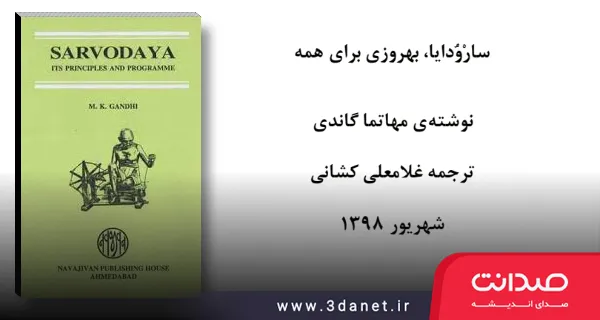
[1] - For information on these two points, see the appendices of the book Sarvodaya: The Welfare of All, by Gandhi, on the "Non-Violence" website.
[2] - Main Stream: The main current, the dominant current, the prevalent current. It refers to the intellectual-practical-executive currents that are the custom of the time, have the upper hand in any theoretical or practical field, and profoundly affect external realities.
.
.




Discussion0 comments
No comments yet; let yours be the first voice.