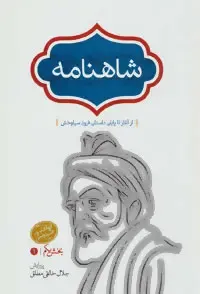
Why this book?
- To read one of the most foundational texts of the Persian language and culture.
- To become acquainted with the mythological, heroic, and historical narratives of Iran.
- To access Jalal Khaleghi-Motlagh's authoritative edition of the Shahnameh.
- To understand Ferdowsi's role in preserving and expanding the Persian language.
- To study a text that has left a lasting impact on Iranian literature, history, identity, and imagination.
About the book
Ferdowsi's Shahnameh is a verse epic in the motaqāreb meter, comprising approximately sixty thousand couplets, the composition of which took nearly thirty years. This work narrates the world of myths, legends, heroisms, and the history of Iran from the time of Kayumars to the end of the Sasanian dynasty and is considered one of the most important texts of Persian literature and Iranian culture.
The overall structure of the Shahnameh can be seen in three parts: mythological, heroic, and historical. The mythological part covers from the beginning of creation and the reign of Kayumars to the era of Fereydun; the heroic part is linked with figures such as Kaveh, Zal, Rostam, and Sohrab; and the historical part reaches the later kingdoms, the emergence of Alexander, the Arsacids, the Sasanians, and finally the conquest of Iran by the Arabs.
Jalal Khaleghi-Motlagh's edition of the Shahnameh holds a special place. This edition was prepared based on the collection, collation, and evaluation of the oldest manuscripts of the Shahnameh, utilizing modern methods of textual criticism. Its complete publication took many years and is considered one of the most important achievements of contemporary Shahnameh scholarship.