Why this book?
- To understand the contrast between two major models of action in the twentieth century: nonviolence and centralized authority.
- To become familiar with Louis Fischer’s view of Gandhi, Stalin, and the ethical crises of the modern world.
- For readers interested in the relation between ethics, politics, power, and individual responsibility.
- To see how biography and history can become a philosophical question about ethical choice.
- For a brief and clear entry into the question of nonviolence against the logic of coercion and domination.
About the book
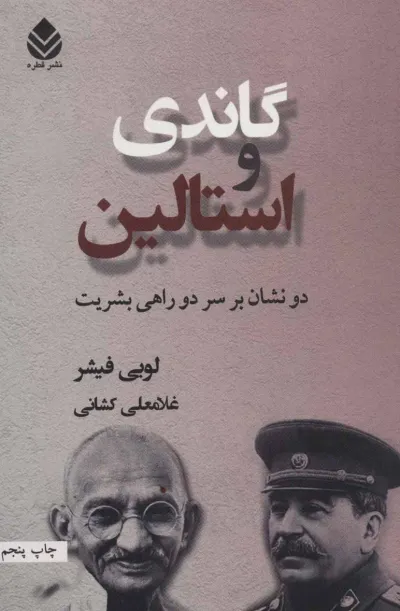
The book "Gandhi and Stalin," subtitled "Two Signs at the Crossroads of Humanity," is a work by Louis Fischer, the American journalist and author, published in 1947. In this book, Fischer juxtaposes two major and contrasting figures of the twentieth century: Mahatma Gandhi, the ethical and political leader of India who relied on nonviolence, and Joseph Stalin, the leader of the Soviet Union who relied on concentrated power and an iron organization of governance.
The book's significance lies in the fact that it is not merely a biography of two figures. Drawing on his own experiences in the Soviet Union, his knowledge of India, and his meetings with Gandhi, Fischer presents the reader with two ways of living and acting. On one side is a path that relies on discipline, coercion, fear, and organized power; on the other side is a path that begins with truth, ethical resistance, self-cultivation, and nonviolence.
Louis Fischer had previously had a close experience with the Soviet Union and actually existing socialism, which he later viewed with critical distance. This background makes his comparison between Gandhi and Stalin more than merely theoretical; he writes from within the historical experience of the twentieth century and seeks to show that the choice between these two models is not an abstract one, but is tied to one's way of living, personal ethics, and the future of society.