Why this book?
- It reconstructs Ayatollah Montazeri's theoretical evolution from the theory of appointment to election and then supervision, alongside Imam Khomeini's relatively consistent position.
- It is organized around two clear axes: "who is the legitimate ruler" and "the goals and frameworks of governance".
- It first reconstructs each view from jurisprudential works, speeches and historical documents, then critiques it through moral philosophy and the theory of constitutional government.
- It openly states the author's own moral-philosophical foundation concerning the relation between religion and ethics, drawing on Abolqasem Fanaei and David Ross.
- It keeps a clear line between what is reported from the two jurists and the author's own evaluation.
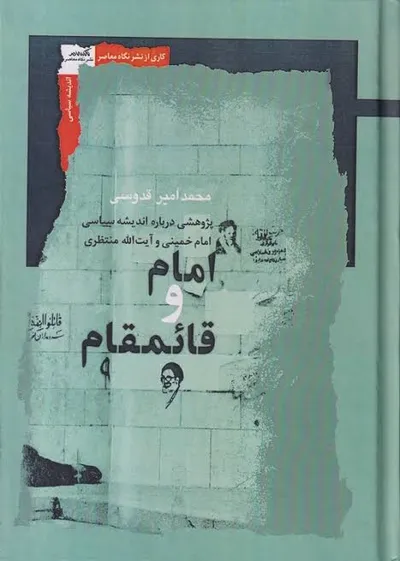
About the book
"The Imam and the Deputy Leader" is the revised version of Mohammad Amir Ghodousi's doctoral dissertation in public law at Shahid Beheshti University. Its subject is the theory of governance of Imam Khomeini and Ayatollah Montazeri. Although the title may call to mind the story of the removal of the Leader's deputy, the book is not a historical narrative; it is a study in public law, political jurisprudence, moral philosophy and contemporary Iranian political thought, and it examines historical events only in connection with these theoretical questions.
The book is organized into two parts and six chapters. The first part addresses the question "Who is the legitimate ruler?" and the second the "goals and frameworks of governance". In each part, the first chapter presents Imam Khomeini's view, the second Ayatollah Montazeri's view, and the third a moral-philosophical analysis of the two. The intermediate sections draw on jurisprudential works such as Kashf al-Asrar, Tahrir al-Wasilah and Velayat-e Faqih, and move on to the relation between jurisprudence and ethics, the critique of the liberal interpretation of expediency, and the question of oversight of power.
The author shows that Imam Khomeini held a relatively consistent view throughout his life on who the legitimate ruler is, whereas Ayatollah Montazeri underwent at least three fundamental shifts: from the appointment of the jurist, to the election of the jurist, and finally to the supervision of jurists over legislation and the judiciary. This trajectory is reconstructed from jurisprudential works, speeches and historical documents.
The analytical part of the book rests on a theory in moral philosophy that accepts the ontological independence of religion and ethics while regarding ethics as the unavoidable framework of jurisprudential rulings. On this basis, and drawing on the theory of constitutional (neutral) government, the author argues that many of the conditions and goals these two jurists envisaged for the ruler and the religious state are not justified from the standpoint of modern political ethics.
The book runs to more than six hundred pages and is a detailed study, neither a biography nor a quick account of events. It is a documented and challenging source for students and researchers of public law, constitutional law, political science, political jurisprudence, moral philosophy and the history of contemporary Iranian political thought, as well as for readers seeking an analytical and critical rereading of the theoretical foundations of the Islamic Republic. Readers are advised to distinguish between the views reported from the two jurists and the author's own evaluation.
Based on what we have said, the legitimate ruler in Imam Khomeini's theory of governance can be defined in a single brief sentence as follows: "An absolute mujtahid who is the most learned of the jurists of his time and place in deriving jurisprudential rulings and in managing political and social affairs; who has personally derived a considerable (mu'tadd-bih) number of jurisprudential rulings and reached his own ijtihadi opinion; and who possesses the habitus of justice befitting the station of the guardianship of the jurist, meaning that he not only never commits a major sin but never commits even a minor sin, and not merely that he does not persist in committing minor sins."
From the table of contents
- 1The Legitimate Ruler According to Imam Khomeini
- 2The Legitimate Ruler According to Ayatollah Montazeri
- 3A Moral-Philosophical Analysis of the Legitimate Ruler in the Views of Imam Khomeini and Ayatollah Montazeri
- 4The Goals and Frameworks of Governance According to Imam Khomeini
- 5The Goals and Frameworks of Governance According to Ayatollah Montazeri
- 6A Moral-Philosophical Analysis of the Goals and Frameworks of Governance in the Views of Imam Khomeini and Ayatollah Montazeri