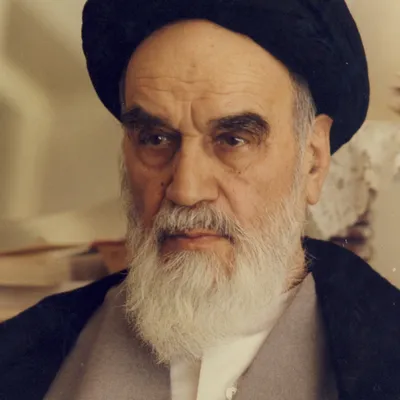
Iranian thinker
Ruhollah Khomeini
Ruhollah KhomeiniShiite jurisprudence, Islamic philosophy and political thoughtIranian1902–1989
We must strive to export our revolution to the entire world.
Life and Thought
Ruhollah Khomeini was an Iranian Shiite cleric, jurist and thinker who led the 1979 Iranian Revolution and became the first Supreme Leader of the Islamic Republic of Iran. He produced works and taught in the fields of jurisprudence, Islamic philosophy, mysticism and Shiite political thought.
Ruhollah Khomeini was born in 1902 in Khomein. He began his religious studies in the seminaries and, after completing the preliminary stages, pursued study and teaching at the Qom Seminary. Among his teachers were Abdolkarim Haeri Yazdi and other prominent scholars of the seminary. He engaged in scholarly activity in jurisprudence, principles of jurisprudence, Islamic philosophy and Islamic mysticism.
Before the 1979 Revolution, Khomeini was known as one of the opponents of the Pahlavi regime. His speeches and writings criticizing the policies of the time contributed to the formation of the revolutionary movement; after the victory of the revolution he returned to Iran in 1979 and assumed leadership of the new political system.
Among his most important works are Velayat-e Faqih (Islamic Government), Sharh-e Do‘a-ye Sahar, Misbah al-Hidaya ila al-Khilafa wa al-Wilaya, Adab al-Salat and Chehel Hadith. His political thought rested on the theory of the Guardianship of the Jurist, the role of the jurist in Islamic government, and the link between Shiite jurisprudence and politics. His works and views continue to be the subject of discussion and critique in the fields of political philosophy, theology and contemporary Iranian studies.