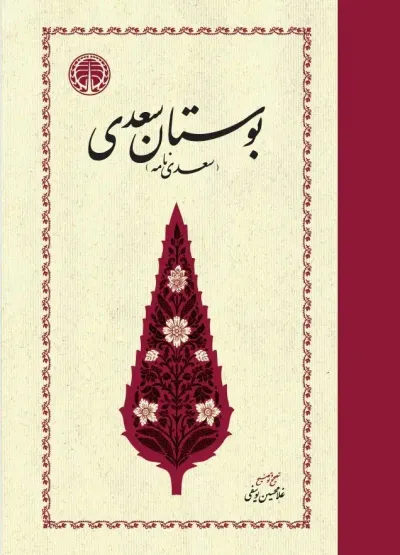
Why this book?
- To read one of the most important ethical poems in Persian literature.
- To become familiar with Saadi’s ideal vision and his view of justice, education, and beneficence.
- To benefit from Gholamhossein Yousefi’s authoritative edition and explanations of difficult words.
- To understand the link between poetry, practical wisdom, and social experience in Saadi’s language.
About the book
Bustan of Saadi, also known as Saadi-nameh, is a masnavi poem in the mutaqārib meter, arranged in ten chapters and comprising more than four thousand couplets. After praising God, honoring the Prophet of Islam, and explaining his reason for composing the work, Saadi turns to themes such as justice, beneficence, love, humility, contentment, education, gratitude, and repentance.
The work holds a special place among Saadi’s writings because it presents the poetic form of his ethical and social thought. If the Gulistan is known chiefly for its rhymed prose and short tales, the Bustan provides a broader field for poetic narrative, parable, counsel, and Saadi’s vision of human ideals.
In the Bustan, Saadi speaks in a simple and fluent language, yet this simplicity is joined to moral depth and subtle insight. Through stories, parables, and poetic expression, he reflects on power and justice, the human being and education, love and ecstasy, and contentment and acceptance.
This edition was prepared by Gholamhossein Yousefi, and because of its careful editing, explanations of difficult words, and attention to textual variants, it is useful for serious readers of Persian literature, students, researchers, and those interested in wisdom and ethics in the Persian tradition.