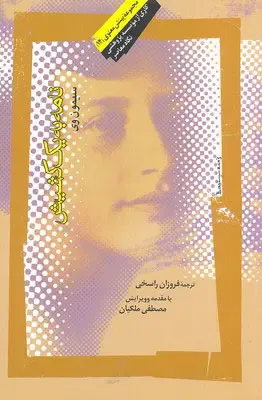
Why this book?
- To become familiar with one of Simone Weil’s most direct texts on religion and the Church.
- To understand the relation between faith, ethics, and truth-seeking in her thought.
- To read a spiritual and ethical critique of religious dogmatism.
- To follow Mostafa Malekian’s illuminating introduction to Simone Weil’s life and thought.
About the book
Letter to a Priest is one of Simone Weil’s most important religious writings; a letter addressed to a Catholic priest in which she sets out the ideas that stood between her and formal entry into the Church. In this text, Weil is both deeply attached to Christianity and sharply critical of the institutional Church, official dogmas, and the violent history of organized religion.
In Mostafa Malekian’s introduction to the Persian translation, Simone Weil is presented as a spiritual, justice-seeking, truth-loving, and morally scrupulous figure; someone who sympathized with the suffering of the oppressed and also avoided every closed and self-sufficient system of thought. Malekian shows that the main themes of the letter can be understood through topics such as God, Christ, necessity, salvation, mysticism, other religions, the Old Testament, and the relation between Christianity and the Church.
The book is important because Simone Weil does not reduce faith to accepting a set of official propositions. She links salvation less to correct belief than to goodness, selfless love, attention to human suffering, and acceptance of truth. For this reason, Letter to a Priest is both a theological text and a work in moral philosophy and spirituality.
This book is useful for readers interested in philosophy of religion, Christianity, mysticism, ethics, religious pluralism, and the critique of religious institutions. For those familiar with Mostafa Malekian’s project of rationality and spirituality, his introduction also offers a clear path into Simone Weil’s difficult and compelling intellectual world.