Religion
Mostafa Malekian's Introduction to Simone Weil's Letter to a Priest
In his introduction to Letter to a Priest, Mostafa Malekian describes Simone Weil as a “Catholic saint outside the Church” who took up manual labour to understand the suffering of the exploited; a text on eight axes of her thought and conduct.
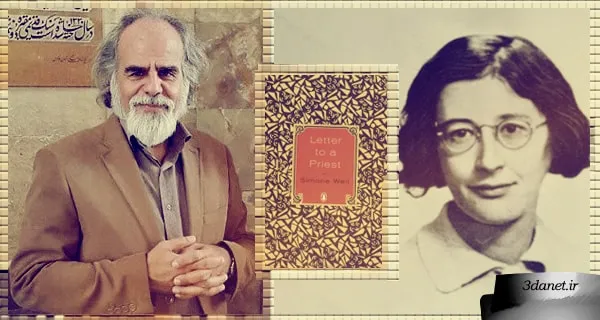
Note: Simone Weil is known as a spiritually oriented writer, committed to the Christian faith yet averse to the Church; she has also been called the “Red Virgin” and a “Catholic saint outside the Church.” “Letter to a Priest” was the first of Simone Weil’s works to be translated into Persian. What follows is the highly illuminating, perceptive, and engaging introduction by Mostafa Malekian to this book, in which, after sketching the radiant portrait of this symbol of purity and piety, he presents the themes of “Letter to a Priest” in eight axes and one hundred and twenty clauses:
Simone Weil was born and raised in a family environment that was French-Jewish, cultured, and middle-class. In this environment, she received a very distinguished and excellent education and learned a great deal, especially about the culture, art, and literature of ancient Greece and Rome, and about ethical ideas. In addition to learning “Greek, Latin, Sanskrit, and several modern languages” well, she undertook extensive studies and research in ethics, “philosophy, Western and Eastern religions, the empirical sciences, mathematics, literature,” and history.
But even more striking and appealing than her information and knowledge is her psychological and moral personality and character. Her boundless love for human beings, her irresistible passion for social justice (which is a consequence of that very love), and her earnest truth-seeking, when combined and fused with her moral scrupulousness and her mystical inclinations and experiences, made her a person most lovable, enviable, and inspiring. It seems that her individual and social conduct, her way of living, and even her dying can be entirely explained and accounted for by appealing to these five psychological and moral traits.
During her short thirty-four-year life, she was a successful and distinguished philosophy teacher, an activist with leftist commitments, an essayist who wrote provocative and thought-provoking pieces on social and religious issues, and a mystical personality who was utterly exceptional and different. In her student days, those who knew of both her purity and her passionate leftist social and political activities referred to her as the “Red Virgin.” In the last years of her life, and after her death, far more numerous people (especially when her articles, notes, and letters were first published in book form) called her a “Catholic saint outside the Church.” She was a personality who stirred her audience, made them anxious, and plunged them into reflection. Her rare moral scrupulousness and her anxious social and religious fervor held immense appeal for many thinkers, even those who disagreed both with her and with one another.
Her boundless love for human beings drove her toward an irresistible feeling of oneness and identification with the oppressed and the despised—that is, a feeling of oneness with workers and farmers, the colonized and other exploited people, and refugees who had fled communist and fascist regimes. The fact that she later converted from Judaism, her ancestral religion, to Christianity was, by her own explicit account, mainly because she saw the early, original form of the Christian religion as “preeminently the religion of slaves” and identified herself with these slaves; and again, within the world of Christianity, her lack of commitment to the Church and the Christian clergy was partly because she found the Church and the clergy in conflict with the slaves. It was this same love for human beings that turned her away from Marxism and communism far more quickly than most leftist intellectuals and caused her to turn intelligently and courageously toward a radicalism that, from revolutionary Marxism, meant not merely avoiding the deceit, injustice, and violence of the Stalinism of her time, but also meant that this creed was rooted in the ruthless opportunism of Leninism and the contradictions of the very principles of Marxist doctrine, and that none of these theoretical and practical matters were in accord with the interests and welfare of suffering human beings. In the mid-1930s, through her analytical and meticulous written polemics, she defended egalitarianism, democratic unificationism, anti-colonialism, pacifism, and a kind of new social order that would be both libertarian and compassionate. Her obsessive attention to the exploited compelled her to work personally, as a laborer, on farms and in factories, and in this way to educate and purify herself—a task that, due to her frail physical constitution, constant ill health, and lack of appetite, was extremely painful and exhausting.
Her irresistible passion for social justice, when combined with a profound knowledge of human nature and the essence of modernity, led her to the conclusion that the solution of Marxist-leaning leftists, which sees social justice as dependent on changes in ownership and political power, could not be a successful solution; rather, a far deeper transformation must be brought about in modern work itself. In her view, the new organization of work, which is based on managerial efficiency—including the hierarchical domination of this organization, which in any case demands the subordination and subjection of the lower orders to the higher, and even the very design of machinery, equipment, and the technological system—must all be humanized from the ground up so that they can meet human needs. Until workers, in the strict sense of the word, oversee the process of work and production, and until the process of work and production is decentralized to guarantee and secure freedoms, socio-economic justice will not emerge. This requires that international capitalist structures, including colonialism, be dismantled and destroyed from the ground up and that local socio-political units (which are more regional than national) be favored once again; it also requires that new political structures, such as political parties and trade unions, also disappear, because these political structures take for granted the violence arising from conflicting interests.
Her earnest truth-seeking drove her, firstly, to flee from any kind of system-building in which facts are sacrificed to preserve the system’s consistency, and secondly, toward a kind of eclecticism and eclectic thinking in which truth and reality, wherever they are found—whether old or new, Eastern or Western—are adopted, and falsehood and error, wherever they are seen, are rejected. Even her religion was eclectic. Her Christianity, in addition to being strongly influenced by her own understanding and discernment and possessing a strong ascetic and devotional aspect, was knowingly, deliberately, intelligently, and learnedly eclectic, because on the one hand it encompassed not only the Greek incarnations of Christ but also his Buddhist incarnations and his numerous incarnations in folk culture and literature; on the other hand, it rejected the greater part of the Old Testament, which official and historical Christianity counts among the holy scriptures; on the third hand, it drew nourishment from Platonic, Stoic, and Indian sources; and on the fourth hand, it was more or less influenced by Kant and Marx as well.
Her moral scrupulosity led her not only to be hard on herself in the pursuit of moral perfection and to become the executioner of her own nature, but also to emphasize the moral teachings and precepts of religion more than its other doctrines, to launch fierce attacks on traditional and historical Christianity and even on the Holy Scriptures from an ethical standpoint, and, in her teaching, to explicate literary and philosophical texts from a moral perspective. Although political disillusionment resulting from the dashed hopes and aspirations of the Popular Front in the late 1930s, along with the violence of red and black fascisms, drew her toward an emphasis on religious matters and issues, and although the repeated mystical experiences that came upon her from 1938 onward brought her into close relations with the Catholic faith—so much so that she even composed poems in accord with the Catholic disposition and creed—nevertheless, she never joined the Church nor received baptism. And despite the fact that her inclination toward the Catholic faith was sincere and heartfelt, she held a highly critical view of the Church as a bureaucratic institution. Her criticisms of this institution were primarily ethical in nature, emphasizing the Church's spiritual contamination, its ambiguous, hypocritical, and deceitful morality, its inquisitional practices, and its intolerance, although the institution's anti-rationalism was not without influence on this critical stance.
Her mystical experiences, while effective in drawing her closer to the Catholic faith, at the same time kept her from joining the Church, for her mystical disposition bore a close affinity to Gnosticism, whereas the Church not only vehemently opposed the three main pillars of this creed—namely, belief in two principles of good and evil, pessimism, and belief in an impersonal God—but also regarded this creed as one of the worst and most intolerable heresies to have arisen within the Christian religion. For this very reason, it had persecuted and tortured the Cathari, followers of a religious movement prevalent in the Middle Ages that believed in dualism and originated from Gnosticism and Manichaeism, and had annihilated them in the most savage manner in the fifteenth century.
Perhaps the most striking message of this saint and moral hero to her audience was that they should seek two things: one, unalloyed purity, and the other, the "gift of affliction" in a world filled with human pain and suffering. In her view, in a world saturated with pain and suffering, a person's undergoing affliction from the pain and suffering of their fellow human beings is a divine gift and grace, akin to the gift and grace of crucifixion that was granted to Jesus Christ. One of her most profound sayings is that "the source of all evils is imagination and daydreaming," because one who engages in this, out of self-satisfaction, disregards a world that is constantly in pain and suffering, and directs their attention to a good or goods that lie beyond this real world. Her manner of dying best bespeaks her need to partake of unalloyed affliction and unadulterated compassion for human beings who come, suffer, and depart.
* * *
Letter to a Priest is the first of Simone Weil’s works to be published in Persian. In this work, Simone Weil speaks as a thinker who, on the one hand, is first and foremost devoted and committed to the Christian religion and has “always accepted the Christian approach as the only reasonable approach,” and on the other hand, is deeply dissatisfied and disgusted with the Roman Catholic Church’s interpretation of this religion and what this Church has done in the name of religion throughout history, to the extent that she “never, even for a moment, had the feeling … that God … want[ed] [her] in the Church.” With this loving attachment to religion and spirituality and that “critical detachment from all forms and shapes of institutionalized religion,” and as someone who “was always more concerned with the suffering and affliction of others—including the evils and villainies committed in the name of religion—than worried about her own position,” and driven by the “scrupulous intellectual honesty and humility” she possessed, she writes a letter addressed to a French Dominican Catholic priest residing in New York, and in it enumerates some of the thoughts that have lodged and taken root in her mind and conscience and have become barriers between her and the Church, noting that these thoughts, in her view, possess varying degrees of probability or certainty and are not equally probable or certain; and at the same time, she asks the recipient of the letter to determine categorically and explicitly whether each of these thoughts is truly compatible with membership in the Church or not, although if the Church condemns all or some of them, she will not abandon them until it is proven to her that they are false. Simone Weil, on the one hand, considers serious engagement with these thoughts, beliefs, and issues to be a matter of the utmost importance and says: “Far be it from me to regard thinking about these matters as a game. This thinking is of vital importance not only considering that one’s own eternal salvation is at stake, but, moreover, it possesses an importance that, in my opinion, far surpasses the importance of my own salvation. The question of life and death is a game compared to this thinking.” And on the other hand, regarding these thoughts, beliefs, and issues, she avoids any self-infatuation, dogmatism, rigidity, and fanaticism and says: “I consider a kind of suspension of judgment concerning all thoughts, whatever they may be, without exception, to be the virtue of humility in the realm of the intellect.” And thus she reveals both her profound spirituality and her genuine rationality. It is fitting if we separate Simone Weil’s principal beliefs in this letter, provide a precise systematization of each of them, and, based on the connection they have with one another, arrange and order them. It seems that these themes and motifs can be confined to eight themes and motifs.
1 God
1) God is love.
2) The most important truth about God is that He is benevolent. Therefore, the belief that God could command injustice and oppression is the greatest error concerning Him.
3) God bestows equal grace upon the good and the wicked. This equal grace to the good and the wicked is not injustice. Rather, it is the most sublime characteristic of God’s justice. 4) This common notion that God, like an absolute, capricious monarch, arbitrarily bestows more grace upon one person and less upon another .
under the pretext that He is indebted to no human being, is a completely incorrect notion. By His own infinite benevolence, He owes it to every creature to bestow good in the most perfect way.
5) God continually showers the perfection of His grace upon everyone. It is we humans who consent to receive His grace to varying degrees. In purely spiritual matters, God fulfills all desires and wishes. Those who have less have wished for less.
6) The idea that God is in search of man is infinitely beautiful and profound; and as soon as it gives way to the idea that man is in search of God, decline appears.
7) God is, at the same time, both personal and anthropomorphic, and impersonal and non-anthropomorphic. These two concepts are only combinable in God, and in anything other than Him they are contradictory and mutually exclusive.
8) Many other contradictory matters (apart from being personal and impersonal) are also combinable in God.
9) God can only be conceived as simultaneously both a Trinity (threefold) and a Unity (one) if we regard Him as both personal and anthropomorphic, and impersonal and non-anthropomorphic.
10) Saints who enjoy the highest levels of spirituality know God as, at once and without contradiction, personal and impersonal; saints at the middle or lower levels direct their attention exclusively, or mostly, to one of these two aspects of God's being.
11) All conceptions we have of God that are incompatible with the activity arising from pure love are false conceptions. All other conceptions I have of Him are true to varying degrees. Love and knowledge of God, in reality, cannot be separated.
2 Faith, Virtue, and Hope (=the three theological virtues)
12) True faith is a kind of commitment, distinct from belief in a particular opinion.
13) Anyone who believes in the Christhood of Jesus, even if they agree with nothing else the Church affirms, possesses true faith.
14) The definition of "faith as firm belief" in everything the Church has taught (the definition of the Council of Trent) is incorrect.
15) The opinion of Saint Thomas Aquinas, namely that one who refuses to accept a single doctrinal article has not a particle of faith, is invalid: and entails a totalitarianism that, if not more suffocating than Hitler's totalitarianism, is exactly as suffocating.
16) Faith and love, though two things, are inseparable.
17) Love of God and love of one's fellow human being, though two things, are inseparable.
18) Anyone who can show pure compassion toward a suffering human being certainly possesses love of God and faith; even if the thought of Jesus Christ does not cross their mind in the slightest.
19) It is a false claim that the Devil provides the means and instruments for the manifestation of the virtue of pure love for one's fellow human being (and acceptance of the entire order of the universe) in heretics, atheists, and infidels so that they can better deceive others. Wherever this love is, faith is also there.
20) So-called atheists and infidels who can exercise pure compassion are just as close to God as Christians, and consequently know Him just as well. Because "God is love," and they know love, even if their knowledge is expressed in other terms or remains unspoken.
21) The meaning of the three theological virtues, namely faith, love, and hope, is this: the virtue of love means putting the faculty of heavenly and divine love into action. The virtue of faith means making all the faculties of the soul subject and submissive to the faculty of heavenly and divine love. And the virtue of hope means guiding the soul toward a transformation after which it is wholly and exclusively turned into love.
22) For the virtue of faith to be realized, that is, for the other faculties of the soul to become subject and submissive to the faculty of love, each of them must find its own specific good in this faculty, and this statement holds even truer for reason, which, after love itself, is more valuable than all other faculties.
3 Reason, the Mysteries of Religion, and Doctrinal Principles
23) The mysteries of religion cannot be affirmed or denied by reason, for they are not of the order of truth, but are beyond truth. The value of propositions such as "Jesus Christ is the Son of God" and that the consecrated bread and wine are the very body and blood of Christ (which are among the mysteries of the Christian religion) does not belong to the level and order of truth, but to a higher level and order; because truth belongs to the domain of reason, whereas it is impossible for reason to grasp the value of these propositions, except indirectly and through the effects and consequences they produce.
24) The only part of the human soul that can establish a real connection with the mysteries of religion and commit to them is the faculty of divine and heavenly love. The role of the rest of the soul's faculties, and above all the faculty of reason, is merely to recognize that the matters with which divine and heavenly love is connected are real and that these realities are superior to each and every object of those faculties themselves, and after this recognition, as soon as divine and heavenly love truly arises in the soul, to fall silent.
25) The silence of reason, in order to permit love to take possession of the entire soul, has two important consequences: first, that reason, when it becomes active again after this silence, finds that, compared to the past, it enjoys greater luminosity and a greater capacity for understanding the truths that are specific to it; and second, that this silence provides reason with an unparalleled cultivation that enables it to grasp truths that, had it not been for this silence, would have remained forever hidden and veiled from it; in other words, some truths are within the reach and grasp of reason, but reason becomes capable of grasping them only when it has passed silently through the heart of matters that are beyond reason.
26) Reason can only recognize the advantages of this submission and subordination to love with the help of experience and through review and reflection, and it cannot know anything about these advantages prior to experience.
27) It is not necessary for reason to begin its work with a justified reason for accepting submission and subordination to love. In reality, this submission and subordination is a supernatural matter brought about only by God.(26)
28) But the situation of reason with regard to the dogmas of religion differs from its situation with regard to the mysteries of religion: the correct approach to the dogmas of religion is not to affirm them, but to look upon them from a certain distance, with attention, respect, and love.(24)
29) We must pay constant, unquestioning, and respectful attention to the statements by which the Church has seen fit to make the mysteries of religion both understandable and preserved, and especially to the condemnations issued by the Church, but it is not necessary to be committed and faithful to them.(27)
30) Likewise, we must pay respectful attention to opinions that have been condemned by the Church, in proportion to the apparent soundness of the content of those opinions or the lives of those who hold them—even if this apparent soundness is very slight and negligible.
31) Recommending intellectual and rational affirmation of and commitment to the dogmas of religion is erroneous for two reasons: first, that an attentive, respectful, and loving regard for the dogmas, accompanied by the shock that this regard inflicts upon a person, causes a light to shine in the human soul that illuminates all aspects of human life in worldly existence, whereas the affirmation of dogmas lacks this art; and second, that intellectual and rational commitment is never, in any way, a voluntary matter, and only attention is voluntary; therefore, only attention can be the object and subject of obligation and duty, not intellectual and rational commitment.
32) What is practically created through the exercise of will is not intellectual and rational commitment, but suggestion and indoctrination. (Pascal's wager leads precisely to this suggestion and indoctrination, not to intellectual and rational commitment.)
33) Nothing degrades faith more than the attempt to create intellectual and rational commitment through the exercise of will. Such faith will, sooner or later, be exposed to doubt, uncertainty, temptation, and misgiving.
34) Nothing has contributed more to the weakening of faith and the encouragement of unbelief than the mistaken conception of the duty of reason, namely, considering the duty of reason to be the affirmation of and commitment to dogmas.
35) Every duty, other than the duty of attention, causes the suffocation of the entire soul, and not just the suffocation of reason.
36) Reason must either be exercised with complete freedom or remain silent (paragraphs 24 and 25); the constrained and conditioned activity of reason is impossible (28). For reason, complete freedom in its own specific domain is essential. In the domain of reason, the Church has no right to any supervision or judgment. Consequently, where a claim must be demonstrated, all ecclesiastical statements are invalid and illegitimate.
37) To the extent that “God exists” is a rational proposition—and only to that extent—we can deny it without committing any sin whatsoever, whether in the realm of faith or in the realm of love. The temporary negation of this proposition is one of the necessary stages of philosophical inquiry.
38) The right of the Church to supervise and judge in matters of devotion is desirable insofar as it imposes a certain discipline of attention upon reason, and also insofar as it prevents reason from entering the realm of mysteries, which is alien to it and in which it would wander astray.
39) The right of the Church to supervise and judge in matters of devotion is undesirable insofar as it prevents reason, in its search for the truths that are its primary concern, from making completely free use of a light diffused in the soul, which is the fruit of loving contemplation and meditation.
4 Miracle
40) Regarding the historical validity and reliability of acts considered to be miracles, one cannot make a definitive affirmation or denial.
41) Miracles, assuming and accepting that they have occurred, are not proof of the truth and rightness of religion, because (first reason:) if they were proof, given that there is no religion without its own miracles, they would prove the truth and rightness of all religions, not one specific religion.
42) And the claim that the miracles of Christianity are the only valid miracles and that other miracles are unreal, or that only the miracles of Christianity are the work of God and other miracles are the work of the Devil, is an arbitrary and unfounded assertion (the same can be said regarding prophecies and martyrs).
43) Miracles are not proof of the truth and rightness of religion, because (second reason:) they are nothing but the natural effects of exceptional powers that a few human beings, and in most cases (not all cases) saints, possess, and, therefore, they give rise to a strong presumption (and not certainty) of the sanctity of the miracle-workers; but miracles, extraordinary deeds, and prophecies can also be produced by evildoers and liars, and, therefore, they cannot signify the rightness and truth of the agent.
44) If miracles truly possessed the nature, importance, and value attributed to them, their rarity in our time could give rise to the belief that the Church no longer has any share in God, truth, and reality.
45) Christ’s message was: Consider me holy because I constantly and exclusively do good works, not because I perform miracles. The goodness and beauty of Christ’s conduct and life were his miracle, not some extraordinary act issuing from him. The real miracle of Christ is the Eucharist and the Passion of Christ, which are invisible and immaterial miracles.
46) Mentioning visible and material miracles makes faith not easier, but more difficult.
47) The very concept of miracle is a Western and modern concept; it is both linked to and incompatible with the scientific conception of the world.
48) The most reasonable and justified way to understand the truth of miracle, one compatible with the scientific conception of the world, is to consider the world as a network of secondary causes in which there is no gap. Therefore, miracles are not outside the unchangeable chain of secondary causes, and a sufficiently advanced science could justify and explain all of them.
49) This view, that a sufficiently advanced science could justify and explain all miracles as matters situated within the unchangeable chain of secondary causes, does not overlook the connection between miracles and the supernatural world.
50) A reality can be connected to the supernatural world in three ways: a) it may be among the effects and results of a mechanism which, while occurring in the body, has a supernatural element as one of its components; b) it may be among the effects and results of the Devil’s intervention in the soul; c) it may be among the effects and results of God’s intervention in the soul. The weeping of someone who is a sincere lover of God, or the giving of alms arising from pure love for someone, or a saint walking on water, are among the effects and results of a psycho-somatic mechanism, but because one of the cogs in this mechanism is love, which is a supernatural thing, that weeping, or almsgiving, or walking on water is also, in this respect, a supernatural thing and an instance of (a).
51) Perhaps there are realities that the body alone can never produce, but which can only be brought into existence by mechanisms in which either the wheel of celestial, divine love or the wheel of satanic hatred is at work. Our ignorance is too great for us to be able to confirm or deny the existence of such realities. Perhaps walking on water is one such reality.
52) Perhaps there are realities that neither the body alone can produce nor satanic hatred, and can only be produced by mechanisms in which one of the wheels is love. Such realities, should we have knowledge of their occurrence, would provide us with indisputable criteria for the sainthood of those who have brought them into manifestation. But, since our ignorance is too great for us to be able to confirm or deny the occurrence of such realities, even if such realities do in fact exist, we cannot take their existence as proof of the sainthood of those who have manifested them. For we can in no way be certain about them that they are realities of this kind. The result is that there is no material and visible criterion for a human being's sainthood.
53) Some, in order to explain and justify miracles, have resorted to the idea that there are gaps in the network of secondary causes that makes up the world, meaning that miracles lie outside the immutable network of secondary causes and are situated in these gaps; unaware that this idea has two corrupt consequences: one, that God cannot achieve His purposes except by tampering with His own creative act, and the other, that the objection can be raised against God as to why He does not use these gaps to deliver the innocent from pain and suffering. This matter can also be expressed in another way: if the Church does not present a convincing doctrine concerning so-called miraculous realities, that is, visible and material miracles, and continues to promote the common conceptions of miracles, according to which miracles lie outside the immutable network of secondary causes, many Christians will be led astray in one of these two directions: either they will see a manifest conflict between science and religion (the first corrupt consequence), or, because they believe that God enters the network of secondary causes and intervenes in it to produce certain effects and results for a specific purpose, they will hold Him responsible for all the evils in which He does not intervene to remove or repel them (the second corrupt consequence).
54) With the common and incorrect conception of miracles, when we are confronted with evils, our situation inevitably leads either to the denial of God's absolute knowledge, power, benevolence, and justice—in short, we cannot accept God's will unconditionally—or to the denial of the very reality of evil and the pain and suffering of the innocent, meaning we are compelled to ignore the nature and extent of evils. How can we not accept God's will? And how can we ignore the evil that truly exists in the world?
55) Only through the acceptance of necessity, which is the immutable and unbroken chain of secondary causes, can one, despite observing the evil and the pain and suffering of the innocent, and without denying this undeniable reality, accept God's will and be submissive and content. But, in this case, miracles must also be sought and found within the network of secondary causes.
5 Salvation, Sanctity, and Mysticism
56) The means of salvation has been, and is, available to all peoples at all times, for historical precedence and succession cannot play an important role in the relationship between God and humanity.
57) All pure-hearted religious people are anonymous Christians. Therefore, religious proselytizing to change the religion of others is futile.
58) Changing one's religion is dangerous for a person and has disastrous consequences.
59) The Holy Spirit's taking possession of the soul of a pure-hearted religious person does not consist in prompting them to abandon the religious tradition of their ancestors, but in bestowing a light upon them within that very religious tradition.
60) Those who, although they attend to, have faith in, and love the impersonal aspect of God, have divine love in their hearts, are certainly among the guided and the saved. These can be recognized through their conception of worldly matters.
61) Anyone who loves their fellow human beings with a pure love and accepts the entire order of the universe, including the pain and suffering within it, is certainly among the guided and the saved, even if they outwardly live and die in disbelief and atheism.
62) Anyone in whom pure love for fellow human beings and acceptance of the entire order of the universe, including pain and suffering, reaches perfection is a saint, even if they outwardly live and die in disbelief and atheism.
63) All human beings, at all times, have always had a tendency toward monotheism, but on the other hand, all God-oriented feelings among people at an average level of intellectual and spiritual development can give rise to similar deviations.
64) What we habitually call idolatry and polytheism is largely an invention of Jewish exclusivism, which accused any form of monotheism that differed from its own of idolatry, whereas none of these forms of theism were or are idolatry.
65) Real and full-fledged idolatry is nothing other than: greed and craving for worldly goods, personality cults, racism and ethnocentrism, and considering oneself the chosen people.
66) It is highly probable that the eternal destiny of human beings does not depend on baptism. Therefore, the Catholic Church's doctrine on baptism is incorrect, because according to verse 9 of the first chapter of the Gospel of John, the divine Word is latently present in every human being, whether baptized or not, and it is not baptism that causes the divine Word to enter the human soul.
67) Many irreligious people are closer to religion than theologians.
68) The mystics are right that the teachings of the Church are not themselves the truth; rather, the truth must be sought beyond and on the far side of them.
69) The religion of the mystics is the true religion. Mysticism represents the truth of every religious tradition.
70) The teachings of the mystics of all traditions are compatible, akin, and indeed identical.
71) Heavenly and divine contemplation, inner illumination, and mystical unveiling and witnessing are also possible outside of Christianity.
6 Other Religions
72) All — both among the Children of Israel and outside this people, both within the Church and outside it — partake of the divine grace that has been equally bestowed upon them (though the majority reject it).
73) Before the advent of Christianity, both among the Children of Israel and among others, and also after the advent of Christianity, outside the Catholic Church and among non-Christians, there have been and are many who have been able to advance on the path of love and knowledge of God as far as Christian saints. Whether, from the time of Christ until now, there has been more love and knowledge of God within Christendom compared to certain non-Christian countries, such as India, is a matter of doubt and suspicion. Non-Israelites, too, have been people of knowledge of God and service to Him far more than the Children of Israel themselves before Christianity, and just as much as Christians.
74) Various authentic and genuine religious traditions are different reflections of a single truth and are probably equally valuable.
75) The reason for the failure to understand that various authentic and genuine religions are different reflections of a single truth and probably of equal value is that each of us experiences only one of these traditions and sees the other traditions from the outside, whereas a religion can only be known from within.
76) The existence of divine incarnations other than Christ (perhaps the divine incarnation of Melchizedek, Osiris in Egypt, and Krishna in India) cannot be denied.
77) Revelatory status is not exclusive to the Judeo-Christian scriptures. The Judeo-Christian tradition is not the only one possessing sacred revelatory texts, sacred rites, and supernatural knowledge of God.
78) The explicit truths of the Catholic Christian religion exist implicitly in other religions, and the explicit truths of other religions exist implicitly in this religion.
79) The content of Christianity existed before Christ, from the beginning of human history. The truths of Christianity (such as the incarnation of God in Christ, the divine Word, the mediation of Jesus Christ between God and humanity, the Holy Spirit, the Trinity, grace, salvation through love, the motherhood of the Virgin Mary, Christ as the Lamb of God, baptism, divine love, the transformation of water into wine, the transformation of wine into blood, bread and wine, the Eucharist, the Passion of Christ, Christ's homelessness before the crucifixion, the cross, the crucifixion of Jesus, the death of Christ, the resurrection of Christ, the redemption of sins through Christ, and being born again) are also reflected in the myths and folk cultures before the advent of Christianity (for example, in Greek culture, among many Hellenic and Asian peoples, and in Egyptian civilization).
80) (As a result of what was stated in paragraphs 74, 78, and 79) The myths and folk cultures before the advent of Christianity clarify Christian truths, and Christian truths illuminate the obscurities and aspects of those myths and folk cultures.
81) (As a result of what was stated in paragraph 80) The most learned Christian individual may learn a great deal about divine matters from other religions (although it is also possible, with the aid of inner spiritual light, to extract and understand all matters from within one's own religious tradition).
82) (As a result of what was stated in paragraphs 74, 77, 78, 79, 80, and 81) The destruction of religious traditions other than Christianity is an irreparable loss.
83) The story of creation and the story of original sin in the Book of Genesis are true, but the stories of other traditions concerning creation and original sin are also true and contain infinitely valuable truths.
84) The various stories concerning creation and original sin are different reflections of a single truth that is untranslatable into human language. This single truth can be inferred through one of these reflections, and it can be better inferred through several different reflections. (Especially, folk culture, if correctly interpreted, contains a treasure trove of spirituality)
85) There is no real difference between the Manichaean and Christian conceptions of the relationship between good and evil.
86) The Manichaean tradition is one of those traditions in which, if studied with sufficient purity and attention, truth is found.
7 Israel and the Old Testament
87) Israel, at a point in its history prior to the advent of Christianity, that is, before the Exile, had less share and portion of God and divine truth than many of the peoples surrounding it (China, India, Egypt, and Greece).
88) The cruel image of God in the Old Testament is incompatible with divine benevolence.
89) Israel, later and thanks to the Exile, learned the most fundamental truth about God (namely, that God is benevolent before being powerful) from the Chaldeans, or the Greeks.
90) Only a small number of the books of the Old Testament (Isaiah, Job, the Song of Solomon, Daniel, Tobit, part of Ezekiel, part of the Psalms, part of the Wisdom books, and the beginning of Genesis), plus a few rare principles scattered throughout the other books of the Old Testament, are acceptable to a Christian; the rest are indigestible, for they lack a fundamental truth at the heart of Christianity, and that truth is that: it is possible for the innocent to suffer affliction. In the view of the Hebrews (at least before the Exile, and with rare exceptions), sin and suffering go hand in hand, and so do piety and happiness.
91) That, on the one hand, sin and suffering, and on the other, piety and happiness are concomitant is one of the errors of the Hebrews, for it turns God into an earthly, not heavenly, and visible, not invisible, father—that is, into a false god. Moreover, with such a conception, not even a single instance of pure love is possible.
92) Israel rejected the mediating, suffering, and sin-redeeming God who had been revealed to the Egyptians (and is accepted and affirmed by Christianity); and for this reason, the peoples of antiquity considered them a detestable nation.
93) If we judge according to the Old Testament, the first completely pure figure is Daniel. Before him, everyone, including Abraham, is considered to have led an impure life.
8 Christianity and the Church in History
94) All that we know about Christ through the Gospel, before his baptism by John, is very little and insignificant.
95) The profound mystery that has engulfed the history of early Christianity has made understanding this religion almost impossible.
96) Christianity's connections, on the one hand, with Israel and, on the other hand, with the religious traditions of the Gnostics are shrouded in ambiguity.
97) But what is certain is that the cultures and civilizations preceding Christianity had many positive and negative influences on this religion.
98) Among the positive influences on Christianity, one is the influence of the Gnostic religious traditions on this religion. Classical Greek philosophy had close ties with the mystery religion, which is the deep religion and spirituality of the Gnostics. In the Gospel, too, the most connections are seen with the mystery religion.
99) Among the negative influences on Christianity is the influence of Israel and Rome on this religion. The dual contamination of Christianity stems from the fact that Israel and Rome left their mark on this religion: Israel caused Christianity to regard the Old Testament as a holy book, and Rome turned Christianity into the official religion of the Roman Empire. This dual contamination is the cause of all subsequent contaminations in the history of the Church.
100) The Church was impure from the beginning and has remained impure. Christ was perfect, but the Church is stained with numerous offenses and crimes.
101) The Church is completely pure in only one respect: in that it is the guardian of the holy sacraments.
102) The Church is not infallible, because it is constantly evolving. Evolution and the diversity of opinions and beliefs among the clergy, within the Church, are proof of the Church's lack of infallibility. Some of the theoretical and intellectual evolutions of the Church include: the transformation of the Church's interpretation of "outside the Church there is no salvation," the transformation of the interpretation of "water" in "unless one is born of water and the Spirit, he cannot enter the kingdom of God," the transformation of opinion regarding certainty of final salvation, and the diversity of opinions and beliefs regarding the instances of the essentials of religion.
103) The Church, by adding other doctrinal principles to the Trinity, the Incarnation, and the Redemption, has acted contrary to the New Testament. The New Testament considers only these three as the doctrinal principles of the Christian religion.
104) The Church, as the guardian of the doctrine, has not completely fulfilled its mission, because: firstly, it has added insulting scrupulosities, superficialities, restrictions, and prohibitions to this doctrine, and secondly, it has lost genuine treasures.
105) Evidence for the claim that the Church has lost genuine treasures of knowledge is certain passages in the New Testament that possess astonishing beauty. But today they are absolutely incomprehensible, and one cannot say they have always been incomprehensible[...]
106) The inadequacy and weakness in transmitting the meanings of verses and doctrines, meaning that we do not understand the meanings of many verses and doctrines, is caused by two factors: one is the poor understanding of some of the Apostles, and the other is the massacre of all, or almost all, those who had correct understanding (until the beginning of the second century AD.)
107) One of the instances where the Apostles did not correctly understand Christ's words on specific points, and thus mistakes were made from the very beginning of the Church's work, is that Jesus Christ's command to religious preaching was not correctly understood, and it was taken to mean turning peoples away from their ancestral religions and faiths. Christ wanted preachers to bring with them good tidings, not a new theological system; that is, to add the tidings of his life and death to the ancestral religions and faiths of the people. Jesus Christ himself also came only for the Children of Israel, and he did not invite them to abandon their religion either. Rather, he added tidings to their religion.
108) That Europe has been spiritually uprooted from antiquity, that from the sixteenth century onward it has also uprooted the spirituality of other continents, that Christianity has practically not penetrated beyond the domain of the white race, and that the missionary zeal of Christian missionaries has brought Africa, Asia, and Oceania under the dry, oppressive, and destructive domination of the white race—all of this stems from a misunderstanding of Christ's words concerning religious mission.
109) The Church's method of mission is incorrect, for it is bound up with power, force, and violence.
110) Christianity, from the very beginning of its emergence and especially from the thirteenth century onward, under the influence of the attitude the Church has held toward its own power of supervision and judgment, and particularly as a result of the Church's use of the formulaic phrase "let him be anathema," has suffered from a kind of intellectual lethargy; and fundamentally, wherever the individual has been placed under the pressure of a social agent with a tendency toward exclusivism and totalitarianism, a kind of intellectual lethargy has arisen.
111) The phrase "let him be anathema" and the manner of its use prevent the Church from becoming universal.
112) Exclusivist and totalitarian parties have taken shape as a result of a mechanism similar to the use of the phrase "let him be anathema." Hence, the Church cannot shirk responsibility for the events of our time.
113) Christianity gave rise to the idea of progress, which is a groundless idea, for we have no reason to believe that there is a connection between the degree of perfection and historical sequence or succession.
114) The idea of progress both brought about the ruin of the modern world and de-Christianized the world.
115) To find the timeless realm, we must free ourselves from the idea of progress, which is a superstition concerning chronology.
116) Christians have never said why celibacy (and especially virginity) has spiritual value. This is a serious void that distances many from Christ.
117) Since the Church is in no way infallible, but is rather subject to much ignorance and many errors, all the principles of religion must be reconsidered anew. Of course, in this reconsideration, an internal inconsistency within the set of religious principles may be revealed.
118) The concept of faith also requires renewed reflection and scrutiny.
119) If the Church does not acknowledge the need for a revision of the principles of religion, there is a danger that it may be unable to fulfill its mission.
120) From the beginning of Christianity until now, the secular civilization of Christian countries has been, more or less, indebted in everything to pre-Christian antiquity, and their spiritual culture is indebted to Israel and Christianity. The necessity of repairing and mending the growing separation between secular civilization and spiritual culture requires that we also regard pre-Christian antiquity as derived and emanating from a religious revelation which, although it temporally precedes Christianity, is not essentially separate from it. Only with this view can the secular life and spiritual life of Christians be integrated and attain union and unity, and Christianity encompass the whole of life. The science and wisdom of God must be considered the sole source of all lights—even the lights that illuminate our material and secular life.
In other words, since the entire secular life of Christian countries has been directly adopted from so-called "pagan" civilizations, as long as the illusion persists that there is a chasm between so-called paganism and Christianity, Christianity will not be incarnated. It will not fill the entire secular life of Christians as it ought to and should, and will remain distant from secular life and, consequently, inactive—that is, the separation of sacred matters from secular and worldly matters is a false duality.
***
How can we not be glad and grateful to become acquainted with the thoughts and ideas of a mystic, philosopher, theologian, and reformer whose core message and essential teaching is that the most important and fundamental attribute of God is His benevolence. God bestows grace equally upon the good and the wicked, and those who partake less of it have themselves desired less. Any conception of God that is incompatible with action born of pure love is a false conception. Faith, love of God, and love of one's fellow human beings are inseparable; consequently, whoever shows pure compassion toward a suffering person possesses both love of God and faith. The activity of reason cannot be constrained or conditioned. What constitutes a miracle is the goodness and beauty of conduct and life, not extraordinary deeds. The means of salvation is available to all human beings at all times. Whoever, firstly, loves their fellow human beings purely, and secondly, accepts the entire order of the universe, including its pains and sufferings, is among the saved. One who attains perfection in these two matters is a saint. Many of the irreligious are closer to God than the learned theologians. The religion of the mystics is the true religion. In this world, it is possible for the innocent to also be afflicted with pain and suffering. In truth, God is in search of man, not man in search of God, and as Mawlana Jalal al-Din says:
We are fragments of steel, Your love is the magnet,
You are the source of all seeking, I saw no seeking within myself.
.
.
Source: Letter to a Priest, Simone Weil, translated by Forouzan Rasekhi, first edition, Negah-e Moaser Publications, 1382 [2003/2004]
.


.webp)



Discussion4 comments
چون در مورد سیمون وی مشهور است که نثری که به فرانسه زبان مادریش می نوشته نثری زیبا است که در زبان ترجمه حتی انگلیسی منعکس نمی شود. و متاسفانه کتابهای وی و آثاری که از وی به فارسی ترجمه شده همه تا انجا اطلاع دارم از انگلیسی ترجمه شده اند. ظاهرا بیشتر علاقمندان به سیمون انگلیسی دانند| و حتی در انگلیسی کتاب مشهورش attente du dieu به waiting for God یا waiting on God ترجمه شده که همه میگویند کاملا وافی به مقصود نیست. یا مهمتر کلمه Malheur فرانسوی که نقش کلیدی در آثار سیمون دارد را در نظر بگیرید هیچ معادل مناسبی در انگلیسی برایش نیست ناچار شده اند affliction را بگذارند ولی ظاهرا بنا بر قول مترجمان کاملا راضی کننده نیست.
سلام دوستان، مقاله ی بسیار بسیار مهمی از سیمون وی دارم که منتظر دستی گشاده، هنرمند و ماهر است که ترجمه کند و من هم کمک به ویرایش اش کنم. اگر دوستی داوطلب این کار بشود، دست شان را می فشارم. برای تماس، لطفا در سایت «عدم خشونت» یا Ghkeshani دات کام، کامنت بگذارید تا با شما تماس گرفته شود. در ضمن، کتابی دیگر هم هست، از یک هم اندیش بزرگ سیمون وی، مهاتما گاندی، که ساده و روان و بی پیچیدگی است، آن هم تشنه ی ترجمه شدن به زبان فارسی ی روان و «تداول» است، ترجمه هایی که «بوی ترجمه ندهند»!
کتاب گاندی: «خود فرمانی روستایی»، به قلم خود اوست. و کار سیمون وی: «لزوم انحلال همگانی احزاب سیاسی»
سالام و درود گمان میکنم مقاله ای از سیمون وی تحت عنوان تاملاتی درباره استفاده درست از تحصیلات در راستای عشق به خدا با ترجمه احسان ممتحن قبل از این اثر منتشر شده و لذا اولین اثر ان است. با تشکر