اندیشهفلسفهخردگفتگوحکمتمعناپرسشفرهنگ
Environment
Simone Weil and the Suffering of Animals
Do we need to regard animals and nature as “persons” in order to care about them? Drawing on Simone Weil, Michela Dianati and Chiara Li Mandri suggest that there may be a deeper path: an ethics grounded not in the resemblance of beings to humans, but in recognizing their vulnerability and suffering.
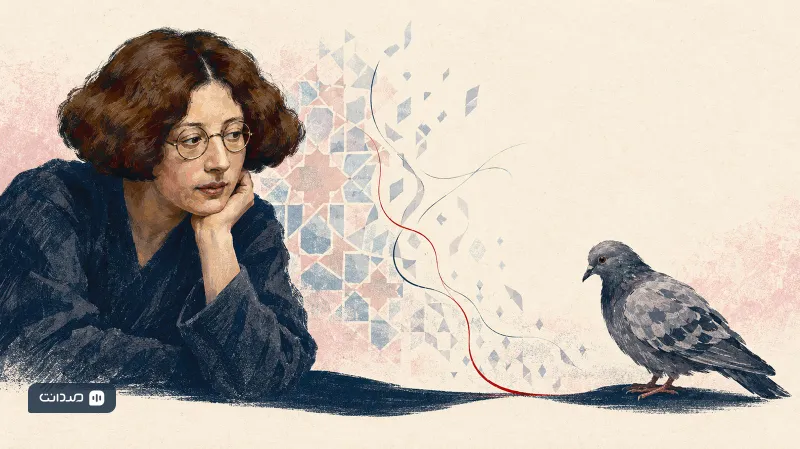
In New Zealand, the Whanganui River is now legally recognised as a person with legal rights. In Argentina, a court likewise recognised an orangutan named Sandra as a “non-human person.” Campaigns are also under way to secure similar recognition for whales, through the “I’m a Person Too” movement launched at the UN Ocean Conference in Nice; for dolphins, including the bottlenose dolphin population near South Korea’s Jeju Island; and even for entire ecosystems. The logic behind these efforts is simple: if such beings or phenomena are regarded as “persons” in the eyes of the law, the law can guarantee their rights.

. Simone Weil, by Darren McAndrew
When environmentalists seek legal personhood for rivers, whales, or forests, the idea can seem both strange and promising. Yet when such legal recognition is actually granted, matters often become complicated. Four years ago, for instance, Quebec’s Magpie River was recognised as a legal person with nine rights, including the right to be free from pollution and the right to flow. Even so, a hydroelectric company retains the right to use 80 per cent of its water until 2039, because legal personhood does not automatically nullify pre-existing laws and agreements. These new rights operate within the established norms of a Western legal system shaped by competing interests and a long history of bias in favour of humans. So although the Magpie River now has greater standing than before, this does not mean it is safe from over-exploitation.
While acknowledging the good faith behind these efforts, we may ask: is treating beings in the non-human realm as legal persons the only way to care for them and respond to worsening ecological destruction?
The “ethics of attention” developed by the French philosopher Simone Weil (1909–1943) offers another path. For Weil, the basis of our moral responsibility towards other human beings lies neither in their agency nor in their individuality, but in their vulnerability. To recognise the value and dignity of others, we must acknowledge the shared vulnerability that all of us experience. Weil called this a matter of “attention”: truly seeing others as they are, in their independence from us, in their particular needs and their finitude, without absorbing them into our own comforting narratives.
Consider pigeons, for example. Sitting in the sun, you may notice them approaching and immediately think of them as annoying animals intruding on your space: carriers of disease, or thieves trying to snatch your dinner. In this way, they become little more than an outlet for your irritation—something to blame as you make your way through a stressful day. Yet pigeons were once human companions, racing birds, and messengers, before people abandoned them in favour of faster technologies. They still turn to us because they associate humans with food. For Weil, becoming aware of another’s needs in this way is what allows a sense of obligation to arise naturally. But what would happen if we extended Weil’s ethics of attention to the natural world?
Consider our present condition: across the globe, habitats are being degraded, species are disappearing, and ecological systems are being pushed to the point of exhaustion. Yet if we confine environmental protection to the granting of legal personhood, we risk cultivating a narrow and selective concern: recognition may be reserved only for those beings that are usually more charismatic animals or more culturally significant landscapes. A whale can readily be celebrated as a “non-human person”; but what of mosses, bogs, or insects, whose lives are no less entwined with ours than a whale’s? Moreover, if we treat the granting of personhood to non-human beings as the sole response to exploitation, we may reinforce the very worldview that has brought us to ecological devastation in the first place: anthropocentrism—the belief that only beings sufficiently like us are worthy of moral consideration.
By contrast, Weil’s approach resists this hierarchy based on human significance, visibility, or lovability. For her, what matters morally is not a thing’s beauty, usefulness, or symbolic importance to humanity. Vulnerability itself gives rise to a claim upon our moral consideration. Moreover, the legal route of personhood is inherently piecemeal: it proceeds entity by entity and is negotiated differently across countries and contexts, often through long and exhausting legal struggles. Such efforts undoubtedly create an important space for new forms of recognition, but they also reveal the limits of a rights-based framework for ecological protection: rights must be codified, debated, and defended, a process that can delay or fragment action. Moral obligations, by contrast, generate more immediate and holistic responses; for Weil, they begin not with arguments over who or what qualifies, but with the kind of attention demanded of us here and now.
Weil therefore invites us to move beyond personhood and rights and to recover the language of “obligation”: not only obligations to individual beings that resemble us, nor merely to abstract categories of “rights holders,” but—if we extend her thought—to all vulnerable beings; that is, to all those exposed to harm and capable of suffering it. Witnessing the vulnerability of a particular bog, bird, or river also engages us emotionally, and in this way awakens the moral call to act. It requires us to acknowledge the possibility of destroying something irreplaceable, something whose loss would impoverish our world as a whole.
As humanity confronts an accelerating climate crisis and the destruction of habitats across the world, it is worth asking whether granting “personhood” to our landscapes and species is the best path forward. The crises we face are not merely the result of failed policies or weak enforcement; they also arise from a crisis of imagination and perception: from a perspective that sees non-human beings merely as resources and renders them invisible unless they are useful. To respond well, we may need more than alternative political and moral frameworks. We may also need a different way of paying attention.
© Dr Michela Dianetti and Chiara Li Mandri, 2026
Michela Dianetti is a postdoctoral researcher in Philosophy at the University of Galway and is funded by Research Ireland.
Chiara Li Mandri is a PhD candidate in Philosophy at the University of Palermo and a visiting researcher at the University of Galway.

Discussion0 comments
No comments yet; let yours be the first voice.